Просмотр новости
Найдите то, что Вас интересует
 Спутники
 РН
РН SpaceX
 Роскосмос
 NASA
NASA
СпутникиРНSpaceXРоскосмосNASA <bild></bild>
There's this one term that you've likely stumbled upon if you've spent enough time in video game adjacent spaces that, as hard as I try, which admittedly hasn't been a lot, I cannot get out of my mind: Game feel. Well, that's not quite right, it's not the word itself that keeps circling around my brain, but rather a question: What is it, actually?
Over the years and through sheer online discourse it has divided itself into both a fairly pragmatic term that encompasses basically every aspect behind the conceptions of game design as a technical affair... and a far, far more nebulous adjective many of us use to communicate a certain feeling precise words just can't get across right. Game feel like a proper noun is incredibly fascinating in its own way—Steve Swink's very aptly named ''Game Feel'' is a must read in that regard—but it's its second abstract meaning that I find so interesting and, in a way, endearing.
Many can't really describe what game feel is to them, yet at the same time we all understand it, an unique catharsis that isn't innate to the act of playing any game, but a particular sensation that in the moment seems intrinsic to the experience itself, when in reality is the direct result of a series of poignant decisions that activate our brain receptors and impulses in ways beyond simple dopamine rushes; a game that plays fine can be good, but a game that plays like a dream can re-wire your entire brain on the fly, make you live it through immediate action, and reaction alone. Of course, not all games can achieve this.
Not all games can achieve what Denshattack! does.
<bild></bild>
I'm not mincing words when I say that what Undercoders has managed to pull off goes beyond the remarkable; a team that I already associated with constant re-invention and exploring gameplay ideas to their furthest possible point was always bound to bring something interesting to the table with something as wild and stylish as Denshattack!, the culmination of an exaggerated amount of anime tropes and the bombastic nature of Shonen works by sheer sincerity and talent alone, and yeah, it is VERY much that... but also so, so much more.
It's a game that starts at full steam and never finds a reason to slow down, nor does it need one; featuring a movement system that, despite quite literally being on rails, forms into something that feels absurdly liberating, a mix of near perfect feedback and readability thanks to both the sheer amount of on-screen effects that do not get in the way of visual clarity on-top of the easier turn and danger warnings, à la arcade racing title.
What begins as a fairly simple move-set of jumps and drifts exploited wonderfully by the level design only gets better chapter-by-chapter, with new tools introduced as the story moves along that mostly seem like fun ways to spice up the new levels, and each chapter that brings a new mechanic does find the best ways to take advantage of it, but it feels like the real magic starts once you go back and tackle already finished stages with your new arsenal of tricks, an excuse that becomes even more justified when you are not limited to unlocking cool stickers, but also full-blown new trains with their own stats and gimmicks that can either fit your play-style strengths like a glove or flip them on their head.
This is not to undermine the actual value of the stages themselves, quite from it; every single new one is a brand-new set piece of their own, completely unique from one another both visually and design wise. One moment you'll be rolling on the top of a Ferris wheel, the next escaping from an active volcano, and more often than not you'll play through the kind of spectacle that would normally be spread out through an entire world concentrated in a single segment of a 3-4 minute level as the sickest techno tunes blast your ears off to the heavens, and it still never feels like too much.
<bild></bild>
At times it even seems to mock the mere idea of staying in one place for too long, at one point there's even a bait and switch with a previous set piece seemingly returning, only to turn into something completely different, and it wouldn't feel as earned if it didn't have the sheer variety to back it up, but here even your end goal is subject to change. The four types of mission—the most common reach the goal stages, trick levels, multi-objective areas, and race tracks—while maintaining the core principle of keeping your combo going, re-invent your approach with your own movement options, and turn the tides of stress on their head. Most of the map is covered in the more straight-forward linear levels where the craziest surprises await, but having to suddenly manage a two minute time limit or facing more than 30 other denshattackers feels just as thrilling, and if anything, that's where the real challenge and tension will await to those not as interested in medal hunting, which as I'll get to in a bit, may be a bit of a mistake.
I haven't even got to the boss fights, a collection of the most intense pseudo-combat encounters I have stumbled upon in a while, and it feels weird to group them up when no two boss encounters feel remotely comparable to one another. They work as more concrete reflex tests with completely different ways to play around them, multi-phased battles fused with the concept of a normal level that brings a new surprise mechanic, and the result is a chaotic dance of jaw-dropping proportions. They are by far the most unique and visually impressive set of levels, but even those don't break from the real depth of the systems at play in every single stage, the thing that elevates Denshattack! from its already impressive style. A combo system to master them all.
<bild></bild>
The base of Tony Hawk's Pro Skater trick system fused with trick inputs straight out of a fighting game is an insane pitch, and the mad lads actually brought it to life. Reaching the end of every stage is fairly easy in no small part thanks to the very lenient checkpoint system, but it's when trying to master every possible string of movement, learning the timing of the inputs to perform tricks of marked difficulties that may or may not lead into one another or turn into a completely different one if you are fast enough, this potential as a game to come back over and over again becomes apparent. Getting a gold medal in any level is a real achievement, a mark of mastery that proclaims you learned and endured stringing train tricks beyond a simple ''that was ok''. You need to be near perfect, instantly reactive, achieve a level of execution that brings you into the zone, metaphorically and literally.
It may sound absurd to say that actually describing how it feels to play Denshattack! feels impossible when I've spent more than a thousand words trying to do exactly that, but it really is just one of those games you need to play to REALLY get it. Getting the sheer satisfaction of seeing the rainbow roads of the zone after wrapping up a combo with a sick kickflip, getting the ways you can stray from repetition and dare to go to a new rail even if you don't know what awaits there, getting the pure satisfaction and awe every nano second you spend hitting that perfection, or at least as close as you can get. That is pure game feel. That is Denshattack!
Respecting it mechanically is one thing, and the fact it manages to be so easily readable despite the absurd speeds it reaches and makes it so every mistake feels like your fault and your fault alone is another victory on its own right, but I respect it even more than I possibly could by the density of accessibility options alone, options I never altered but that can make the whole thing for so, so many more people. Being able to tinker with the blur and shaking alone will make for a far smoother entry for players that may have issues adapting, let alone experiencing, the absolute wonders of the game at play, and that effort is worth celebrating.
<bild></bild>
With going on about its substance and the innate pleasure of simply playing the damn thing, we may be due to remember the fact this does, indeed, ooze style from every orifice imaginable. Said style comes with the interaction itself, of course, but I cannot stress enough just how happy Denshattack! makes me just by stating at it for a while. It's deceptively simplistic, and I mean the good kind of deceptive; much of the modelling here, especially less used assets like the character models that are usually hidden by the outstanding key art, look a bit rough on closer inspection, but there really isn't just room in your mind to process a thought close to add when it all pops this much.
Environments rarely repeating is one thing, but the way the colours contrast with one another and the effects properly mask the polygons' rougher edges breath a certain air to it that, while style a bit wonky in some areas, is always charming, hell, it feels alive. A sea of beautiful mashes of colour and electrifying effect snaps don't just hide the imperfections, they celebrate and embrace them, a testament to the fact you don't need to appear good all the time to look fantastic.
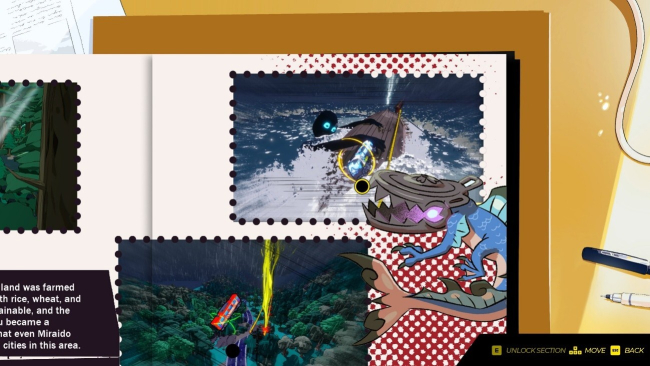
Everything forms the envelope to an experience that by all accounts stands tall as a behemoth of fun intractability should just be extras layering on a rock-solid foundation... except they really aren't. It's not just a case of me saying it looks really good yet again or that it's a natural by-product of the story bleeding out into the levels themselves, it's that there's genuine care placed into every possible crevice of this game, either by sheer design prowess or the gift of context. The UI is excellent, apparent even in the small zines you can piece together, embodying the constant use of striking fonts and key art that not only look great, but help give even more context to a Japan that, despite blasting Mach 20 through it, really wants to stick with you.
<bild></bild>
Pure action cannot sustain a game firing on all cylinders all the time, it needs a driving force compelling enough to make the explosions hit the hardest they can, and for how much Denshattack! embraces so many common tropes of the media it's clearly inspired by, it ended up leaving me with a feeling of wanting to see even more of it. There's nothing earth shattering going on in the narrative, but Emi's quick journey from aspiring denshattacker to outright revolutionary it's still a great motivator; in the limited time the fast-paced cut-scenes lasts, we get to see Miraido's evil corporation shenanigans affect the world at large and the cast, who, pile of tropes that they are, never at any point failed to make me smile. Part of me wishes there were more Onsen sections, small portions of pure dialogue where you can chat with your ever expanding squad of misfits that have risen on the world beyond the domed cities, because they really do show sides of this group of people I really wanted to see more of in ways that just aren't them gushing about Emi, throwing shade at Emi, or describing the next big bad that Emi will have to face. Still, it works, at least for me; I didn't need a perfect story, just a sincere one, and this, helped by the flares of text in the side content and the cut-scenes in between chapters, and while we still don't know the people of this new Japan at large, we see sides of it, sides that place it into context and give reason to the fight. Reasons for the cool explosions to be cool.
Denshattack! is, in one word, cathartic at all levels. It's much more than it's cool concept, much more than its neat sights, more than the tight tricks and failed jumps; it's a whole that never stops giving, even after the 9 to 10 hours where you would have likely seen all stages, because the reasons to come back to it are endless. The feeling never goes away no matter how much you master it, the love it processes to both denshattack as a form of in-universe self-expression and the realised mechanical potential it offers. It is, in the most abstract and concrete ways, a master class of game feel, for this IS game feel. This is Denshattack!

There's this one term that you've likely stumbled upon if you've spent enough time in video game adjacent spaces that, as hard as I try, which admittedly hasn't been a lot, I cannot get out of my mind: Game feel. Well, that's not quite right, it's not the word itself that keeps circling around my brain, but rather a question: What is it, actually?
Over the years and through sheer online discourse it has divided itself into both a fairly pragmatic term that encompasses basically every aspect behind the conceptions of game design as a technical affair... and a far, far more nebulous adjective many of us use to communicate a certain feeling precise words just can't get across right. Game feel like a proper noun is incredibly fascinating in its own way—Steve Swink's very aptly named ''Game Feel'' is a must read in that regard—but it's its second abstract meaning that I find so interesting and, in a way, endearing.
Many can't really describe what game feel is to them, yet at the same time we all understand it, an unique catharsis that isn't innate to the act of playing any game, but a particular sensation that in the moment seems intrinsic to the experience itself, when in reality is the direct result of a series of poignant decisions that activate our brain receptors and impulses in ways beyond simple dopamine rushes; a game that plays fine can be good, but a game that plays like a dream can re-wire your entire brain on the fly, make you live it through immediate action, and reaction alone. Of course, not all games can achieve this.
This is an ad:
Not all games can achieve what Denshattack! does.
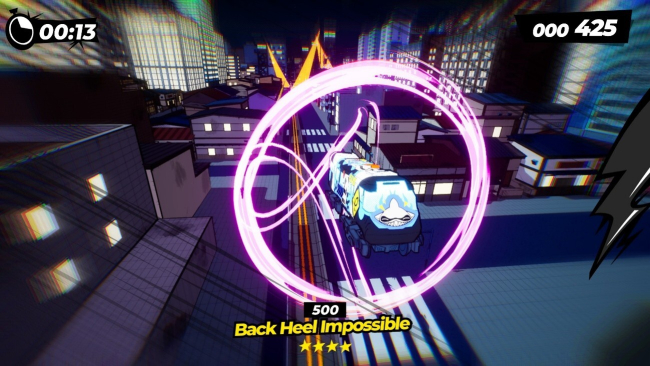
I'm not mincing words when I say that what Undercoders has managed to pull off goes beyond the remarkable; a team that I already associated with constant re-invention and exploring gameplay ideas to their furthest possible point was always bound to bring something interesting to the table with something as wild and stylish as Denshattack!, the culmination of an exaggerated amount of anime tropes and the bombastic nature of Shonen works by sheer sincerity and talent alone, and yeah, it is VERY much that... but also so, so much more.
It's a game that starts at full steam and never finds a reason to slow down, nor does it need one; featuring a movement system that, despite quite literally being on rails, forms into something that feels absurdly liberating, a mix of near perfect feedback and readability thanks to both the sheer amount of on-screen effects that do not get in the way of visual clarity on-top of the easier turn and danger warnings, à la arcade racing title.
This is an ad:
What begins as a fairly simple move-set of jumps and drifts exploited wonderfully by the level design only gets better chapter-by-chapter, with new tools introduced as the story moves along that mostly seem like fun ways to spice up the new levels, and each chapter that brings a new mechanic does find the best ways to take advantage of it, but it feels like the real magic starts once you go back and tackle already finished stages with your new arsenal of tricks, an excuse that becomes even more justified when you are not limited to unlocking cool stickers, but also full-blown new trains with their own stats and gimmicks that can either fit your play-style strengths like a glove or flip them on their head.
This is not to undermine the actual value of the stages themselves, quite from it; every single new one is a brand-new set piece of their own, completely unique from one another both visually and design wise. One moment you'll be rolling on the top of a Ferris wheel, the next escaping from an active volcano, and more often than not you'll play through the kind of spectacle that would normally be spread out through an entire world concentrated in a single segment of a 3-4 minute level as the sickest techno tunes blast your ears off to the heavens, and it still never feels like too much.
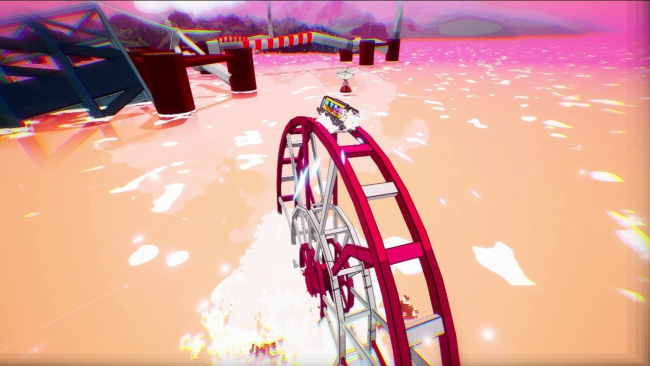
At times it even seems to mock the mere idea of staying in one place for too long, at one point there's even a bait and switch with a previous set piece seemingly returning, only to turn into something completely different, and it wouldn't feel as earned if it didn't have the sheer variety to back it up, but here even your end goal is subject to change. The four types of mission—the most common reach the goal stages, trick levels, multi-objective areas, and race tracks—while maintaining the core principle of keeping your combo going, re-invent your approach with your own movement options, and turn the tides of stress on their head. Most of the map is covered in the more straight-forward linear levels where the craziest surprises await, but having to suddenly manage a two minute time limit or facing more than 30 other denshattackers feels just as thrilling, and if anything, that's where the real challenge and tension will await to those not as interested in medal hunting, which as I'll get to in a bit, may be a bit of a mistake.
I haven't even got to the boss fights, a collection of the most intense pseudo-combat encounters I have stumbled upon in a while, and it feels weird to group them up when no two boss encounters feel remotely comparable to one another. They work as more concrete reflex tests with completely different ways to play around them, multi-phased battles fused with the concept of a normal level that brings a new surprise mechanic, and the result is a chaotic dance of jaw-dropping proportions. They are by far the most unique and visually impressive set of levels, but even those don't break from the real depth of the systems at play in every single stage, the thing that elevates Denshattack! from its already impressive style. A combo system to master them all.
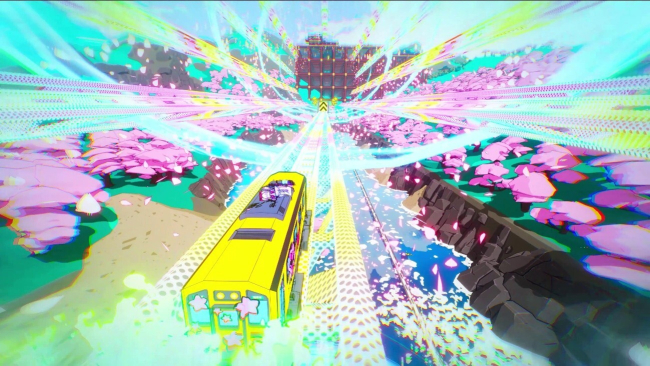
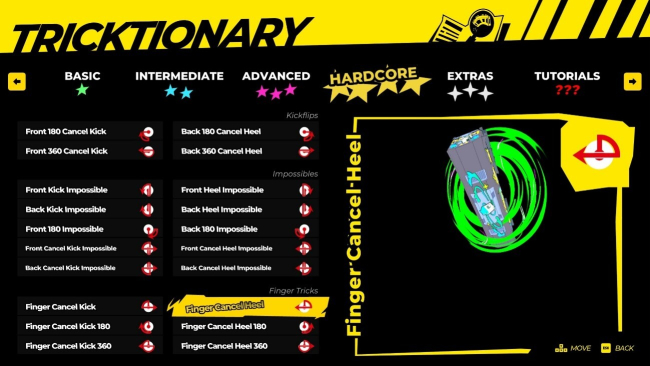
The base of Tony Hawk's Pro Skater trick system fused with trick inputs straight out of a fighting game is an insane pitch, and the mad lads actually brought it to life. Reaching the end of every stage is fairly easy in no small part thanks to the very lenient checkpoint system, but it's when trying to master every possible string of movement, learning the timing of the inputs to perform tricks of marked difficulties that may or may not lead into one another or turn into a completely different one if you are fast enough, this potential as a game to come back over and over again becomes apparent. Getting a gold medal in any level is a real achievement, a mark of mastery that proclaims you learned and endured stringing train tricks beyond a simple ''that was ok''. You need to be near perfect, instantly reactive, achieve a level of execution that brings you into the zone, metaphorically and literally.
It may sound absurd to say that actually describing how it feels to play Denshattack! feels impossible when I've spent more than a thousand words trying to do exactly that, but it really is just one of those games you need to play to REALLY get it. Getting the sheer satisfaction of seeing the rainbow roads of the zone after wrapping up a combo with a sick kickflip, getting the ways you can stray from repetition and dare to go to a new rail even if you don't know what awaits there, getting the pure satisfaction and awe every nano second you spend hitting that perfection, or at least as close as you can get. That is pure game feel. That is Denshattack!
Respecting it mechanically is one thing, and the fact it manages to be so easily readable despite the absurd speeds it reaches and makes it so every mistake feels like your fault and your fault alone is another victory on its own right, but I respect it even more than I possibly could by the density of accessibility options alone, options I never altered but that can make the whole thing for so, so many more people. Being able to tinker with the blur and shaking alone will make for a far smoother entry for players that may have issues adapting, let alone experiencing, the absolute wonders of the game at play, and that effort is worth celebrating.
With going on about its substance and the innate pleasure of simply playing the damn thing, we may be due to remember the fact this does, indeed, ooze style from every orifice imaginable. Said style comes with the interaction itself, of course, but I cannot stress enough just how happy Denshattack! makes me just by stating at it for a while. It's deceptively simplistic, and I mean the good kind of deceptive; much of the modelling here, especially less used assets like the character models that are usually hidden by the outstanding key art, look a bit rough on closer inspection, but there really isn't just room in your mind to process a thought close to add when it all pops this much.
Environments rarely repeating is one thing, but the way the colours contrast with one another and the effects properly mask the polygons' rougher edges breath a certain air to it that, while style a bit wonky in some areas, is always charming, hell, it feels alive. A sea of beautiful mashes of colour and electrifying effect snaps don't just hide the imperfections, they celebrate and embrace them, a testament to the fact you don't need to appear good all the time to look fantastic.
Everything forms the envelope to an experience that by all accounts stands tall as a behemoth of fun intractability should just be extras layering on a rock-solid foundation... except they really aren't. It's not just a case of me saying it looks really good yet again or that it's a natural by-product of the story bleeding out into the levels themselves, it's that there's genuine care placed into every possible crevice of this game, either by sheer design prowess or the gift of context. The UI is excellent, apparent even in the small zines you can piece together, embodying the constant use of striking fonts and key art that not only look great, but help give even more context to a Japan that, despite blasting Mach 20 through it, really wants to stick with you.
Pure action cannot sustain a game firing on all cylinders all the time, it needs a driving force compelling enough to make the explosions hit the hardest they can, and for how much Denshattack! embraces so many common tropes of the media it's clearly inspired by, it ended up leaving me with a feeling of wanting to see even more of it. There's nothing earth shattering going on in the narrative, but Emi's quick journey from aspiring denshattacker to outright revolutionary it's still a great motivator; in the limited time the fast-paced cut-scenes lasts, we get to see Miraido's evil corporation shenanigans affect the world at large and the cast, who, pile of tropes that they are, never at any point failed to make me smile. Part of me wishes there were more Onsen sections, small portions of pure dialogue where you can chat with your ever expanding squad of misfits that have risen on the world beyond the domed cities, because they really do show sides of this group of people I really wanted to see more of in ways that just aren't them gushing about Emi, throwing shade at Emi, or describing the next big bad that Emi will have to face. Still, it works, at least for me; I didn't need a perfect story, just a sincere one, and this, helped by the flares of text in the side content and the cut-scenes in between chapters, and while we still don't know the people of this new Japan at large, we see sides of it, sides that place it into context and give reason to the fight. Reasons for the cool explosions to be cool.
Denshattack! is, in one word, cathartic at all levels. It's much more than it's cool concept, much more than its neat sights, more than the tight tricks and failed jumps; it's a whole that never stops giving, even after the 9 to 10 hours where you would have likely seen all stages, because the reasons to come back to it are endless. The feeling never goes away no matter how much you master it, the love it processes to both denshattack as a form of in-universe self-expression and the realised mechanical potential it offers. It is, in the most abstract and concrete ways, a master class of game feel, for this IS game feel. This is Denshattack!
| # | Наименование новости | Тональность | Информативность | Дата публикации |
|---|---|---|---|---|
| 1 | Обзор Denshattack! Поезд-трюкач который довезет вас до станции «Фаново» и заставит снова поверить в силу инди-игр | 0 | 11.05 | 24-07-2026 |
| 2 | Обзор Denshattack! Поезд-трюкач который довезет вас до станции «Фаново» и заставит снова поверить в силу инди-игр | 0 | 11.05 | 24-07-2026 |
| 3 | Обзор Denshattack! Поезд-трюкач который довезет вас до станции «Фаново» и заставит снова поверить в силу инди-игр | 0 | 11.05 | 24-07-2026 |
| 4 | "Let's make a better world": Denshattack's developers on counterculture, biker gangs, and the optimism of fighting a mecha with a train | 0 | 10.4 | 24-07-2026 |
| 5 | Hyperwired | 0 | 7.24 | 13-07-2026 |
| 6 | #Drive Rally | 0 | 6.81 | 27-07-2026 |
| 7 | Fading Echo | 0 | 7.96 | 21-07-2026 |
| 8 | Deathbulge: Battle of the Bands | 0 | 6.86 | 09-07-2026 |
| 9 | Silent Hill: Townfall promises to "massively subvert" your expectations, and it's left me painfully excited | 0 | 10.41 | 29-07-2026 |
| 10 | The Mermaid Mask | 0 | 6.56 | 17-07-2026 |