Просмотр новости
Найдите то, что Вас интересует
 Спутники
 РН
РН SpaceX
 Роскосмос
 NASA
NASA
СпутникиРНSpaceXРоскосмосNASAThis history behind this 200-year old double bass is one of mystery and renewal.
By David Templeton | From the March/April 2026 issue of Strings
Every musical instrument has a history. Some of those histories are more interesting than others. Many are lost to time. In the case of the 200-year-old double bass known to many as the “Scott LaFaro”—and sometimes the “LaFaro-Prescott”—the backstory is a little of both. Crafted under the eye of American luthier and manufacturer Abraham Prescott, the bass is believed to have been built in 1825 in New Hampshire. And then, a blank. Almost nothing is known of its past from that point until 1958, when it was purchased by the groundbreaking jazz bassist Scott LaFaro—best known as a member of the Bill Evans Trio—when it was pointed out by a friend in a music shop in Hollywood, California.
To this day, no one knows where the bass had been, or who owned it, before it arrived there. But what happened next has become the stuff of modern legend.
“The Prescott basses are kind of unique in the string world, and especially unique in the bass world, because the maker was an American jack-of-all-trades who was extremely innovative and surprisingly forward thinking,” explains Sam Finlay of Finlay and Gage Musical Instruments, where the LaFaro bass currently resides. “Prescott’s company made barrels and umbrellas and other things. I even heard he made wagons—which is interesting—and eventually he made reed organs and pianos. But for a while there, he made double basses.”
Often referred to as “church basses” or “bass viols,” the style of instruments that Prescott made were commonly used as an accompaniment to worship in the 1800s, delivering a sonorous sound similar to an organ, but they were far more portable and appropriate for small rural congregations.
 A copy of the LaFaro Bass and the original, right, Courtesy of Barrie Kolstein
“This instrument in particular, Scott LaFaro’s bass, speaks with a really strong swelling sound,” says Finlay. “It doesn’t have a ton of attack. It has more of a blossoming, blooming sound, which makes it a wonderful trio or small ensemble instrument. It offers a big, thick sustain. It’s kind of wonderful.”
LaFaro didn’t have long to get to know his Prescott. He died in a car crash in Seneca, New York, while traveling between Geneva and Canadaigua on US Route 20. His death, which shocked and deeply saddened the international jazz community, came just four days after LaFaro had accompanied Stan Getz at the 1961 Newport Jazz Festival. He was 25 years old. His then-136-year-old Prescott bass—which was with him in the car at the time of the accident—was seriously damaged by the impact of the crash and the fire that followed it.
It would be more than 50 years before anyone would play the instrument again.
Although it’s currently housed and cared for at Finlay and Gage Musical Instruments—not far from where LaFaro was born, in Newark, New Jersey—the LaFaro bass is owned by the International Society of Bassists, to which the instrument was donated in 2014 by New Jersey luthier Barrie Kolstein, now retired but formerly of Kolstein & Son. His father, Sam Kolstein, first met LaFaro in the late 1950s, when the young musician showed him the Prescott bass he’d bought a year or so before. Fond of how the instrument looked and felt, he asked Kolstein to do a major restoration in the hopes that it might enhance its overall sound.
“Scott actually acquired the bass through the recommendation of Red Mitchell,” says Kolstein, referring to Keith “Red” Mitchell, another prominent jazz double bassist of the mid-20th century. “Red was out on the West Coast visiting Stein on Vine, where he found his own instrument, a cutaway Lowendall. While Red was there, he happened to see this smaller, reduced Prescott, and he knew that Scotty was looking for a new instrument.”
LaFaro’s previous instrument, a German-made Mittenwald double bass, had been stolen in early 1958, and he was looking for something even better. “So Scott went out to California, tried the bass, acquired it, and brought it back to New York,” Kolstein says. “To be honest with you, he loved the design of the instrument, the dimensions of the instrument, but he wasn’t crazy about the sound of the bass back then.”
At the time, Barrie was about eight years old. The elder Kolstein had recently moved his lutherie shop from 55th and 6th Avenue in Manhattan to a new home in Merrick, Long Island. That’s where LaFaro met Kolstein for the first time.
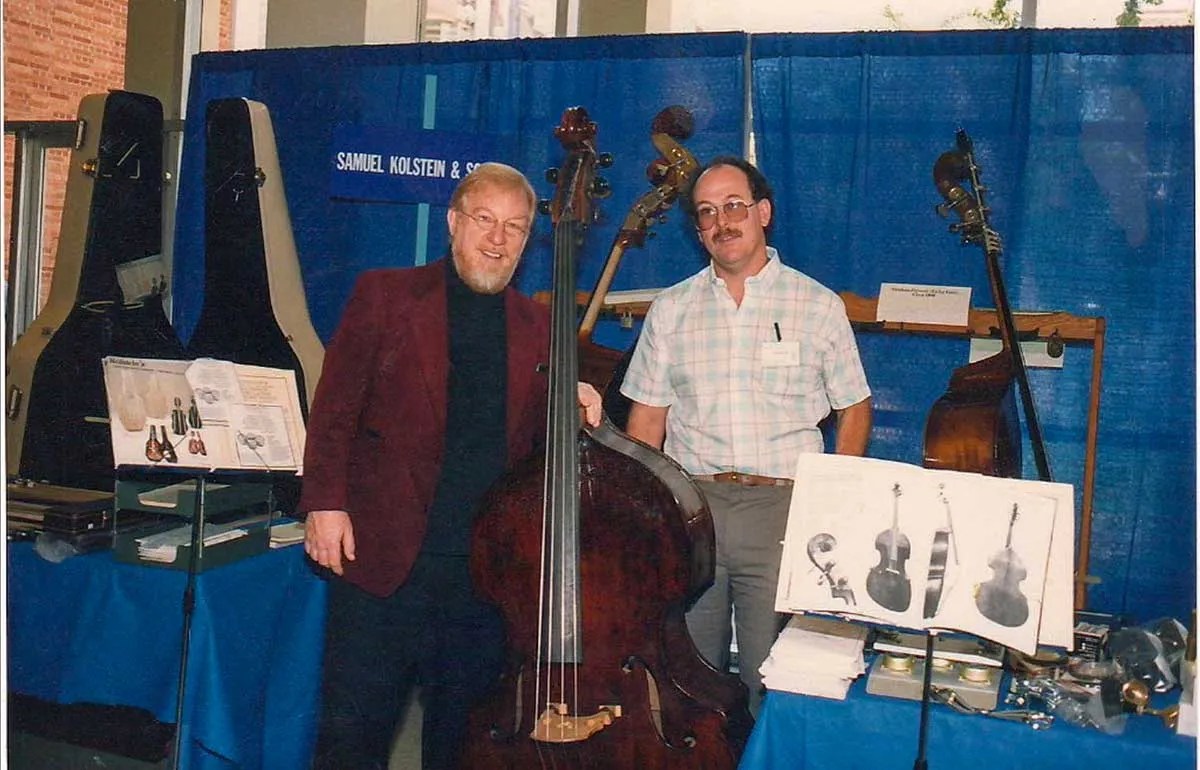 Samuel and Barrie Kolstein with the LaFaro bass, Courtesy of Barrie Kolstein
“My father said that he was in another room when he heard Scott playing from the shop, and he turned and said, ‘Who is that and what is that?’” remembers Kolstein. “He looked out there into the basement studio, where there was a preponderance of instruments, and Scottie was like a kid in a candy store. He was going around playing everything, and my father just fell in love with him. They talked about the Prescott bass, and Scotty was concerned about the money involved, and my dad said, ‘Don’t worry about the money. Let’s get this bass sounding the way you want it.’
“So my dad did a major restoration of the bass,” he continues, “and Scotty, who ended up absolutely loving the way it sounded, got it back less than a year before his death.” That was just long enough for LaFaro to play the Prescott, along with Bill Evans and drummer Paul Motian, on the Sunday at the Village Vanguard album, now widely considered one of the greatest live jazz records of all time. Almost two weeks later, “he perished in that car accident—and of course the bass was with him at the time.”
LaFaro, who would have been 90 this year—his birthday was April 3, 1936—only performed professionally for a decade, but made enough of an impression to be considered one of the most influential jazz musicians of the 20th century. In addition to working will Bill Evans, he was in high demand, playing with such luminaries of the time as trumpeter Chet Baker, pianist Stan Kenton, multi-instrumentalist (including violin) Ornette Coleman, and clarinetist-bandleader Benny Goodman. At the time of his death, he was reportedly talking with Miles Davis about a potential recording project together.
“Scotty was originally a saxophone player, and studied the sax and the clarinet in college,” Kolstein reveals. “But he always had an affinity for the double bass. There’s a story that he dated a girl in college just because she was a bass player, just so he could borrow her double bass. He just took to it like a duck takes to water. If you listen to his recordings today, you can hear how he carried a lot of the lyrical aspects of saxophone playing into how he played the bass. That was unheard of in those days.”
At the time of the accident, because the bass was insured, it was taken to the Wurlitzer shop in New York to be repaired, but since Sam Kolstein had done the original restoration for LaFaro, he was asked to do this restoration as well. Instead, he offered to buy it. “My dad met with Scott’s mother, and at that point she agreed to let him buy it—I still have the receipt—and the plan was that he would repair it, but he never had the heart to do it,” Kolstein says. “He really loved Scotty, and his death left my father heartbroken. So the bass sat on a shelf in our shop for decades. In 1986, 25 years after Scotty had died, I went to my dad and asked for permission to repair the bass myself.”
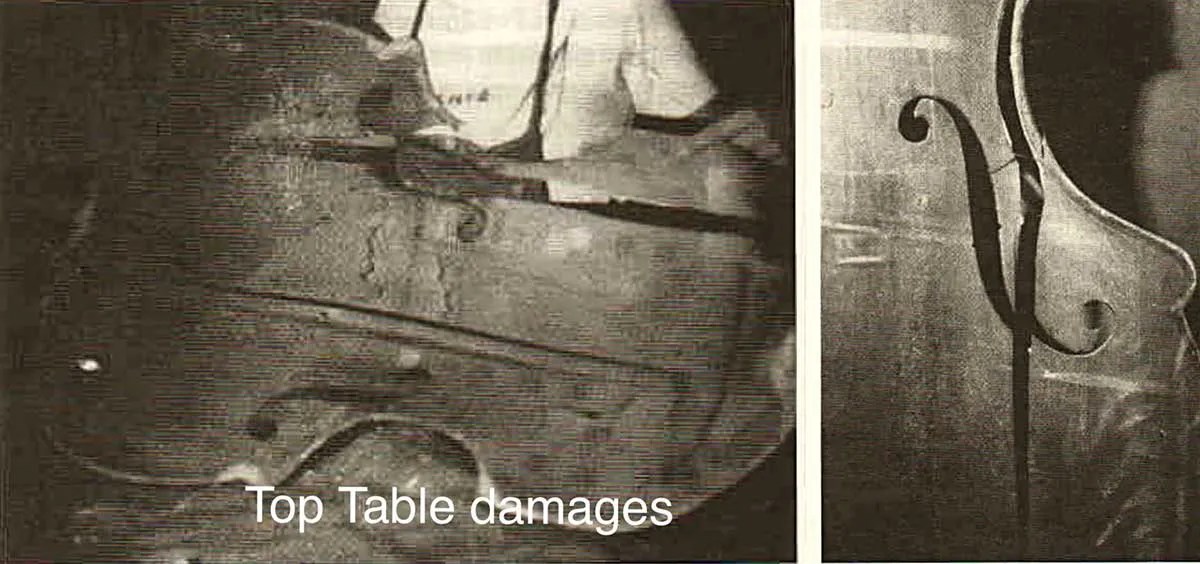 Courtesy of Barrie Kolstein
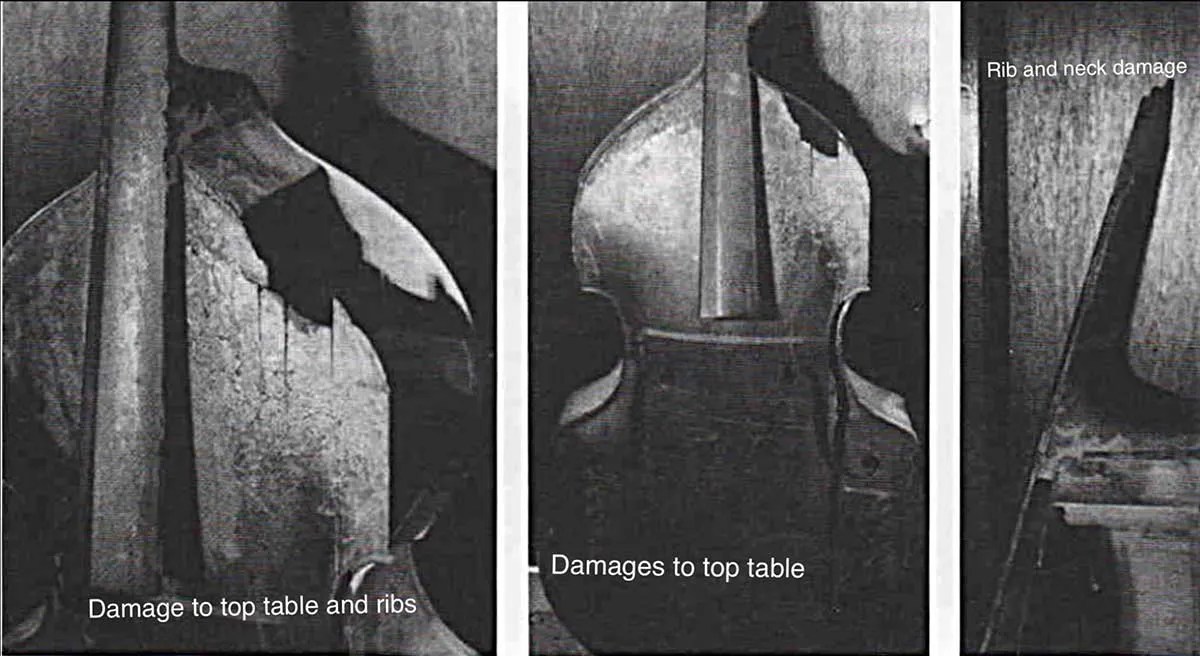 Courtesy of Barrie Kolstein
The next convention of the International Society of Bassists (ISB) would be coming up in two years, and it had been announced that there was going to be a special program honoring the legacy of Scott LaFaro. “When I heard that, I thought it would be a good thing to have LaFaro’s double bass make an appearance at the celebration of his life and career,” he explains. “My dad said, ‘Go do it,’ and though it took me almost all of those two years, I did it.”
The bass had been stored during LaFaro’s last road trip with the scroll facing the windshield of the car. It took much of the impact. Part of the top and one of the ribs were also severely damaged by the fire, large parts of them burned away. “It was a matter of making a new rib, of grafting and matching wood of the parts that had been burned, and a lot of other things,” Kolstein says. “I did everything I could to save the work of my father, who’d made it sound so good during his original restoration. My goal was to bring the instrument back to where it was functionally at the time my father was done with it. And I think we accomplished that. To this day, it’s a great-sounding bass.”
That restoration took place from 1986 to 1988, when the LaFaro-Prescott double bass made its grand return to the stage during that year’s ISB conference. “And guess what? Red Mitchell made the trip to California for the convention, just to see the bass again,” says Kolstein, noting that he still treasures the photograph he has of the two of them together with LaFaro’s bass. He adds that Mitchell, along with several others, offered to buy the bass, but the Kolsteins weren’t ready to give it up.
“It had been part of our lives for nearly 30 years,” Kolstein says. “So we didn’t sell it, but I sometimes loaned it out to people to play on various projects. We brought it to conventions and made it available for people to play in the shop.”
To that end, in November of 2025, as part of the NJPAC’s annual TD James Moody Jazz Festival, the LaFaro Bass was loaned to the center to be played by an array of acclaimed musicians, including Ben Williams, Max Gerl, Gregory Jones, and Christian McBride. “I’ve played a few other Prescott basses, and that was wonderful enough,” says McBride, who performed during the festival with his Big Band. Of the LaFaro Bass, he says, “When I heard that I’d have a chance to play the actual LaFaro bass—the bass he played himself and is now being used by NJPAC—I was excited. I’m mainly just grateful to have had the opportunity.”
 Christian McBride playing the LaFaro bass, Photo: Anthony DiMatteo
Eventually, in 2014, in honor of the LaFaro family, Kolstein donated the instrument to the ISB, which eventually engaged Finlay and Gage to serve as its primary caretakers. “Since we’ve had it,” says Finlay, who remembers seeing the LaFaro bass at that convention in 1988, “we’ve been making it available to the New Jersey Performing Arts Center (NJPAC), which has been doing a lot of jazz-centric programming, programming focused on the bass. I hate seeing an instrument in a museum, just sitting there. So now people can hear the instrument, and musicians can play the instrument, which I think is really amazing. It was made to be performed on, in front of audiences. Scott LaFaro was such an amazing performer, so it’s great that Dave Rodriguez [NJPAC executive vice president and executive producer] and the people at NJPAC are really involving the instrument in their programming. It’s the proper way to celebrate Scott LaFaro’s life.”
During his concert in November, McBride mostly played pieces from his new album, Without Further Ado, Vol. 1. Of LaFaro’s Prescott, McBride says, “It sounded great. Even if we didn’t know Scott LaFaro had played that bass, we would still know that it is a special instrument. It sounds very open, very resonant. Particularly on the E and A strings. I’m a stickler for that. You’ve got to have some resonance on those notes. You want them to really ring. It has a lot of punch too. I like an instrument with punch—and this one’s got it.”
Knowing the instrument’s history, of course, McBride says one can’t help but be cognizant of LaFaro’s life, death, and legacy while playing the late legend’s bass. “That kind of thing happens a lot,” he says. “I have one of Ray Brown’s basses. I have one of John Clayton’s basses. The person who originally played these instruments is always a fun thought to have when you are playing one, you know? Now granted, when I’m in the middle of a gig, I’m not geeking out thinking, ‘Oh my god! Scott LaFaro played this bass!’ I’m thinking about what I’m playing. But it’s nice to be able to play the actual instrument that was used by someone who played such an integral part in the development of the jazz bass.”
Kolstein, who’s spent more time in the presence of the LaFaro-Prescott bass than anyone, agrees with McBride’s observations about how a player’s musical and historical essence become permanently linked to the instrument they played. “There’s a lot of spirit in that bass,” he says. “You can hear it. You can feel it. To me, the spirit of Scotty LaFaro will always be alive in that instrument.”
| # | Наименование новости | Тональность | Информативность | Дата публикации |
|---|---|---|---|---|
| 1 | 100 years of Mehboob: A legacy that lives on | 6 | 7 | 23-06-2026 |
| 2 | Instant Chemistry—Arnaud Sussmann Knew Immediately That He and the “Schneeberger” Strad Were a Perfect Match | 0 | 6.31 | 29-07-2026 |
| 3 | Bootlegging and bands: Yankee Lake's glory days remembered | 0 | 10.4 | 29-07-2026 |
| 4 | Review: ‘From Violin to Viola’ Covers All the Essentials | 0 | 7.95 | 20-07-2026 |
| 5 | From Picasso to Murillo: how the great masters painted music | 0 | 9.38 | 29-07-2026 |
| 6 | How a Hidden Songbook Survived the Holocaust | 2 | 8 | 08-07-2026 |
| 7 | How the Blues found a home in Meghalaya | 0 | 5 | 01-07-2026 |
| 8 | ‘Love’s in need of love today’: A look at Stevie Wonder | 7 | 7 | 10-07-2026 |
| 9 | Akai’s MPC Sample is Bridging the Gap for Generations of Music Producers | 5 | 7 | 30-06-2026 |
| 10 | Vini Reilly, héros culte du post-punk, renaît avec le somptueux “Renascent” | 0 | 10.87 | 31-07-2026 |