Просмотр новости
Найдите то, что Вас интересует
 Спутники
 РН
РН SpaceX
 Роскосмос
 NASA
NASA
СпутникиРНSpaceXРоскосмосNASAFinancial mistakes are often measured by lost rupees, not lost time. Compounding benefits are significantly impacted by delays and interruptions in investments. Pausing systematic investment plans can push financial goals further into the future. Withdrawals from investments also reduce capital available for compounding over time. Increasing SIP contributions can help investors recover lost time and build wealth.
When investors think about financial mistakes, they usually quantify them in rupees. A pause in systematic investment plans (SIPs), an occasional withdrawal from investments, or a missed savings target is often judged only by the amount involved. Yet the bigger cost is often far less visible: the cost of time.
Lost money can often be recovered. A salary hike, a bonus, an additional income stream or a few years of disciplined saving can help replenish depleted savings. Lost time, however, is much harder to recover.
In investing, the greatest damage often comes not from an immediate financial loss, but from the loss of compounding caused by delays and interruptions. Every financial goal has a timeline. A young professional may want to retire at 55. Parents may be building a corpus for their child’s higher education over the next 15 years. Another investor may be saving for a home purchase a decade away. Achieving these goals depends not only on how much is invested, but also on how long the money stays invested.
Compounding works best when given adequate time. The longer money stays invested, the greater its ability to generate returns on both the principal and the accumulated gains. Conversely, any disruption to this process can push financial goals further into the future.
The encouraging part is that the reverse is also true. Small positive decisions—such as increasing SIPs when income rises, avoiding unnecessary withdrawals and staying invested during market volatility— can help investors gain valuable years. To understand how time affects wealth creation, consider a hypothetical investor who aims to build a corpus of Rs.1 crore through a monthly SIP of Rs.20,000 and expects a return of 10% annually. If the SIP continues uninterrupted, the target corpus can be accumulated in approximately 198 months, or about 16 years and 6 months.
Table 1
How temporary interruptions delay financial goals
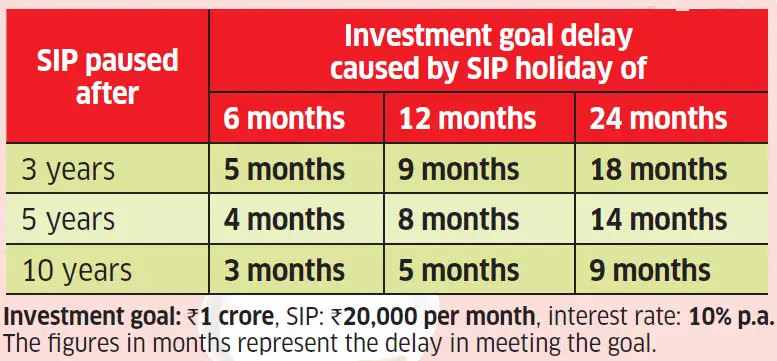
Table 2
Impact of stopping SIPs permanently
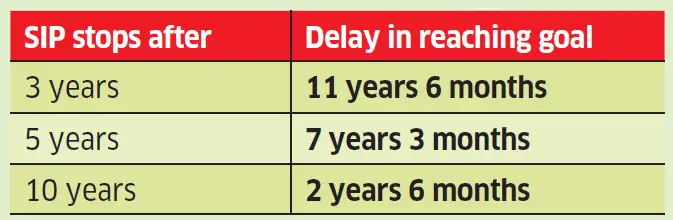
Table 3
Impact of withdrawals on financial goals
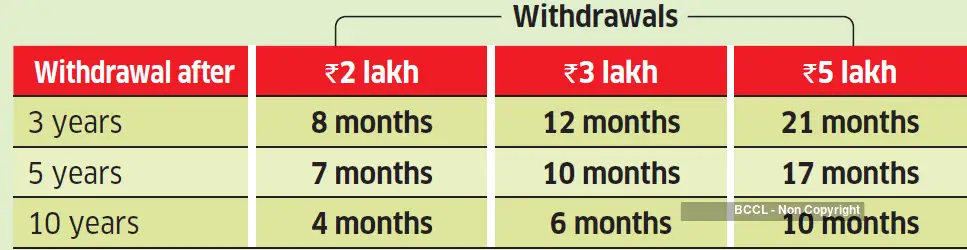
Note: Investment goal: Rs.1 crore, SIP: Rs.20,000 per month, interest rate: 10% p.a. The figures in months represent the delay in meeting the goal.
SIP breaks can delay goalsOne common mistake is pausing SIPs for a temporary period and resuming them later. Table 1 shows how a SIP holiday can delay the achievement of a Rs.1 crore goal. The timing of the break matters as much as its duration. For instance, a 24-month SIP holiday taken after just three years of investing delays the goal by about 18 months. However, if the same break is taken after 10 years, the delay falls to around nine months.
This happens because the SIPs missed during the early years lose a much longer period of future compounding. Contributions skipped closer to the goal have less time to grow, making early interruptions far more damaging.
Uttam Agarwal, Chief Business Officer at Bajaj Capital, says that a pause may look small on paper, but if it becomes a habit, the financial goal can start moving further away.
“You may eventually have to invest more, take greater risk, or wait longer to reach the same destination,” he says.
Table 4
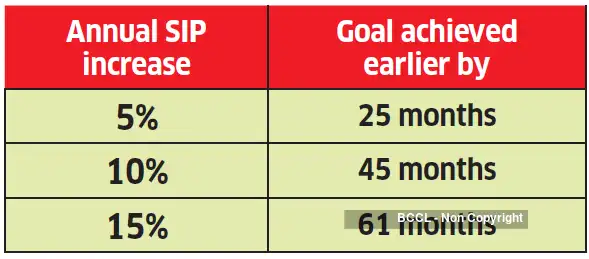
How annual SIP increases achieve goals sooner
A more serious mistake is permanently discontinuing SIP contributions. Although the money already accumulated in the portfolio continues to earn returns, the absence of fresh contributions dramatically slows wealth creation.
Table 2 shows what happens when an investor permanently discontinues SIP contributions after investing regularly for a few years. The impact is particularly severe when SIPs are stopped early. If an investor discontinues SIPs after just three years, the Rs.1 crore target gets pushed back by nearly 11.5 years. In contrast, stopping SIPs after 10 years delays the goal by about 2.5 years. The reason is straightforward. When SIPs stop early, investors lose not only future accumulations but also the compounding benefits those investments would have generated over the years.
Withdrawals can push goalsWithdrawals from long-term investments can be equally damaging because they reduce the capital available for compounding. Just as with SIP interruptions, the timing of the withdrawal determines the extent of the damage.
Table 3 shows that withdrawals made in the early years of investing are significantly more damaging than those made later. A withdrawal of Rs.5 lakh after three years delays the goal by about 21 months. The same withdrawal made after 10 years delays it by only 10 months.
Every rupee withdrawn loses years of future compounding. The earlier the withdrawal, the longer the period over which that lost compounding could have worked. This is why financial planners often recommend maintaining a separate emergency fund instead of dipping into longterm investments.
How to recover lost timeThe good news is that investors can recover lost time by increasing SIP contributions whenever income rises.
The impact seen in Table 4 is surprisingly powerful. Even a modest 5% annual increase helps investors achieve the target more than two years earlier. A 10% annual increase advances the goal by about 45 months, or 3 years and 9 months. A 15% annual increase brings the goal forward by 61 months, or just over five years.
Higher contributions not only add more money to the portfolio but also give those additional investments time to compound. As the annual step-up continues, the impact accelerates, allowing investors to build wealth much faster.
The broader lesson is simple: financial mistakes should not be measured only in rupees. They should also be measured in time foregone.
A SIP holiday, an unnecessary withdrawal or abandoning investments altogether may appear manageable in the short term, but the real cost often emerges later in the form of delayed financial goals. Conversely, disciplined investing and regular increases in savings can help investors buy back time, which aids in long-term wealth creation.
“The real discipline in investing is not just starting an SIP; it is having the financial resilience to keep long-term investments untouched through the ups and downs of life,” adds Agarwal.
Note: All calculations assume that the investments are made at the end of each month.