Просмотр новости
Найдите то, что Вас интересует
 Спутники
 РН
РН SpaceX
 Роскосмос
 NASA
NASA
СпутникиРНSpaceXРоскосмосNASANASA's Perseverance rover has identified some of the most tantalizing clues to date of life in the Red Planet's distant past. The question of whether ...
By T.K. Randall
June 25, 2026
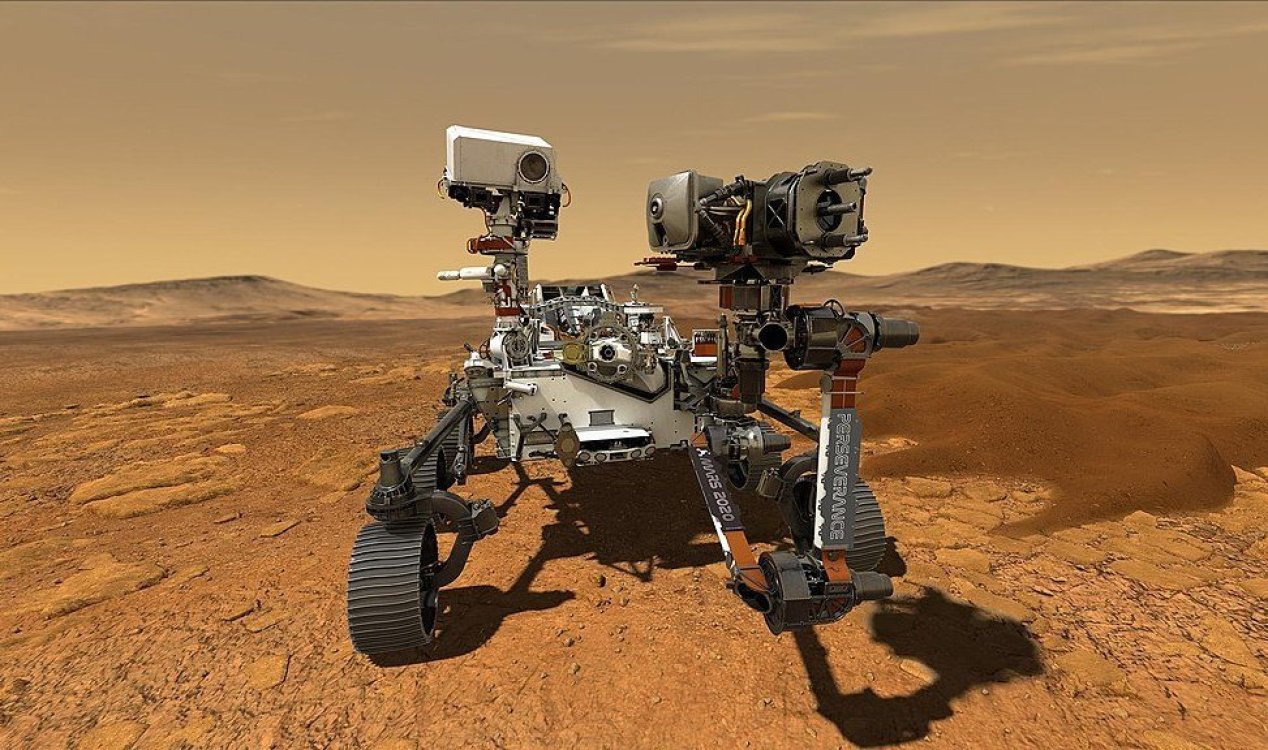
Image Credit: Courtesy NASA/JPL-Caltech
NASA's Perseverance rover has identified some of the most tantalizing clues to date of life in the Red Planet's distant past.
The question of whether Mars was once home to primitive organisms has long remained one of the most pressing mysteries in space exploration.
Whereas today the Red Planet is a barren, freezing wasteland, billions of years ago it was a lot more like the Earth with liquid water oceans, lakes and rivers.
If life ever did emerge there, it would have most likely been during this period.
Now, NASA's Perseverance rover has identified a tantalizing new clue in the form of complex carbon molecules in stones discovered in an ancient dried-up river bed.
The specific carbon detected - known as macromolecular carbon - is known to be produced by life forms, although it is also possible for it to be formed through geological processes.
This means that, while it's an interesting result, it doesn't prove that there was ever life on Mars.
The rover is unfortunately not equipped with the necessary analytical tools to determine if these molecules were produced organically or geologically, with scientists instead aiming to identify particularly interesting samples for collection and future return to Earth.
With the mission to pick up these samples and return them to Earth having been canceled, however, we may sadly have to wait quite a long time before anything further can be learned from them.
Source: The Guardian
Tags: Mars
| # | Наименование новости | Тональность | Информативность | Дата публикации |
|---|---|---|---|---|
| 1 | NASA обнаружило следы древней жизни на Марсе Марсоход Perseverance, работающий ... | 5 | 8 | 27-06-2026 |
| 2 | This Mars rover could finally reveal whether life ever existed on Mars | 0 | 6.84 | 09-07-2026 |
| 3 | NASA Curiosity rover finds mysterious life linked molecules on Mars | 0 | 7.31 | 28-04-2026 |
| 4 | Ученые подтвердили обнаружение возможных следов древней микробной жизни на Марсе | 5 | 7 | 25-06-2026 |
| 5 | Марсоход Curiosity обнаружил органические молекулы, укрепляющие версию о жизни на ... | 5 | 7 | 08-07-2026 |
| 6 | Has NASA already found life on Mars? | 0 | 9.34 | 27-07-2026 |
| 7 | Mars Mission: A Stress Test for the Search for Life | 0 | 6.87 | 18-06-2026 |
| 8 | Марсоход NASA «Персеверанс» зафиксировал в кратере Езеро крупные углеродсодержащие молекулы, ... | 0 | 6 | 27-06-2026 |
| 9 | Ученые обнаружили древнейшие следы жизни на Земле | 0 | 9.33 | 22-08-2026 |
| 10 | NASA study finds ancient life could survive 50 million years in Martian ice | 0 | 9.57 | 25-02-2026 |