Просмотр новости
Найдите то, что Вас интересует
 Спутники
 РН
РН SpaceX
 Роскосмос
 NASA
NASA
СпутникиРНSpaceXРоскосмосNASA
The Lion Nebula glows gloriously in this new snapshot from the James Webb Space Telescope.
Image 1 of 2
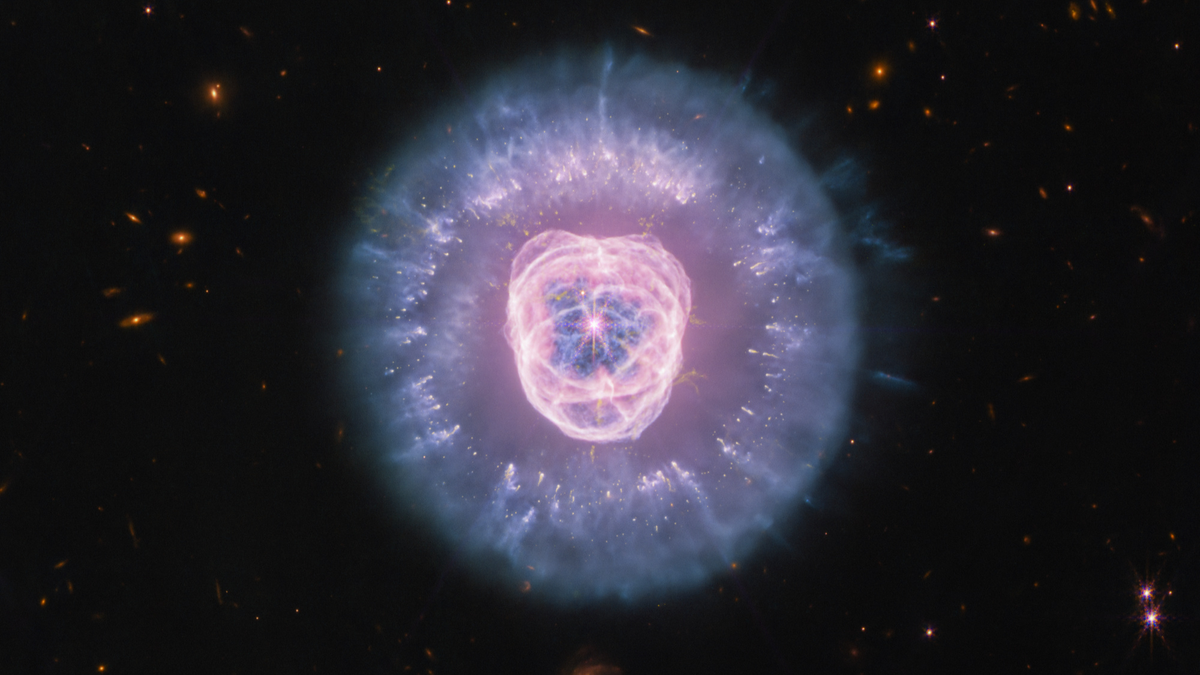
With a glorious mane of glowing purple gas and dust, the Lion Nebula sparkles on the cosmic savanna in this new image captured by the James Webb Space Telescope.
What is it?This new image highlights the stunning beauty of the Lion Nebula (formally named NGC 2392), which earned its nickname thanks to its vaguely lion-head-shaped "face" and surrounding, fuzzy "mane".
At the center of this lion's face lies its nose, a bright purple spot. This spot is actually the remnant of a dying star that's radiating energy outward and powering the cosmic structure. This oxygen-rich remnant is a white dwarf, or the hot core of a dying star. As a star like this dies, it becomes unstable and sheds its outer layers, blasting gas and dust outward to create a planetary nebula.
The white dwarf got left behind after the nose in the center of the "lion's" face expelled energy and created a big bubble of ionized gas around itself. Over time, the lion's face will continue to expand. Astronomers estimate that in about 10,000 years, the lion might dissipate entirely.
Why is it incredible?This isn't the first time we've seen the Lion Nebula. Back in 2000, for instance, the Hubble Space Telescope took a close look at the nebula.
However, the JWST snapped this image of the nebula using two of its state-of-the-art instruments: the NIRCam (Near Infrared Camera) and MIRI (Mid Infrared Instrument). And the new view gives us a very detailed look at the nebula.
With these new instruments, we can see details we never saw in the Hubble's view of the Lion Nebula — like certain dust and gas features. Overall, this view gives us a much more accurate view of what the nebula actually looks like, and what cosmic structures hold it up.
Chelsea Gohd served as a Senior Writer for Space.com from 2018 to 2022 before returning in 2026, covering everything from climate change to planetary science and human spaceflight in both articles and on-camera in videos. With a M.S. in Biology, Chelsea has written and worked for institutions including NASA JPL, the American Museum of Natural History, Scientific American, Discover Magazine Blog, Astronomy Magazine, and Live Science. When not writing, editing or filming something space-y, Gohd is writing music and performing as Foxanne, even launching a song to space in 2021 with Inspiration4. You can follow her online @chelsea.gohd and @foxanne.music
| # | Наименование новости | Тональность | Информативность | Дата публикации |
|---|---|---|---|---|
| 1 | Colorful Collage of Tarantula Nebula | 0 | 14.78 | 17-08-2026 |
| 2 | Телескоп "Джеймс Уэбб" получил детальные изображения планетарной туманности Льва https://www.pravda.ru/news/science/2387679-james-webb-leo-nebula/ ... | 0 | 5.95 | 11-08-2026 |
| 3 | В космосе обнаружили ЛЬВА — телескоп James Webb передал самое ... | 0 | 7.33 | 13-08-2026 |
| 4 | Green comet caught soaring over Namibia | Space photo of the day for Aug. 12, 2026 | 0 | 16.41 | 12-08-2026 |
| 5 | Космический царь зверей позирует: Джеймс Уэбб заснял пушистую гриву туманности ... | 0 | 7 | 11-08-2026 |
| 6 | «James Webb» показал удивительную структуру туманности вокруг умирающей звезды в ... | 0 | 6.5 | 11-08-2026 |
| 7 | Sharpest image of the sun ever captured! | Space photo of the day for Aug. 10, 2026 | 0 | 12.43 | 10-08-2026 |
| 8 | APOD: 2026 September 10 – LDN 1295: The Giraffe Nebula | 0 | 9.99 | 10-09-2026 |
| 9 | APOD: 2026 August 16 – Milky Way over Yellowstone | 0 | 11.49 | 16-08-2026 |
| 10 | 12.08.2026 Подготовка к фотосъемке звездопада🤤🤤🤤 | 0 | 14.69 | 13-08-2026 |