Просмотр новости
Найдите то, что Вас интересует
 Спутники
 РН
РН SpaceX
 Роскосмос
 NASA
NASA
СпутникиРНSpaceXРоскосмосNASAWith half a beak, Bruce has developed a unique fighting style that has won him top status in his flock, videos and documented interactions reveal.
A parrot missing half his beak has become top bird at New Zealand’s Willowbank Wildlife Reserve. Named Bruce, he wins every fight with other kea parrots. He also gets priority access to food.
This observation has made scientists question their ideas about disabilities in animal social groups. Bruce showed that a physical disadvantage doesn’t have to hold an animal back. Sometimes the right moves and a little creativity can make all the difference.
Researchers shared this finding April 20 in Current Biology.
Willowbank’s kea live in a large aviary with trees and a stream. Visitors who stop by often fail to notice the parrots snoozing among the leaves. But when they spot Bruce, they always make the same comment, says behavioral ecologist Alex Grabham: “Look at that poor bird.”
That pity is misguided, says Grabham. He’s part of a team studying kea at the University of Canterbury in Christchurch, New Zealand. That team tracked how Bruce interacted with his flock. (A group of kea is called a circus, reflecting the birds’ playful nature.) Like other parrots, kea have a social hierarchy. This is a ranking system where some birds are in charge; others follow the leader. Birds compete for the top spot by fighting, squawking or puffing up feathers.
Meet Bruce, the disabled kea parrot that managed to become the alpha male of his flock.
Grabham’s team spent four weeks recording 162 physical confrontations between the nine males in Bruce’s circus. Bruce won all 36 of his. Without a doubt, he was the top kea.
What’s more, he’s the first disabled animal to be recorded achieving top status within a group, at least without support from an able-bodied ally. (Faben was a dominant, or “alpha,” male chimpanzee living at Gombe National Park in Tanzania. He lost his top rank after polio paralyzed his arm. Faben’s brother took over his alpha status, but also became his ally. Faben then worked his way back to second place after perfecting a charging technique to bat away rivals.)
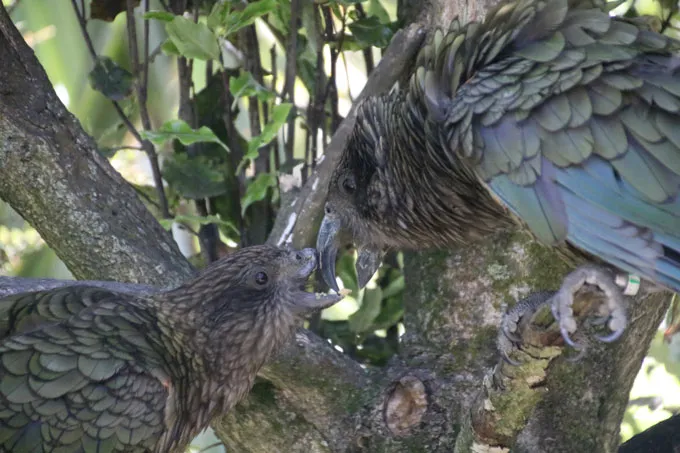
Parrot joustingAlso key to Bruce’s success: an unusual combat technique. Other kea tend to rely solely on kicking to repel other birds. Bruce supplemented his kicks with a unique jousting technique. He jabbed at rivals with his exposed lower beak.
Grabham’s team filmed 109 more confrontations between Bruce and the other birds. During these, Bruce kicked slightly more than he jousted. But jousting proved much more effective. Jousting drove off his opponent 73 percent of the time. When Bruce kicked, he drove them off just 48 percent of the time.
As another kea approaches, Bruce (seen here on the right) jabs with his half a beak. This fighting style has helped the disabled parrot win alpha status among his circus in New Zealand.Ximena NelsonBruce’s top spot comes with perks. Other male kea will preen Bruce, helping to clean parts of his beak that he cannot reach. This is highly unusual among kea. Normally, they only preen their mates. The lower another male’s rank, the more likely he was to preen Bruce. This behavior mimics hierarchical grooming seen in chimps.
Lower-ranked birds also gave Bruce first dibs on food. The birds’ food was spread mostly between four central feeders. Over the four weeks that Grabham’s team analyzed Bruce, he was the first to dine at those feeders 83 percent of the time. On four days, the other birds gave Bruce 15 minutes of alone time with all four feeders. Later, they ate his leftovers.
 Another kea preens Bruce (left). This helps remove food that gets stuck in Bruce’s beak. Alex Grabham
In many animal societies, top status comes at a cost. “An animal that is high up in the dominance hierarchy has to defend that position constantly,” says Amalia Bastos. She’s a comparative psychologist at the University of St Andrews in Scotland who used to study Bruce. Alpha male baboons, for instance, show higher levels of stress hormones called glucocorticoids (Glu-ko-KOR-ti-koids).
Grabham’s team measured those hormones in the birds’ droppings. Bruce, it turns out, was the most chill kea in his circus. It isn’t yet clear why. But Grabham thinks that Bruce is so dominant that other kea don’t mount any serious challenges to his throne. “He isn’t going to be followed around and beaten up or bullied or chased,” Grabham says. And Bruce “knows that.”
It’s unclear whether Bruce would have thrived as well in a wild circus as he has at Willowbank. Bastos points out that with his damaged beak, Bruce might struggle with tougher foods during the winter. In the wild, most kea circuses don’t have a fixed hierarchy. Birds join and depart groups throughout the year, constantly changing the rankings. For now, in Willowbank’s strict hierarchy, Bruce is boss.
This isn’t the first study to show Bruce is capable of innovation. In 2021, researchers reported his self-preening technique. He uses pebbles to clean his feathers. “Bruce has now shown twice that being different is not necessarily disadvantageous,” Bastos says.
Bruce gained renown a few years ago for showing tool use. To groom himself, the parrot would select a pebble and hold it just so. This pebble “tool” overcame the lack of a part of his upper beak.
aviary: Some building or other human-made enclosure designed to house birds.
baboon: A large ground-dwelling African monkey with a long, doglike snout and large teeth. Baboons are social animals and live in troops.
behavior: The way something (often a person or other organism) conducts itself or acts towards others.
behavioral ecologist: A scientist who studies how animal behavior relates to where animals live.
biology: The study of living things. The scientists who study them are known as biologists.
birds: Warm-blooded dinosaurs with wings that first showed up at least 150 million years ago. Birds are jacketed in feathers and produce young from the eggs they deposit in some sort of nest. Most birds fly, but throughout history there have been the occasional species that don’t.
ecologist: A scientist who works in a branch of biology that deals with the relations of organisms to one another and to their physical surroundings.
hierarchy: The ranking or organization of things or individuals — one above the other — based on their perceived importance, authority or status. Colloquially, among animals within a community, this might be referred to as their pecking order.
hormone: (in zoology and medicine) A chemical produced in a gland and then carried in the bloodstream to another part of the body. Hormones control many important body activities, such as growth. Hormones act by triggering or regulating chemical reactions in the body.
innovation: (v. to innovate; adj. innovative) An adaptation or improvement to an existing idea, process or product that is new, clever, more effective or more practical.
New Zealand: An island nation in the southwest Pacific Ocean, roughly 1,500 kilometers (some 900 miles) east of Australia. Its “mainland” — consisting of a North and South Island — is quite volcanically active. In addition, the country includes many far smaller offshore islands.
physical: (adj.) A term for things that exist in the real world, as opposed to in memories or the imagination. It can also refer to properties of materials that are due to their size and non-chemical interactions (such as when one block slams with force into another). (in biology and medicine) The term can refer to the body, as in a physical exam or physical activity.
perk: An abbreviation for perquisite. It’s a term for some advantage or privilege given to workers in addition to their salary. It might range from free coffee at the office to a company phone or free gym membership. For an airline pilot, it might be the ability to fly free on other airlines.
polio: An infectious viral disease that affects the central nervous system and can cause temporary or permanent paralysis.
preen: (in biology) A verb for the way birds straighten and clean their feathers.
psychologist: A scientist or mental-health professional who studies the mind, especially in relation to actions and behaviors. Some work with people. Others may conduct experiments with animals (usually rodents) to test how their minds respond to different stimuli and conditions.
ranking: An ordering of things or individuals based on some scale or agree-upon values; a hierarchy.
social: (adj.) Relating to gatherings of people; a term for animals (or people) that prefer to exist in groups. (noun) A gathering of people, for instance those who belong to a club or other organization, for the purpose of enjoying each other’s company.
stress: (in biology) A factor — such as unusual temperatures, movements, moisture or pollution — that affects the health of a species or ecosystem. (in psychology) A mental, physical, emotional or behavioral reaction to an event or circumstance (stressor) that disturbs a person or animal’s usual state of being or places increased demands on a person or animal; psychological stress can be either positive or negative. (in physics) Pressure or tension exerted on a material object.
system: A network of parts that together work to achieve some function. For instance, the blood, vessels and heart are primary components of the human body's circulatory system. Similarly, trains, platforms, tracks, roadway signals and overpasses are among the potential components of a nation's railway system. System can even be applied to the processes or ideas that are part of some method or ordered set of procedures for getting a task done.
Tanzania: A nation in East Africa that sits just south of the equator. It’s well known in science communities as home to the East African Rift valley, where many hominid fossils have turned up. With a small population, many big wildlife species remain, including lions, rhinos, elephants, zebras, hippos, cheetahs and giraffes. The country is bordered by the Indian Ocean to the east; Kenya and Uganda to the north; Rwanda, Burundi and Democratic Republic of Congo to the west; and Zambia, Malawi and Mozambique to the south. It became a country in 1964. Its capital is Dodoma.
unique: Something that is unlike anything else; the only one of its kind.
Journal: A.A. Grabham et al. A disabled kea parrot is the alpha male of his circus. Current Biology. Vol. 36, April 20, 2026, p. R320. doi: 10.1016/j.cub.2026.03.004.
Journal: A.P.M. Bastos et al. Self-care tooling innovation in a disabled kea (Nestor notabilis). Scientific Reports. Vol. 11, September 10, 2021. doi:10.1038/s41598-021-97086-w.
Journal: N.E. Newton-Fisher and S.S.K. Kaburu. Grooming decisions under structural despotism: the impact of social rank and bystanders among wild male chimpanzees. Animal Behaviour. Vol. 128, June 2017, p. 153. doi: 10.1016/j.anbehav.2017.04.012.
Journal: L.R. Gesquiere et al. Life at the top: rank and stress in wild male baboons. Science. Vol. 333, July 15, 2011, p. 357. doi:10.1126/science.1207120.
| # | Наименование новости | Тональность | Информативность | Дата публикации |
|---|---|---|---|---|
| 1 | Багаевская: Ночь 18 дек, Вт | 0 | 0 | 17-12-2018 |
| 2 | Багаевская: Утро 18 дек, Вт | 0 | 0 | 17-12-2018 |
| 3 | Спрос на перевозки из Китая и Казахстана в Беларусь вырос в 3 раза | 0 | 0 | 28-01-2025 |
| 4 | Resolución de 5 de enero de 2023, del Ayuntamiento de Navia (Asturias), referente a la convocatoria para proveer una plaza. | 0 | 0 | 17-01-2023 |
| 5 | Ofertan viajes gratuitos para ir de compras a Cabra por Navidad | 0 | 0 | 18-11-2021 |
| 6 | Opel Adam S. Мал, но горяч | 0 | 0 | 18-09-2014 |
| 7 | Чалханоглу: В последнее время у Милана все получается | 0 | 0 | 31-01-2020 |
| 8 | venuskissed:queen of getting thru it!!! even if I gotta cry along the way….bitch imma get through... | 0 | 0 | 22-02-2020 |
| 9 | Таролог: «Поставь эту карту на заставку телефона, чтобы привлечь богатство» | 0 | 0 | 23-02-2025 |
| 10 | Точечные изменения в Кабмине приведут к усилению позиций Ахметова – политолог Молчанов | 0 | 0 | 29-02-2020 |