Просмотр новости
Найдите то, что Вас интересует
 Спутники
 РН
РН SpaceX
 Роскосмос
 NASA
NASA
СпутникиРНSpaceXРоскосмосNASAA Senate defense panel aims to place guardrails on direct equity investments, create an oversight board, and require briefings.
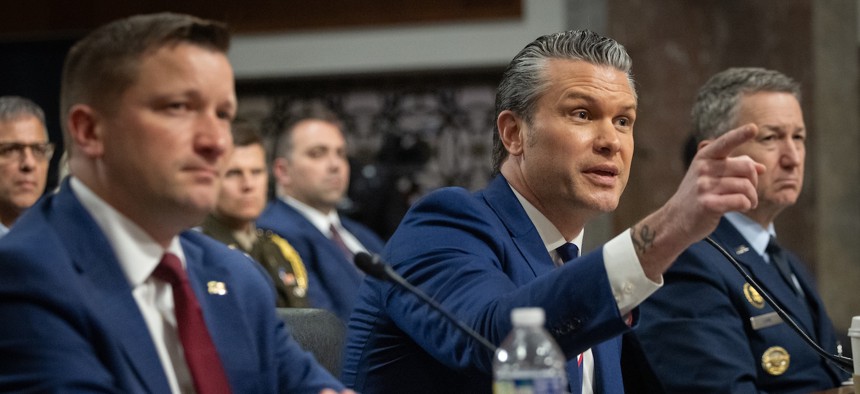
Defense Secretary Pete Hegseth testifies during a Senate Armed Services Committee hearing on the Department of Defense's FY27 budget request, on April 30, 2026. Nathan Posner / Anadolu via Getty Images
The Pentagon office that lends money to weapons developers would be allowed to take equity stakes in private companies deemed critical to national security under draft provisions of the 2027 defense policy bill.
“We have allowed them to take equity in certain sectors. We have, what I think, is a very robust reporting regime and ethics regime, and we are working to reorganize or rationalize equity at the department by co-locating it with the loan authority at the Office of Strategic Capital and leaving the industrial-based fund, IBAS, as a tool for smaller dollar grants…as it's traditionally been used,” a congressional staffer with the Senate Armed Services Committee told reporters last week.
Meanwhile, the defense spending bill passed out of the House Appropriations Committee’s defense panel would give the Office of Strategic Capital $2.16 billion in loan authority and $216 million “to carry out the capital assistance program, including loans, loan guarantees, and technical assistance,” according to legislative language and the bill summary.
The Senate Armed Services Committee passed its version of the 2027 National Defense Authorization Act earlier this week to be considered on the Senate floor. It included provisions regarding the Pentagon’s ability to take financial stakes in defense contractors.
Using existing authorities, the Pentagon has already taken equity stakes worth more than a billion dollars in defense-related companies. High-profile examples include taking a $400 million stake in a rare-earths producer last July and a $1 billion stake in L3Harris’ solid rocket motor business in April. The latter drew congressional scrutiny.
The SASC bill does several things with respect to equity investments, according to the bill summary:
The bill also limits use of the direct equity investment account to fund “critical minerals, materials, and chemicals; and batteries,” and direct equity investments would be limited to 40 percent “of the total amount of all equity investments made to the entity,” according to the text. Investments would also be capped at $500 million.
The bill would also create an Economic Defense Unit, which would meet quarterly and enforce briefing requirements, including the defense secretary’s “ownership review of all companies in which the Department of Defense holds equity” and certification the Pentagon “does not hold, and does not have the option to hold, any seat on the board of directors or any other form of voting representation or control in any entity in which the Department holds equity,” according to the bill’s executive summary.
“We can see some value in this tool. We have differing opinions about how much value,” the SASC staffer said.
Senators on the committee are aiming for a long-lasting solution to match the yearslong challenge of reshoring supply chains and sectors to the U.S.
“Because whether you're talking about critical minerals, batteries, some of these other fundamental sectors where the Chinese have domination—this is going to be a decade-plus long project,” the staffer said.
| # | Наименование новости | Тональность | Информативность | Дата публикации |
|---|---|---|---|---|
| 1 | Three initiatives causing industry new concerns about DoD acquisition reforms | 0 | 8.82 | 26-08-2026 |
| 2 | Senate defense bill seeks to attract cyber talent, limit civilian layoffs | 0 | 10.4 | 22-06-2026 |
| 3 | Congress ramps up scrutiny of Pentagon AI data center plans | 0 | 7.02 | 24-07-2026 |
| 4 | DoD eyes accounting reforms to lower barriers for commercial firms | 0 | 8.57 | 12-08-2026 |
| 5 | Watchdog tightens rules on investment trusts after Saba raids | -3 | 6 | 27-06-2026 |
| 6 | Senate eyes Hegseth travel cuts without probes into Iran school bombing, boat strikes | 0 | 8.31 | 18-06-2026 |
| 7 | New law barring DoD contractors from retaining certain outside consultants goes into effect | 0 | 8.69 | 30-06-2026 |
| 8 | USDA, Treasury Moves May Widen Agricultural Deal Scrutiny | 0 | 8.54 | 27-07-2026 |
| 9 | Defense Business Brief: SECARMY’s dream marketplace; USARPAC + USVs; and Quantum EOs | 0 | 5 | 25-06-2026 |
| 10 | Законопроект о преференциях для инвесторов в Арктике может быть рассмотрен Госдумой осенью | 0 | 0 | 05-09-2019 |