Просмотр новости
Найдите то, что Вас интересует
 Спутники
 РН
РН SpaceX
 Роскосмос
 NASA
NASA
СпутникиРНSpaceXРоскосмосNASAA SeeAbility mural at Tower Bridge set a Guinness World Record while highlighting untreated sight loss among people with learning disabilities
Author: SeeAbility
Published: 7 Jun 2026 - Updated: 18 Aug 2026
Publication Type: Announcement
Table of Contents:
Synopsis - Definition - Overview - FAQs - Insights, Updates - Related Content
This article reports on how the national charity SeeAbility secured a Guinness World Record at London's Tower Bridge, where muralist Luke Embden and autistic artist Alex the Doodler illustrated 800 members of the public into a single live portrait over 48 hours, with each face standing in for 1,000 of the roughly 800,000 people in the UK who have both a learning disability and a sight problem. Readers will find value in the story of Terence, a non-verbal autistic Londoner who reached his twenties before a SeeAbility eye test revealed a severe prescription and gave him clear sight for the first time, a case that shows why families, carers and educators should treat vision screening as essential rather than optional.*
At a GlanceSight loss describes any partial or complete reduction in vision that cannot be corrected with standard glasses or contact lenses, ranging from difficulty seeing fine detail or judging distance to the loss of central or peripheral vision and, in its most severe form, total blindness. It can be present from birth or acquired later through conditions such as glaucoma, cataracts, macular degeneration, diabetic eye disease, or injury, and it may come on gradually over years or quite suddenly. Because the degree and type of impairment vary so widely, two people described as having sight loss can experience the world very differently, which is why support tends to focus on practical adaptations, assistive technology, and environmental changes that help a person carry out daily tasks and maintain independence.
In a brilliant display of art and advocacy right beneath Tower Bridge, national charity SeeAbility has officially broken a Guinness World Record, drawing vital attention to a massive oversight in healthcare through a deeply moving personal story.
The Record-Breaking CanvasOver an intense 48-hour period at Potters Fields Park, celebrated muralist Luke Embden and 23-year-old autistic artist Alex the Doodler (@alexthedoodler) worked tirelessly to create a massive 5-meter by 3-meter live portrait installation.
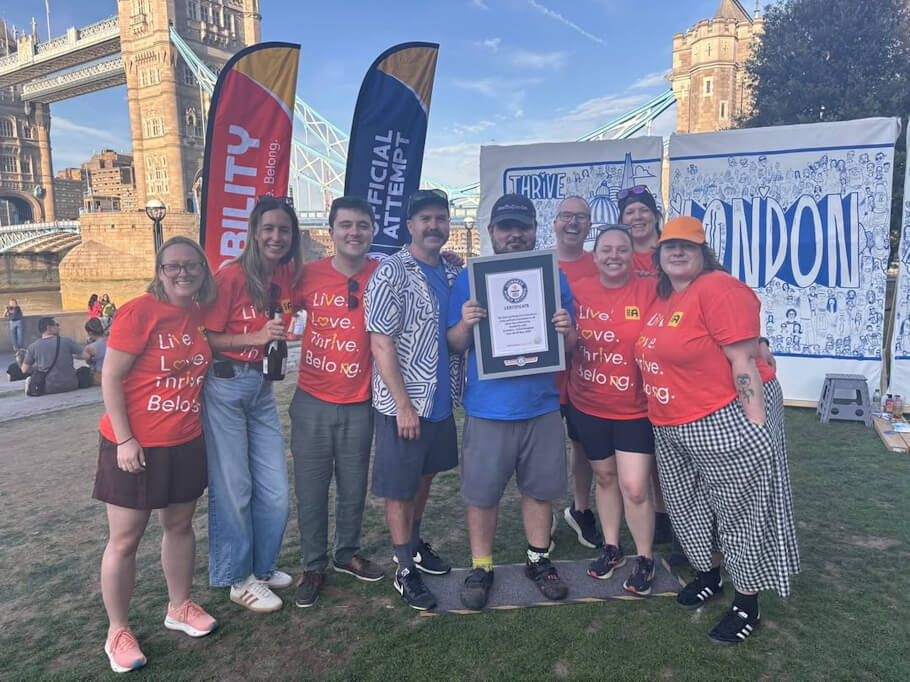 A group of nine people stands closely together on a grassy lawn beside the River Thames in London, with the distinctive twin towers and blue suspension cables of Tower Bridge rising in the background under a clear sky. Most of the group wear matching bright red t-shirts printed with the words Live. Love. Thrive. Belong. while one man near the center wears a blue t-shirt and a baseball cap, and beside them two tall advertising flags read ability in red and Official Attempt in dark blue. The man in blue holds up a framed Guinness World Records certificate toward the camera, and the people around him smile broadly, with a couple of them holding a bottle as if celebrating. Behind the group hangs a large white banner covered in a hand-drawn blue illustration of crowds of people, topped with the word London and a small sketch of a landmark, tying the celebration to the city setting and the record-breaking mural event.
The duo successfully captured the likenesses of 800 participants, officially securing the world record for the Most participants featured on a live portrait installation in 48 hours.94 Members of the public had their Polaroid photos taken, which the artists then vividly illustrated onto the mural. Each of the 800 faces on the canvas represents 1,000 of the estimated 800,000 people with learning disabilities in the UK who live with sight problems.
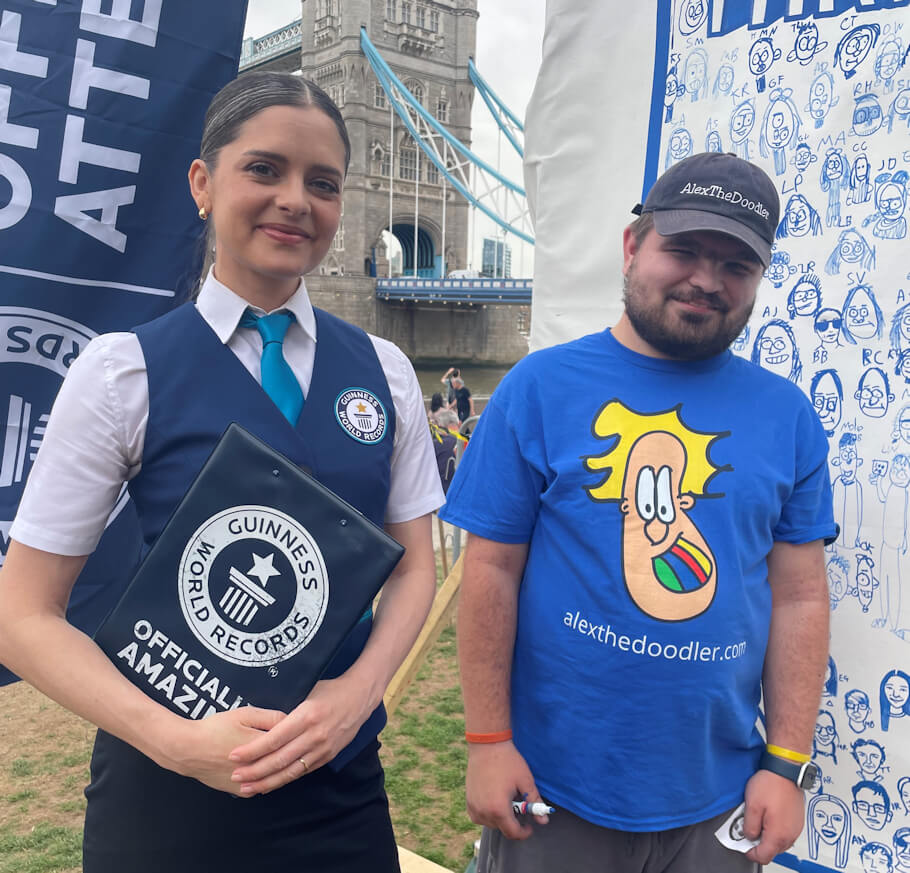 This image captures Alex the Doodler at a Guinness World Records event beside an official Guinness World Records adjudicator, who is dressed in the organization’s distinctive uniform and holding a branded folder. Standing in front of London’s Tower Bridge and a large collaborative doodle artwork filled with hand-drawn portraits, Alex wears his signature blue T-shirt featuring one of his cartoon characters and a cap bearing his name. The scene conveys a moment of recognition and celebration, marking the successful achievement of a Guinness World Record through a creative public art project that engaged and connected a large community of participants.
At the absolute center of this record-breaking artwork is the face of Terence, a 20-year-old Londoner whose life was completely transformed by SeeAbility's Special Schools Eye Care team.
Terence, who is autistic and non-verbal, had gone his entire life without ever having a sight test. Because he could not communicate his struggle, no one knew that he was living with a severe -19 eye vision prescription. Without glasses, Terence's world was a complete blur; he was unable to see further than just two inches (five centimeters) in front of his face.
"When SeeAbility fitted Terence's glasses I was so happy, I was in tears of joy! This is life-changing for Terence. With his glasses he can see the world clearly. He is smiling all the time!" Chantal Panzu, Terence's mother
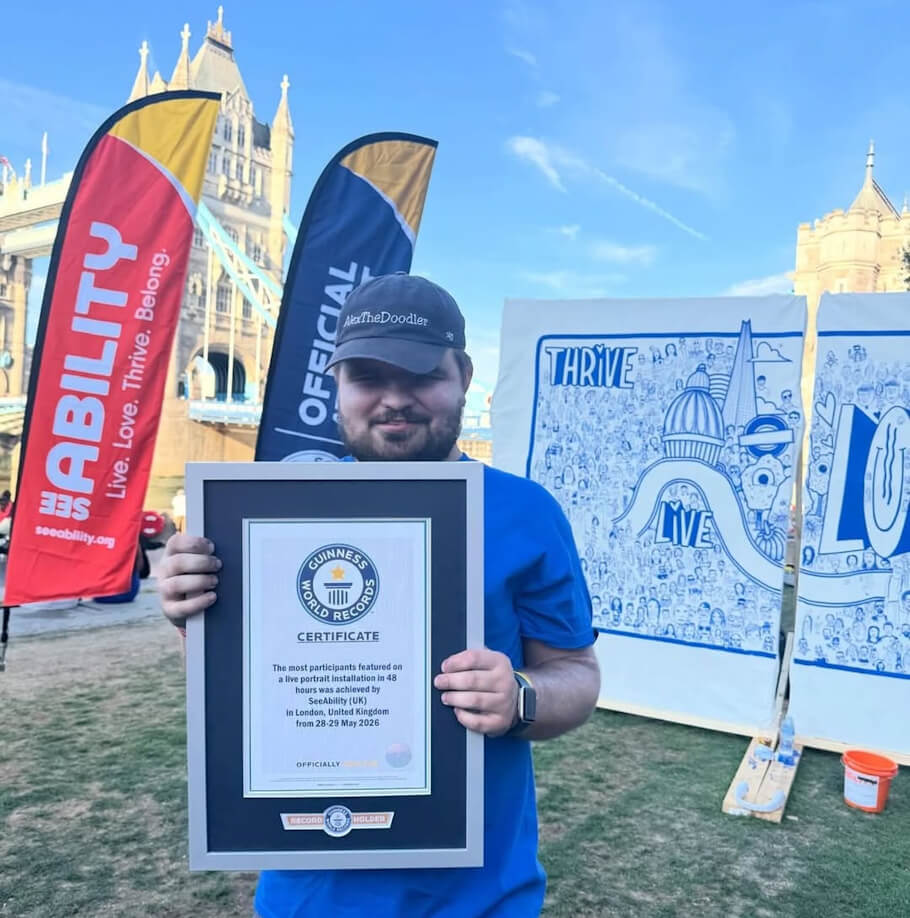 This image shows Alex the Doodler standing outdoors in front of London’s iconic Tower Bridge, proudly holding a framed Guinness World Records certificate awarded for a project supporting people with visual impairments. Dressed casually in a blue shirt and cap, he poses beside a large live mural installation featuring hand-drawn artwork and positive words such as Thrive, Live, and Love. Colorful event banners for SeeAbility, a charity that supports people with learning disabilities and autism, are visible in the background, emphasizing the community-focused nature of the achievement. The scene captures a celebratory moment recognizing a record-breaking inclusive art initiative that brought together a large number of participants in a public creative event.
Children with learning disabilities are 28 times more likely to suffer from serious sight complications than other children, yet tens of thousands pass through the special education system without basic eye care.
The Tower Bridge event was organized not just to break records, but to raise urgent funds and awareness for SeeAbility's campaign to ensure specialize d sight tests and glasses are readily available in special schools. Thanks to the collaboration of Luke Embden, Alex the Doodler, and hundreds of everyday Londoners, Terence and the thousands of children like him are finally being seen.
Frequently Asked QuestionsNOTE: Researched FAQs by Disabled World (DW)
How can I tell if a non-verbal person is struggling with their sight?Watch for behavioral clues such as holding objects very close to the face, bumping into things, reluctance to move in unfamiliar spaces, or unusual head tilting, since someone who cannot describe their vision may show difficulty through their actions instead.
What is a minus 19 eye prescription?A minus 19 prescription indicates very severe short-sightedness, meaning distant objects appear extremely blurred and only things held right in front of the face can be seen with any clarity, which is far stronger than a typical corrective prescription.
Are eye tests different for people with learning disabilities?Yes, specialist eye tests are adapted so they do not rely on a person reading letters or verbally responding, using picture cards, lights, and observation techniques so that people who cannot communicate easily can still have their vision measured accurately.
What does SeeAbility do besides eye care?SeeAbility supports people with learning disabilities, autism, and sight loss through housing, daily living support, communication help, and campaigns, aiming to help individuals live more independently and be included in their communities.
At what age should children with learning disabilities have eye tests?Eye care experts recommend that children with learning disabilities begin regular sight checks from an early age and continue them throughout schooling, because vision problems in this group are common yet often go unnoticed for years.
Can severe sight problems in children be reversed once glasses are provided?Glasses can dramatically improve blurred vision caused by refractive errors, giving clear sight where none existed before, though outcomes depend on the underlying cause and starting treatment as early as possible gives the best results.
How does a Guinness World Records attempt get verified on site?An official adjudicator attends the event in person, checks that the specific rules and evidence requirements are met, counts or confirms the qualifying entries, and then presents a framed certificate once the attempt is judged successful.
Why is sight loss sometimes called a hidden disability?Sight loss is often described as hidden because it is not always visible to others and may go undetected in people who cannot report their symptoms, meaning the person can face significant daily barriers that those around them do not recognize.
Editorial Note: The Tower Bridge installation works on two levels at once, celebrating a genuine artistic achievement while confronting a quiet failure in how sight is checked for people who cannot easily report what they see, and its lasting message is that routine eye care belongs in every special school rather than being left to chance.*
Attribution/Source(s): This quality-reviewed publication was selected for publishing by the editors of Disabled World (DW) due to its relevance to the disability community. Originally authored by SeeAbility and published on 7 Jun 2026, this content may have been edited for style, clarity, or brevity.
* Editorial additions by Ian C. Langtree.
| # | Наименование новости | Тональность | Информативность | Дата публикации |
|---|---|---|---|---|
| 1 | Guide Dogs highlights life firsts in debut work by Fold7 | 0 | 10.4 | 28-08-2026 |
| 2 | Motril y Salobreña estrenan un sistema de playas accesibles para personas ciegas y con baja visión | 0 | 7.2 | 27-07-2026 |
| 3 | В храме Василия Блаженного появились тактильные макеты для незрячих | 0 | 0 | 11-02-2021 |
| 4 | В Исаакиевском соборе представили выставку работ незрячих и слабовидящих художников | 0 | 0 | 05-12-2018 |
| 5 | В Китае экспериментальный скоростной поезд побил мировой рекорд | 0 | 10 | 12-08-2026 |
| 6 | Pyrographer With Usher Syndrome Wins National Rare Artist Award | 0 | 5.49 | 18-02-2026 |
| 7 | Un dispositivo permitirá a personas con discapacidad visual experimentar el eclipse | 0 | 7.35 | 12-08-2026 |
| 8 | В "Сколково" создали гаджет c распознаванием лиц для людей с нарушениями зрения и слуха | 0 | 0 | 21-08-2019 |
| 9 | Access all areas: Arts body puts focus on inclusion by bringing Fleadh into care homes and hospices | 0 | 10 | 02-08-2026 |
| 10 | Leeds Rhinos legend Sir Kevin Sinfield recreated in incredible 13-metre crochet marathon | 0 | 8.19 | 22-09-2026 |