Просмотр новости
Найдите то, что Вас интересует
 Спутники
 РН
РН SpaceX
 Роскосмос
 NASA
NASA
СпутникиРНSpaceXРоскосмосNASASenate Republicans are revising White House security funding after a procedural setback, adding uncertainty to an already contested project
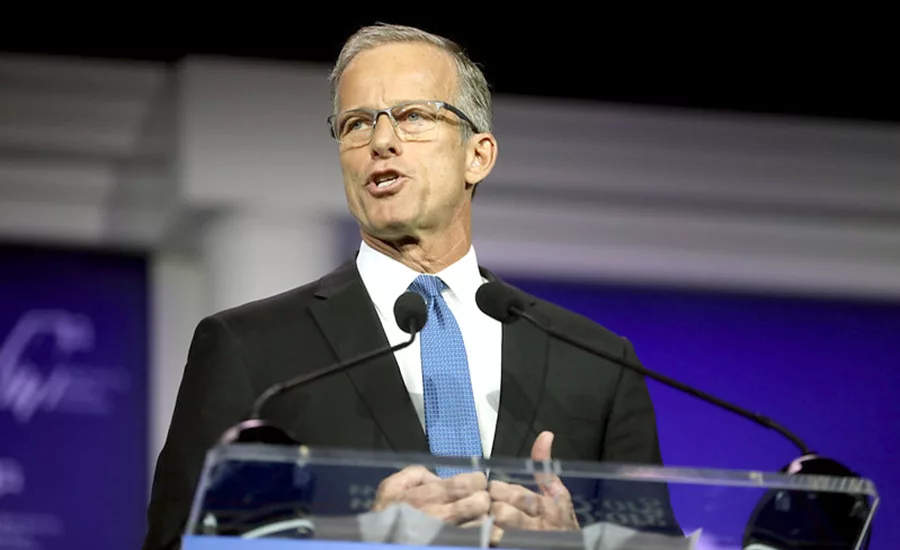
Image by Gage Skidmore/Flickr/CC BY-SA 2.0
“Redraft. Refine. Resubmit. None of this is abnormal during a Byrd bath process,” Ryan Wrasse, spokesman for US Senate Majority Leader John Thune, pictured above, wrote on X after the body's Parliamentarian ruled that budget reconciliation could not be used to provide $1B in funding the Republican majority intends to provide for the East Wing rebuild project.
Senate Republicans are revising a proposal to direct $1 billion toward White House security and related improvements after the body's parliamentarian determined the language did not comply with budget reconciliation rules, creating another uncertainty point for a project already navigating legal challenges and procurement scrutiny.
The ruling affects a package Republicans had argued would support broader security and protective infrastructure needs surrounding President Donald Trump's planned White House and East Wing modernization effort, not solely his ballroom construction.
Still, GOP leaders signaled the effort is continuing.
“Redraft. Refine. Resubmit. None of this is abnormal during a Byrd bath process,” Ryan Wrasse, spokesman for Senate Majority Leader John Thune, wrote on X after the ruling.
The ruling stemmed from the Senate's "Byrd rule," named for the late Sen. Richard Byrd (D-W.Va.), which limits what can be included in budget reconciliation bills by barring provisions considered primarily policy-focused rather than directly budgetary. During an internal review process known as a "Byrd bath," the Senate parliamentarian evaluates whether provisions meet those standards, forcing lawmakers to rewrite or remove language that falls outside the rules.
Trump has said the approximately $400-million ballroom itself would be privately funded, while separate discussions in Congress focused on security and supporting infrastructure. Republicans have argued the broader request would include visitor screening, agent training and other protective measures extending beyond the ballroom itself.
Questions remain regarding where project boundaries begin and end between privately funded ballroom construction and federally supported protective infrastructure, particularly if security assumptions become intertwined with project delivery or supporting infrastructure.
Looking for quick answers on construction and engineering topics?
Try Ask ENR, our new smart AI search tool.
Ask ENR →
Legal uncertainty surrounding the project also remains unresolved. Earlier this spring, a federal appeals panel allowed ballroom construction to continue while administratively staying U.S. District Judge Richard J. Leon’s injunction and scheduling expedited review for June as litigation brought by the National Trust for Historic Preservation continues.
Judges previously wrote that the record raised “unresolved factual questions” about whether above-grade ballroom work and below-grade security systems could be separated—an issue with potential implications for project sequencing and delivery assumptions.
ENR previously reported that the dispute arrived at a sensitive construction phase, with structural steel fabrication, sequencing and logistics on the constrained White House campus positioned to advance as the injunction was paused.
The White House has also faced questions about procurement decisions linked to supporting work on the complex and use of urgency authorities on certain contracts.
Senate Republicans appear to be treating the latest ruling as a drafting issue rather than as a substantive rejection of the proposal. Multiple reports indicated lawmakers are revising the language rather than abandoning the effort.
Whether changes affect eventual scope, timing or assumptions surrounding associated security work remains unclear.
Trump said earlier this month the ballroom project remained “ahead of schedule,” with a targeted opening around September 2028.
The latest development may not alter near-term construction activity, but it adds another layer of uncertainty to one of the country's most scrutinized federal building efforts.

Bryan Gottlieb is the online editor at Engineering News-Record (ENR).
Gottlieb is a five-time Society of Professional Journalists Excellence in Journalism award winner with more than a decade of experience covering business, construction and community issues, including finance, law and real estate. He has reported for Adweek and the San Diego Daily Transcript and led a community newsroom in Santa Monica, Calif. He served as editor-in-chief of the Detroit Metro Times and as managing editor at Roofing Contractor, where he helped shape national industry coverage. At Engineering News-Record, Gottlieb covers breaking news, large-scale infrastructure and megaprojects, regulatory developments and business trends across the U.S. and global construction sectors.
email: gottliebb@enr.com | office: (248) 786-1591
