Просмотр новости
Найдите то, что Вас интересует
 Спутники
 РН
РН SpaceX
 Роскосмос
 NASA
NASA
СпутникиРНSpaceXРоскосмосNASAA new Trump administration memo could require green card seekers already in the U.S. to apply from abroad, potentially affecting hundreds of thousands annually.
 (welcomia/Getty Images)
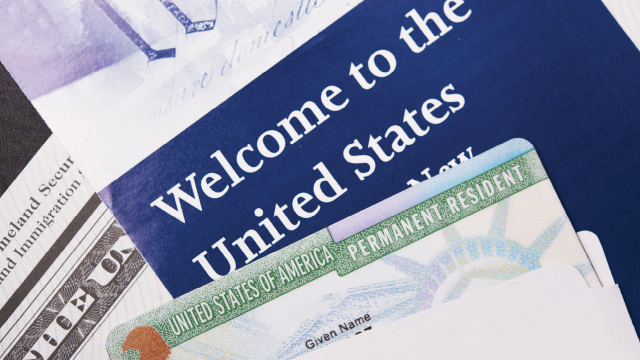
The Trump administration has issued a new guidance memo that could require many immigrants who are seeking a green card – lawful permanent residence in the United States – to leave the country and apply for it from their home nation instead of from within the U.S. The memo gives immigration officers the discretion to make decisions on a case-by-case basis.
Majority of new green cards are awarded to immigrants who adjust status while living in U.S.
Number of lawful permanent resident issuances by class of admission each fiscal year since 2000

Note: Numbers are rounded to the nearest 10 for 2023 and 2024.
Source: Pew Research Center analysis of Department of Homeland Security data.
PEW RESEARCH CENTER
Majority of new green cards are awarded to immigrants who adjust status while living in U.S.
Number of lawful permanent resident issuances by class of admission each fiscal year since 2000
| Year | Adjustment of status | New arrivals |
|---|---|---|
| 2000 | 442,405 | 407,402 |
| 2001 | 653,259 | 411,059 |
| 2002 | 679,305 | 384,427 |
| 2003 | 347,416 | 358,411 |
| 2004 | 583,921 | 362,221 |
| 2005 | 738,302 | 384,071 |
| 2006 | 819,248 | 447,016 |
| 2007 | 621,047 | 431,368 |
| 2008 | 640,568 | 466,558 |
| 2009 | 667,776 | 463,042 |
| 2010 | 566,576 | 476,049 |
| 2011 | 580,092 | 481,948 |
| 2012 | 547,559 | 484,072 |
| 2013 | 530,802 | 459,751 |
| 2014 | 535,126 | 481,392 |
| 2015 | 542,315 | 508,716 |
| 2016 | 565,427 | 618,078 |
| 2017 | 549,086 | 578,081 |
| 2018 | 567,884 | 528,727 |
| 2019 | 572,513 | 459,252 |
| 2020 | 439,209 | 268,153 |
| 2021 | 512,796 | 227,206 |
| 2022 | 552,631 | 465,718 |
| 2023 | 608,260 | 564,660 |
| 2024 | 782,770 | 573,990 |
Note: Numbers are rounded to the nearest 10 for 2023 and 2024.
Source: Pew Research Center analysis of Department of Homeland Security data.
PEW RESEARCH CENTER
The new guidance could affect hundreds of thousands of people a year, according to a new Pew Research Center analysis. Since the turn of the century, about half or more of green cards have gone to people who are already living in the U.S., rather than to new arrivals from abroad.
In the 2024 fiscal year, the U.S. granted a total of about 1.36 million green cards. A majority of them (58%) went to people who were already living in the country. By comparison, 42% went to new immigrant arrivals who applied through U.S. consulates in their home countries.
About this researchThis Pew Research Center analysis looks at how immigrants in the United States receive their green cards or permanent residency status. It comes as the Trump administration has issued a new memo that could prevent many applicants from adjusting their immigration status from within the U.S.
Why did we do this?Pew Research Center does demographic studies, opinion surveys and other research to better understand U.S. immigration, including Americans’ views on immigration. This analysis builds on our previous work on immigration and migration.
How did we do this?This analysis relies on the Department of Homeland Security’s Yearbook of Immigration Statistics for data about lawful permanent resident admissions. Specifically, we examined annual counts of adjustment of status recipients (processed within the U.S.) and new arrivals (processed in immigrants’ home countries). For each year, we identified the classes of admission and top countries of nationality.
The administration’s new guidance could limit a process known as “adjustment of status” (AOS), which allows immigrants who are already living in the U.S. on a legal temporary basis to become permanent residents without leaving the country.
The administration says the guidance is “returning to the original intent of the law” and would close loopholes in the immigration process. But critics of the memo say it could lead to processing delays, family separations and job losses, as well as limit pathways to legal immigration.
Some groups are more likely than others to be affectedSome immigrant groups are especially likely to be affected by the memo because they’re more likely to adjust their status while already living in the U.S.:
Adjustment of status is more common among certain groups of immigrants
Number of adjustments of status and its share among all lawful permanent resident issuances in fiscal year 2024
| Total number | # of adjustment of status (AOS) | # of new arrivals | Share AOS | |
|---|---|---|---|---|
| Total, all lawful permanent resident issuances | 1,356,760 | 782,770 | 573,990 | 58% |
| Refugees | 178,200 | 178,200 | 0 | >99% |
| Asylees | 41,650 | 41,650 | 0 | >99% |
| Employment-based preferences | 170,980 | 118,480 | 52,500 | 69% |
| Immediate relatives of U.S. citizens | 669,160 | 402,890 | 266,260 | 60% |
| Family-sponsored preferences | 184,670 | 10,430 | 174,230 | 6% |
| Diversity | 49,580 | 1,240 | 48,340 | 3% |
| All other | 61,860 | 29,880 | 31,990 | 48% |
Note: Numbers are rounded to the nearest 10. Shares are based on the rounded data.
Source: Pew Research Center analysis of Department of Homeland Security data.
PEW RESEARCH CENTER
By contrast, some categories of immigrants are mostly processed outside the U.S:
Nearly 9 in 10 Cuban immigrants received their green cards through adjustment of status in 2024
Number of adjustments of status by country of nationality, fiscal year 2024

Note: “Share adjusted” refers to the share of all legal permanent resident issuances that are received through adjustment of status. Numbers are rounded to the nearest 10. Shares are based on the rounded data.
Source: Pew Research Center analysis of Department of Homeland Security data.
PEW RESEARCH CENTER
Nearly 9 in 10 Cuban immigrants received their green cards through adjustment of status in 2024
Number of adjustments of status by country of nationality, fiscal year 2024
| Country of nationality | Adjustment of status | Share adjusted |
|---|---|---|
| Cuba | 155,630 | 87% |
| Mexico | 131,330 | 65% |
| China | 46,530 | 66% |
| India | 39,190 | 61% |
| Brazil | 22,040 | 80% |
| El Salvador | 21,750 | 71% |
| Colombia | 20,300 | 69% |
| Dominican Republic | 17,030 | 25% |
| Afghanistan | 15,640 | 31% |
| Venezuela | 15,120 | 87% |
Note: “Share adjusted” refers to the share of all legal permanent resident issuances that are received through adjustment of status. Numbers are rounded to the nearest 10. Shares are based on the rounded data.
Source: Pew Research Center analysis of Department of Homeland Security data.
PEW RESEARCH CENTER
Many immigrants who adjust their status in the U.S. come from a few countries, a pattern that has changed little over nearly two decades.
In 2024, more immigrants from Cuba than any other country obtained a green card via adjustment of status. Almost nine-in-ten (87%, or more than 155,000 people) became green-card holders this way. This reflects recent migration patterns and Cuba-specific policies – for example, many Cuban parolees and refugees adjusting their status.
Mexico also contributed significantly to AOS green-card approvals in 2024. Some 65% of Mexican immigrants became permanent residents this way. Since 2006, the share has been about 50% or more. A large number of Mexican immigrants apply as immediate relatives of a U.S. citizen – a category that is often processed within the U.S.
China and India also continue to rank among the top countries for AOS green-card approvals. This is largely due to large numbers of immigrants from these countries seeking permanent status through employment-based green cards. In 2024, most Chinese (66%) and Indian (61%) immigrants received their green cards through adjustment of status.
Many people also live in the U.S. on temporary visasA green card is not the only way immigrants live in the U.S. legally. Millions of people reside in the country on temporary (nonimmigrant) visas – for example, as international students or seasonal or specialized skilled workers. These groups would not be directly impacted by the administration’s new guidance memo.
About 4 in 10 Americans say highly skilled workers should get top priority in legal immigrationNearly half of Americans say legal immigration into the U.S. should be kept at present levels, according to an August 2024 Pew Research Center survey.
The same survey also asked whether certain groups of immigrants should get top priority, some priority or no priority in immigration decisions. Around four-in-ten Americans (42%) said high-skilled workers such as scientists, doctors, nurses and computer programmers should get top priority for legal immigration. Fewer said this about people who fill labor shortages such as agricultural or childcare workers (25%), people who have close family members in the U.S. (19%), and those from countries not well represented in the U.S. (5%).

Sahana Mukherjee is an associate director of race and ethnicity research at Pew Research Center.

Mark Hugo Lopez is director of race and ethnicity research at Pew Research Center.
| # | Наименование новости | Тональность | Информативность | Дата публикации |
|---|---|---|---|---|
| 1 | BREAKING: Trump Administration Tells Foreigners to Apply for Green Cards in Home Countries | 0 | 7.51 | 22-05-2026 |
| 2 | Asylum rule changes could lead to quick, wrongful removals, advocates warn | 0 | 7.99 | 30-07-2026 |
| 3 | Asylum rule changes could lead to quick, wrongful removals, advocates warn | 0 | 7.99 | 30-07-2026 |
| 4 | New Trump administration policy puts refugees living in San Diego at risk of detention | 0 | 7.19 | 26-02-2026 |
| 5 | The Trump administration’s big move to limit legal immigration | -2 | 6 | 26-05-2026 |
| 6 | Foreign students applying to US colleges fell 10% this year | 0 | 11.89 | 21-08-2026 |
| 7 | State Department considering $100,000 bonds on green card applicants | 0 | 5 | 17-07-2026 |
| 8 | State Department considering $100,000 bonds on green card applicants | 0 | 5 | 19-07-2026 |
| 9 | They hoped to fix their immigration status. They got scammed instead | 0 | 7.81 | 31-07-2026 |
| 10 | Ужесточенные правила выдачи грин-карт США начнут действовать с 24 февраля | 0 | 0 | 23-02-2020 |