Просмотр новости
Найдите то, что Вас интересует
 Спутники
 РН
РН SpaceX
 Роскосмос
 NASA
NASA
СпутникиРНSpaceXРоскосмосNASAAn immigration scholar highlights five reports with three takeaways each — and makes a case for reading deeply instead of reacting to chaos.
The post Want to understand immigration enforcement in 2026? Read these 5 reports appeared first on The Journalist's Resource.
An earlier version of this article first appeared on Austin Kocher’s Substack. We’ve edited it for style and republished it with permission.
Even while staying busy with my own research, I try to read as much of other people’s work as I can.
Keeping up with the news is important, but I think reading deeply invested work by academic and policy experts will give you a less sensational and less emotional understanding of the immigration enforcement system than the news cycle alone.
These reports and articles take months or years to produce. They draw on data that most people never see.
And they tend to ask better questions than the ones that dominate cable news.
The problem is that a lot of this work is hard to find. Unlike books or journal articles, reports don’t have a central repository. They circulate online, and if you happen to be in the right networks you see them — and if you’re not, you don’t.
My effort here is to highlight a few pieces that you might have missed, all of which have come out recently and all of which I think represent really important work.
I’ve gone over my notes and marginalia for each of these and pulled out three key observations. Most of the pieces below are policy reports. One is a peer-reviewed academic article. Thanks to everyone named and unnamed for the massive aggregation of intellectual labor that went into these five pieces.
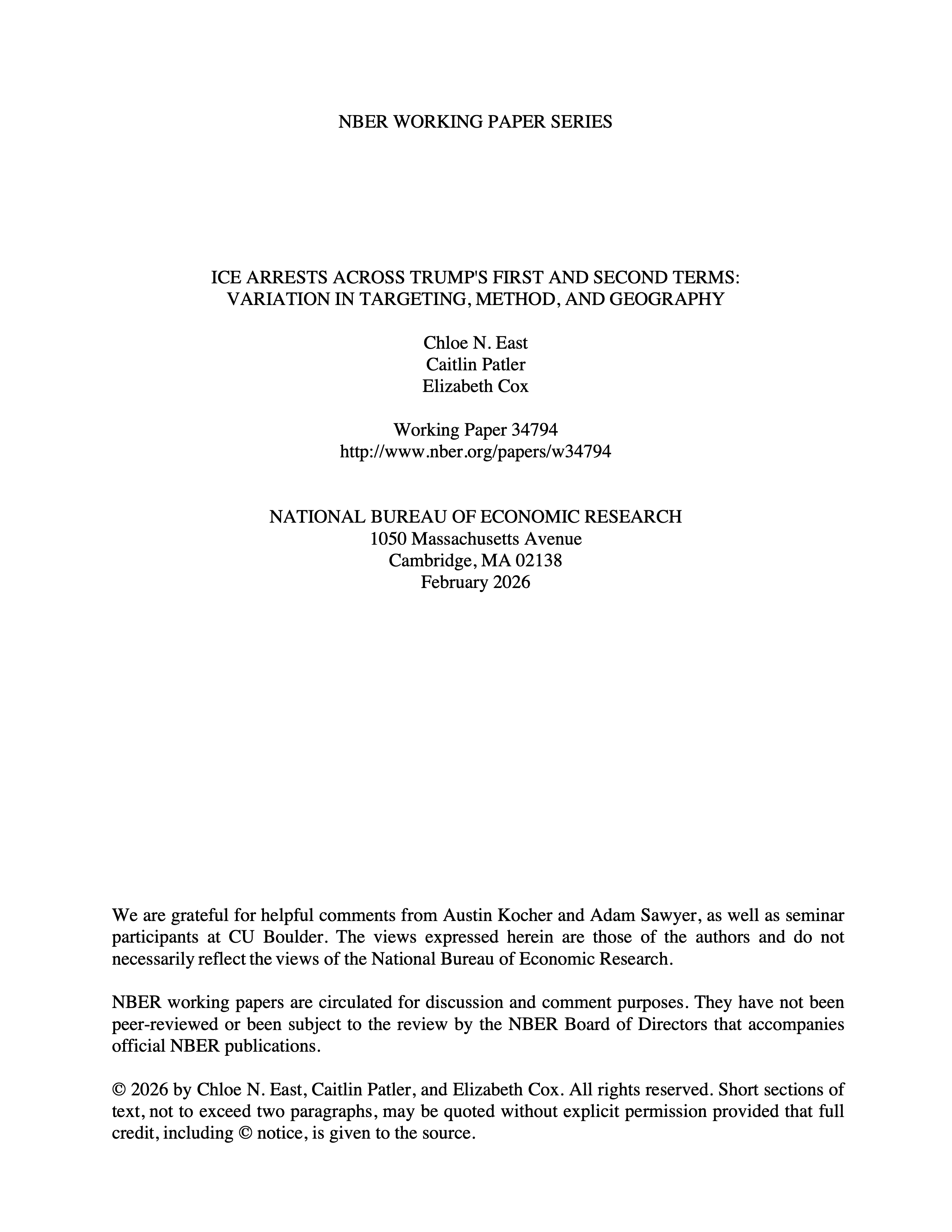
ICE Arrests across Trump’s First and Second Terms: Variation in Targeting, Method, and Geography
Chloe N. East, Elizabeth Cox and Caitlin Patler. NBER Working Paper, February 2026.
A lot of people have written over the past year about how immigration enforcement under Donald Trump’s second presidential administration has shifted away from people with criminal convictions.
I’ve written about this extensively myself, and this observation remains important. But it is also important to reproduce that analysis with greater academic rigor — which is exactly what this paper does — and to surface patterns in the data that have been missed, which it also does.
Using administrative data covering the complete universe of U.S. Immigration and Customs Enforcement arrests from 2015 through October 2025, this team compares the two Trump administrations directly to identify what is different between them statistically and what is driving the shift toward arresting people with less criminal history. Here are three key findings.
Some in the news media have touched on this topic, but what this team brings is the kind of rigorous, comprehensive data analysis that deepens our understanding of what is driving enforcement. Digging into the full universe of arrest data and comparing the two administrations side-by-side is exactly the kind of work we need more of right now.
Mass Deportation and the Intensity of Policing in the United States’ 100-Mile Border Zone
Geoff Boyce. Law & Policy, October 2023.
This paper was published before the current administration, but it may be one of the most important pieces you can read to understand what is happening right now. Boyce’s argument is that the familiar binary between “border” and “interior” enforcement obscures far more than it reveals.
Drawing on an expansive archive of internal government records obtained through Freedom of Information Act requests and court litigation, primarily I-213 arrest forms from Border Patrol sectors in Tucson, Arizona, Buffalo, New York and Detroit, Michigan, Boyce documents what enforcement looks like across parts of the 100-mile border zone.
As I recently argued on the Project Censored podcast, rather than thinking about enforcement in terms of where the border is, we should think about what the border does. Boyce’s work is essential to that reframing. He proposes an “intensity” framework: the volume, diversity, and networked interconnectivity of law enforcement institutions operating in a given area at a given time.
This helps explain why the arrival of Border Patrol agents in cities like Minneapolis and Chicago should not be understood as an aberration, but as an extension of a long-standing enforcement logic. The enforcement authority, racial profiling, and web of inter-agency cooperation that Boyce documents in border communities travel with those agents wherever they go.
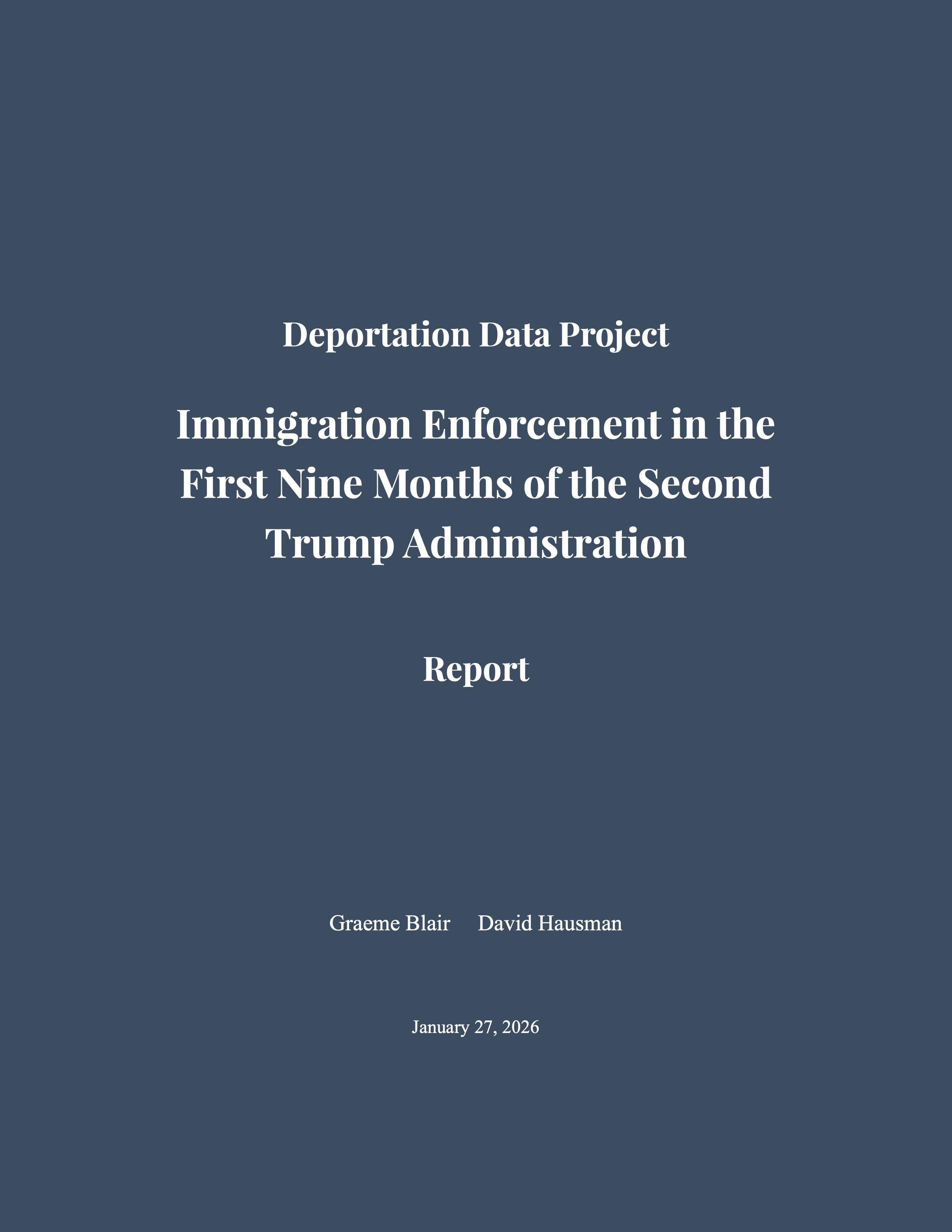
Immigration Enforcement in the First Nine Months of the Second Trump Administration
Graeme Blair and David Hausman. Deportation Data Project, January 2026.
The Deportation Data Project, based at the University of California, Berkeley, School of Law — in collaboration with the University of California, Los Angeles — has been one of the most important initiatives in the immigration space over the past year. Their core contribution has been making the data available in the first place.
Through repeated FOIA requests and litigation — they sued ICE when the agency failed to respond — they have obtained and published individual-level enforcement data that the administration has otherwise refused to share transparently. Without this project, we would have very little reliable information about what the Trump administration is doing on immigration enforcement.
It’s really valuable that the team fought to get this data and took the time to analyze it. Given their deep knowledge of the datasets — and the limitations of the data — this report provides an authoritative summary and analysis that will be useful to researchers, journalists, and anyone trying to understand the full picture of what has happened over the first nine months of the second Trump administration.
Still, the administration is not close to its stated goal of deporting one million people per year. At the most recent rate, the government would deport under 300,000 people annually. That is unprecedented in this century, but well short of the political rhetoric.
Immigration Detention Expansion in Trump’s Second Term
American Immigration Council. January 2026.
If the Deportation Data Project report gives you the numbers, this report from the nonprofit American Immigration Council — which advocates for immigrant inclusion in the U.S. — gives you the full picture: the policy architecture, funding pipeline, infrastructure buildout, conditions on the ground, and the human stories of people trapped inside the system.
It is, in my view, the definitive overview of what has happened to immigration detention during the first year of the second Trump administration.
While the overall numbers have been covered by many people at this point, some of the most valuable parts of this report are its observations about what kinds of detention facilities are being built, what is happening to people once they enter the system, and how bad conditions have gotten.
The report also documents the gutting of oversight. The Department of Homeland Security Office for Civil Rights and Civil Liberties was cut from 150 staff to 22, the Office of the Immigration Detention Ombudsman from 110 to 10, and Congressional surprise inspections have been effectively blocked.
This is an essential reference document.
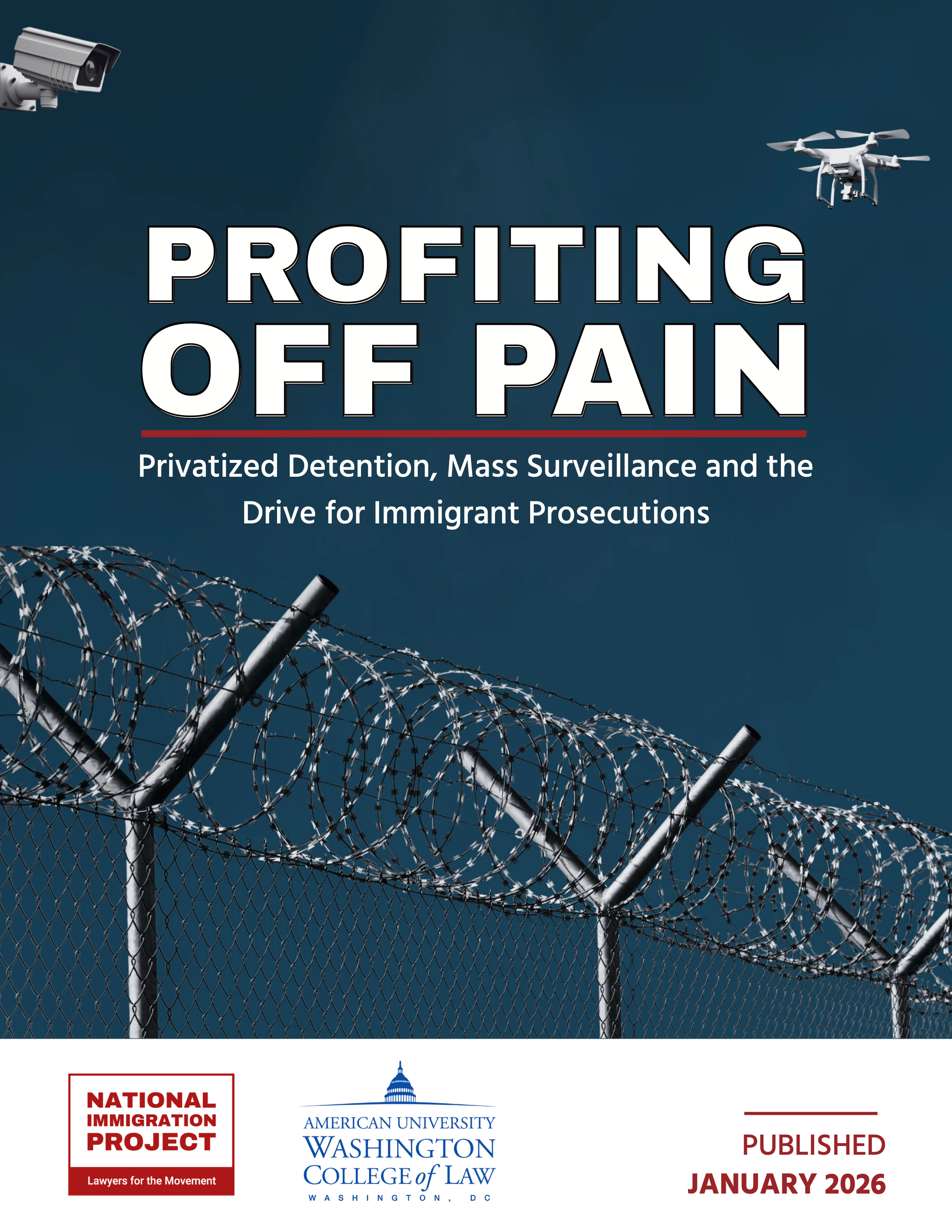
Profiting Off Pain: Privatized Detention, Mass Surveillance and the Drive for Immigrant Prosecutions
American University Washington College of Law, Immigrant Justice Clinic and the National Immigration Project. January 2026.
This is the report to pair with the AIC detention report above, and the distinction matters. The AIC report documents what is happening.
This one asks why the system exists, who built it, and who profits from it.
This is a report about a feedback loop: criminalization fills beds, filled beds generate profits, profits fund lobbying, lobbying produces more criminalization. The report also documents how the surveillance industry and the detention industry are converging, with companies like Anduril, Palantir and Amazon Web Services deeply embedded in the enforcement apparatus.
It flags the resuscitation of World War II-era provisions that criminalize failure to register with the federal government or to produce registration documents when stopped by a federal agent. Understanding this loop is essential to understanding why the detention system keeps growing regardless of which party is in power — and why the American Immigration Council’s projection of 135,000 beds is a business plan.
This report was produced with significant contributions from law students in American University’s Immigrant Justice Clinic, including Andrew Gamble, Kailey Kynast, Jack Murer, Junnah Mozaffar and Kimly Tran, supervised by Professors Jayesh Rathod and Chloe Sugino.
It is exactly the kind of clinic project that produces real impact. These students deserve recognition for the depth of research they helped pull together.
A Case for Reading DeeplyThanks to all of the authors and contributors to these five reports for helping us understand the immigration enforcement apparatus from a systemic and theoretically robust perspective. This kind of work takes months or years to produce, and it matters enormously.
One of my favorite books is Cal Newport’s “Deep Work.” His argument is that the ability to focus without distraction on cognitively demanding tasks is becoming both rarer and more valuable. I think about that a lot in the context of immigration.
The news cycle can exhaust you. Instead, you need to be able to put other things aside and focus on high-quality resources like the ones I have highlighted here. Print them out if you can, sit with them, read them top to bottom and read the footnotes. That is the kind of work it takes to develop a real understanding of these systems — and it is part of my case for reading deeply.
| # | Наименование новости | Тональность | Информативность | Дата публикации |
|---|---|---|---|---|
| 1 | Immigration enforcement | 0 | 5.46 | 24-03-2026 |
| 2 | RCFP asks federal court system to lift access restrictions on immigration records | 0 | 5.21 | 28-05-2026 |
| 3 | 7 questions & answers about immigration enforcement in Nebraska | 0 | 11.65 | 15-07-2025 |
| 4 | ICE Flouting Federal Judge’s Order to Stop Arresting Immigrants at New York Courts | -5 | 3 | 01-07-2026 |
| 5 | DOJ blocks public and press from accessing immigration courts, lawsuit alleges | 0 | 6.26 | 27-04-2026 |
| 6 | Green card holder faces deportation in harsh immigration system shift | -2 | 6 | 09-07-2026 |
| 7 | ICE arrests 10,000 in 5 days, a sharp late-June surge in Trump's deportation push | 0 | 11.77 | 03-07-2026 |
| 8 | The Supreme Court Undermines Immigrant Rights | 0 | 11.48 | 06-07-2026 |
| 9 | Trump admin's hardline deportation policy an 'attempt to break the global refugee and asylum system' | 0 | 8.38 | 22-09-2026 |
| 10 | Border Report Live: Watchdog group calls for more oversight of ICE, DHS, detention centers | 0 | 5 | 11-07-2026 |