Просмотр новости
Найдите то, что Вас интересует
 Спутники
 РН
РН SpaceX
 Роскосмос
 NASA
NASA
СпутникиРНSpaceXРоскосмосNASAToday's state income tax cutting is defined less by sweeping one-time reforms than by sustained campaigns to ratchet down income tax rates year after year. This approach enables lawmakers to enshrine significant long-term reductions into law, while obscuring the fiscal impact by spreading it across multiple state budgets and legislative cycles.
Americans broadly agree that the richest households should pay more in taxes. Yet this decade has brought a surge of state tax cuts for the rich, often in the form of reductions in top personal income tax rates. These cuts have come at a cost to public services and in some cases have been offset by increases in sales and property taxes that fall more heavily on families that aren’t wealthy.
Today, the median state has a lower top corporate (5.9 percent) and personal (4.6 percent) income tax rate, and a higher sales tax rate (6 percent) than it did in 1990 when those rates were 7.2, 6, and 5 percent, respectively. Over this period the frequency of income tax cutting has outpaced tax raising by nearly three to one, and the downward trend in income tax rates has accelerated in recent years. (It bears noting, however, that the tax cutting states have tended to have lower populations than the tax-raising states, so tallying up the number of states choosing one course or another has its limitations.) The median top income tax rate fell 1.4 percentage points since 1990, but half of that reduction has occurred this decade when the rate fell from 5.3 percent in 2020 to 4.6 percent today.
So far this decade, states have cut their top personal income tax rates 71 times, setting a record as the most active period of such cuts in state income tax history—and the decade isn’t over yet. If states continue to cut at the same pace, we could see over 100 cuts to top state income tax rates in the span of just 10 years.
Figure 1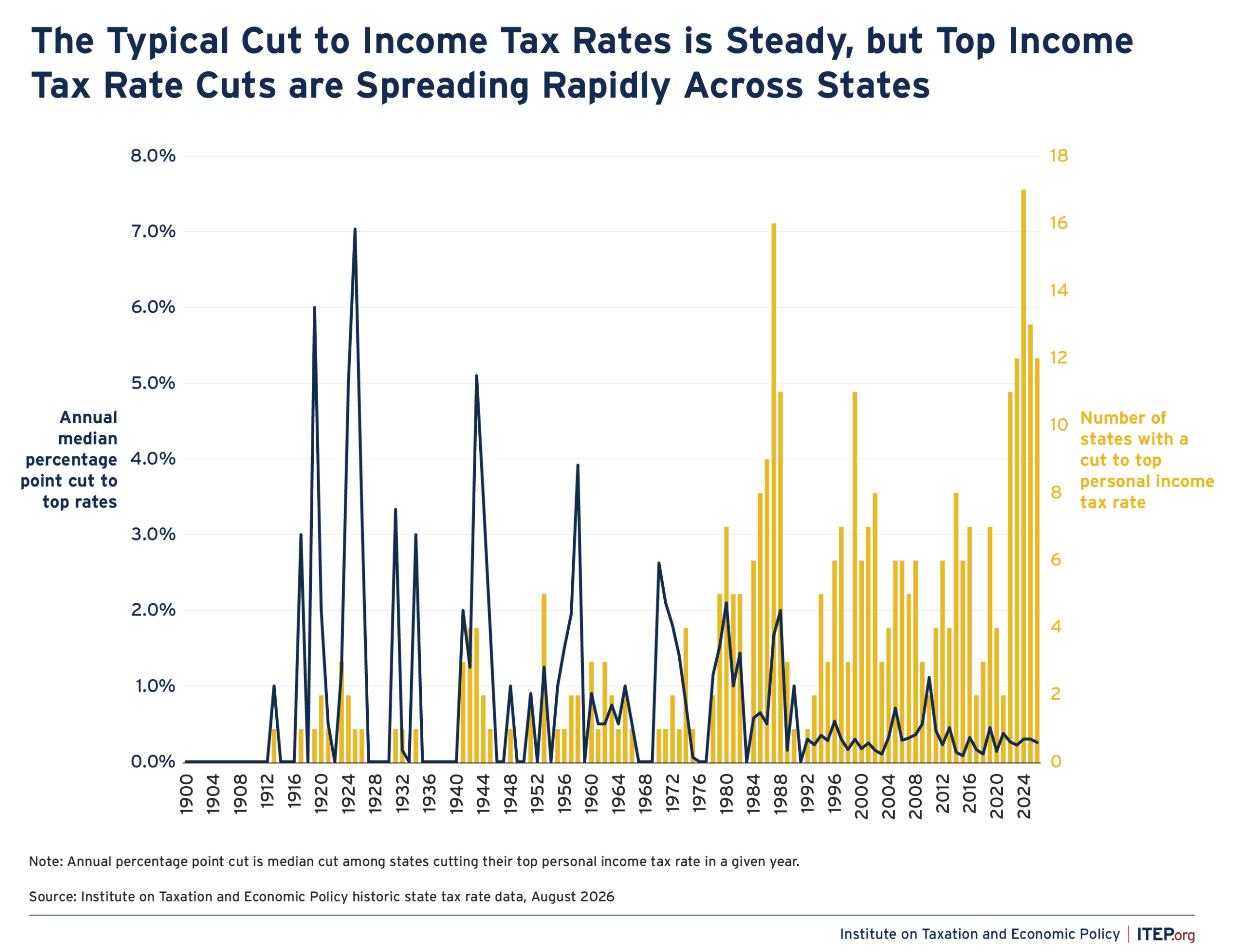
The next most active decade for income tax cuts was the 1980s, when states cut their top income tax rates 70 times. This flurry of tax cutting came about partly because state linkages to federal tax reforms enacted in 1986 substantially expanded state tax bases, and many states cut income tax rates in the latter half of the decade to avoid a surge in tax revenue.
The nature of state income tax cutting today is markedly different.
For one thing, the most recent changes in federal law actually narrowed the tax base both federally and for conforming states, while also forcing new costs onto states in areas like food assistance and health care. Unlike the 1980s, recent changes at the federal level point toward states needing to pursue higher tax rates, not lower ones.
Moreover, some state lawmakers have set their sights on long-range and dramatic income tax cuts, not just reforms that trade a broader base for a lower rate. Today’s tax cutting landscape is dominated by frequent, repeated cuts that come at the expense of state budgets.
While the typical size of state income tax rate cuts has remained fairly consistent (at about a third of a percentage point) over the last four decades, the frequency with which states have implemented rate cuts has noticeably increased, our analysis of ITEP’s historical tax rate data shows. Since 2020, 16 states have cut their top income tax rate three or more times, roughly twice as many as any other decade.
Figure 2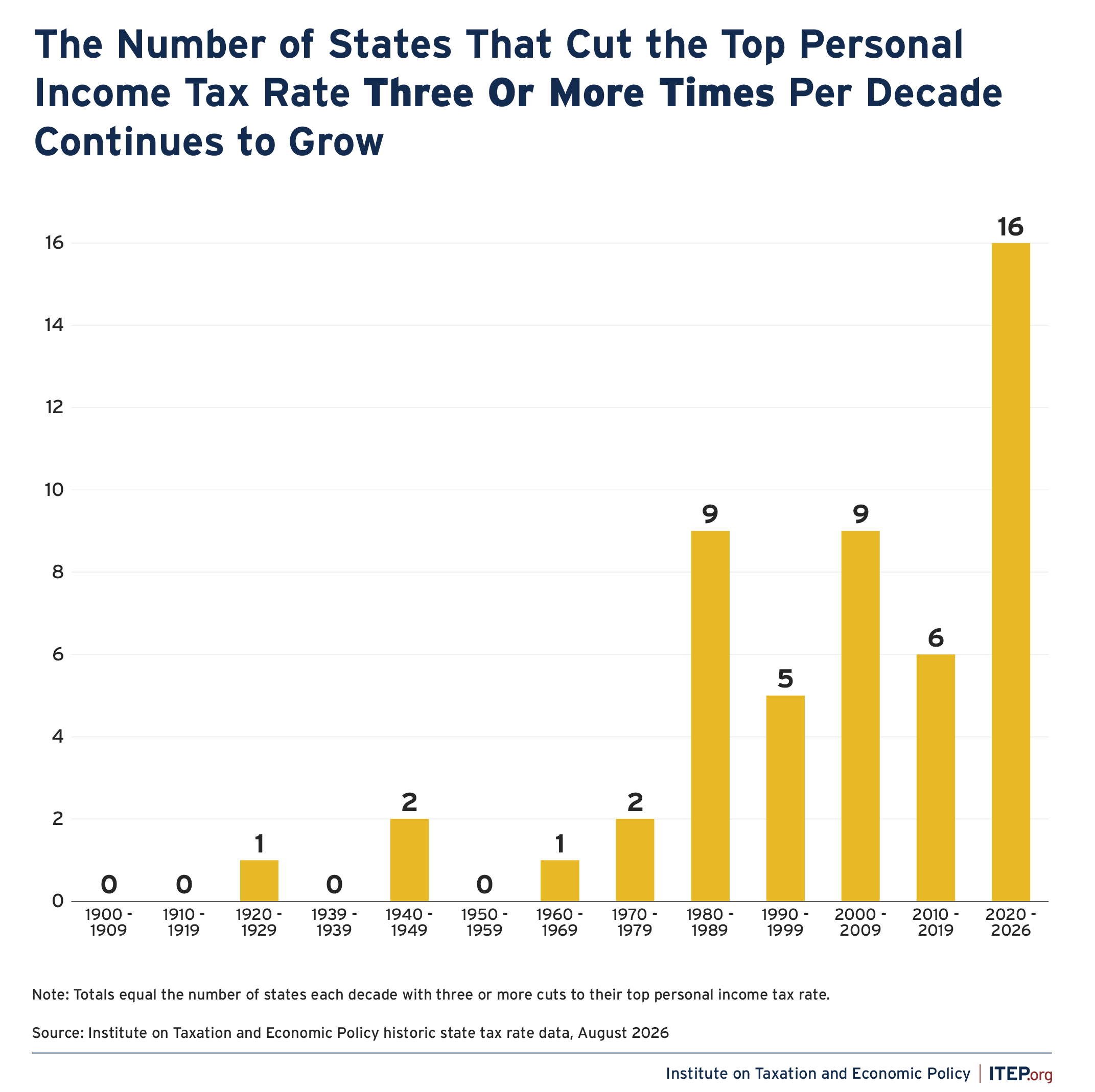
Many states have enacted these multi-year rate cuts through phase-ins and triggers, often at the urging of anti-tax and corporate-backed groups such as ALEC, Americans for Prosperity, and the Tax Foundation.
Phased-in tax cuts take effect according to a set schedule while tax cut triggers are typically contingent on the state meeting simplistic revenue milestones. A fundamental problem that plagues both policies is they set in place future tax cuts without having full knowledge of future state budgeting needs or economic conditions when the tax cuts take effect.
State lawmakers rarely have access to estimates of budgeted costs more than a year or two into the future. Even when triggers are based on revenue projections, most states base them only on one year of data. This can cause poorly timed tax cuts, as small rebounds in state revenues after a recession, or even just high inflation, can trigger tax cuts even if state costs are high and reserves are depleted. Phased in and triggered tax cuts also push the bulk of the cost of tax cuts into future years and off the balance sheets for budgeting purposes—a convenient strategy in the short term for state lawmakers who are only constitutionally bound to balance their budgets for the coming year or two.
Overall, the rise of multistage tax cuts has produced larger total tax cuts than lawmakers could afford to pass in a single budget cycle and has pushed the thorny decisions of which services to cut onto future legislatures. And while those lawmakers could choose to repeal the tax cuts, it is politically difficult to repeal a tax cut that has already been promised. Moreover, many states have supermajority requirements for passing laws that raise tax revenue, making it even harder to undo the harms after they have been set into motion.
Figure 3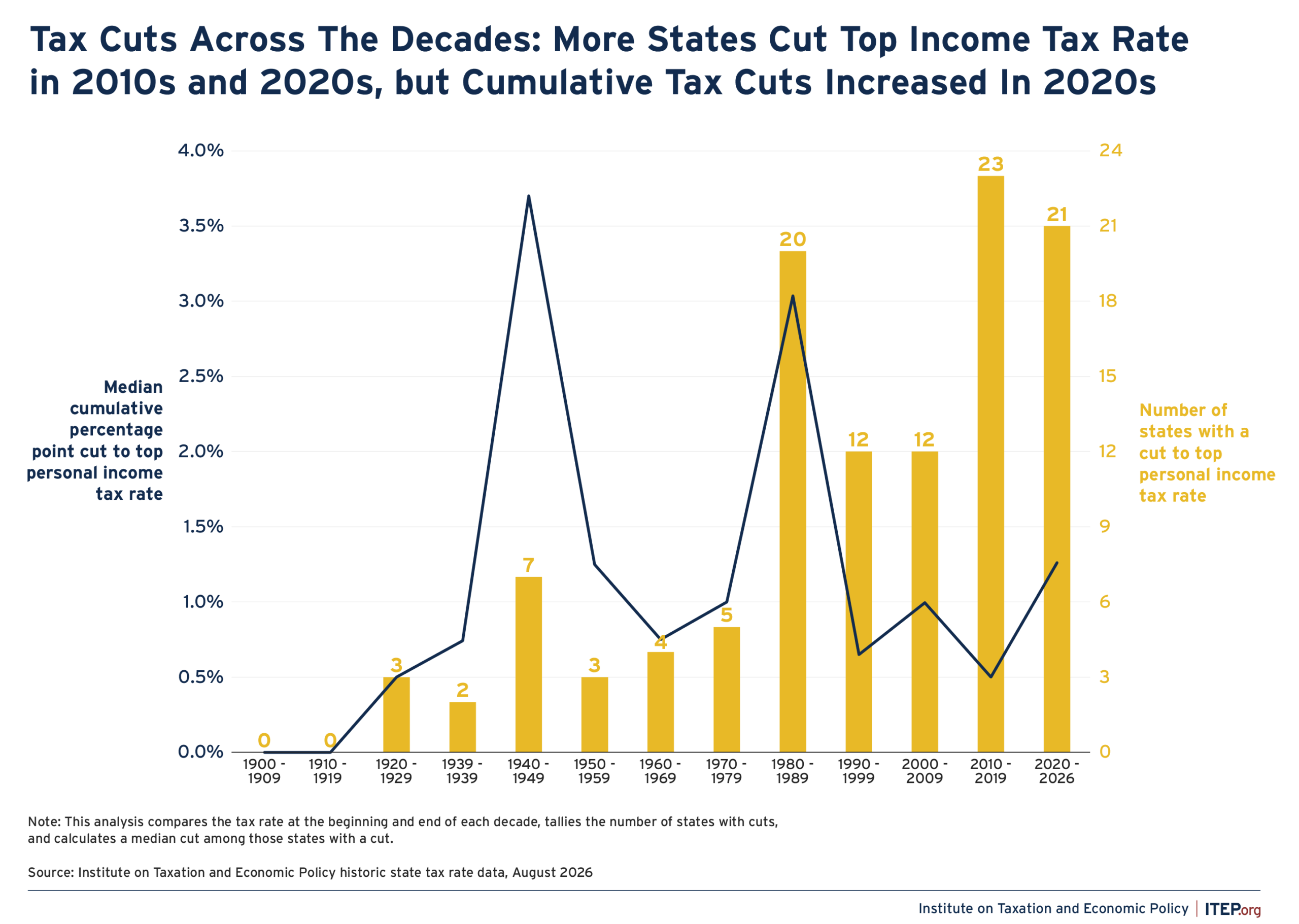
These repeated cuts have produced much larger overall top rate reductions than the annual tax reduction figures suggest on their own and have resulted in major cuts to services in states adopting these measures like in Georgia, Kentucky, Louisiana, Missouri, North Carolina, Nebraska, and West Virginia. While some of these cuts have been steep and severe, they can also sometimes resemble a frog in boiling water, with services gradually degraded in a way that is less politically explosive than sudden and drastic service reductions—even if the end result is the same.
Comparing top income tax rates from the beginning and end of each decade makes the magnitude of overall tax cutting more apparent, even if it has sometimes been obscured by the incremental way in which these cuts were rolled out. So far, among states that have cut their top personal income tax rate, the 2020s have produced a median cumulative reduction of 1.3 percentage points—an amount significantly higher than any of the previous three decades, and more than double the median reduction of 0.5 percentage points from the decade prior. Meanwhile, the number of states cutting top rates within the decade for the 2010s and 2020s is nearly double the number of states that cut rates during the 1990s or 2000s. In other words, what distinguishes recent tax cutting trends is the persistence of tax cutting and the cumulative impact of those cuts, with repeated rate reductions racking up to big tax cuts for those with high incomes.
Today’s state income tax-cutting is defined less by sweeping one-time reforms than by sustained campaigns to ratchet down income tax rates year after year. This approach enables lawmakers to enshrine significant long-term reductions into law, while obscuring the fiscal impact by spreading it across multiple state budgets and legislative cycles.
This shift in strategy among anti-tax forces has almost certainly resulted in much larger cumulative tax cuts than would have been possible by trying to move new tax-cutting bills during each legislative session. But this “leap before you look” strategy has predictably failed to deliver the economic gains that tax opponents often tout, and has instead left communities struggling to fund education, infrastructure, healthcare, and other essential needs.
| # | Наименование новости | Тональность | Информативность | Дата публикации |
|---|---|---|---|---|
| 1 | По итогам года у нас будет 10 тысяч школ с инклюзивным образованием – Васильева | 0 | 0 | 10-12-2018 |
| 2 | Антон Чиж Машина страха Рецензия на книгу Антона Чижа «Машина ... | 0 | 0 | 21-02-2025 |
| 3 | Багаевская: Утро 18 дек, Вт | 0 | 0 | 17-12-2018 |
| 4 | Агидель: Ночь 20 дек, Чт | 0 | 0 | 19-12-2018 |
| 5 | 🔥 Кризис на подходе: Киев и Вашингтон на грани разрыва ... | 0 | 0 | 21-02-2025 |
| 6 | На четырех рязанских улицах отключат свет | 0 | 0 | 10-02-2020 |
| 7 | В Петербурге при столкновении четырех машин погиб один человек | 0 | 0 | 14-03-2019 |
| 8 | Rilevazione MEF/ISTAT 2023: in rete i risultati del Programma di razionalizzazione degli acquisti | 0 | 0 | 25-10-2024 |
| 9 | Что будет с нашим космосом? (часть 6) (#20225) | 0 | 0 | 10-08-2019 |
| 10 | Князья полярных войн Россия сама по себе страна северная, с ... | 0 | 0 | 06-04-2024 |