Просмотр новости
Найдите то, что Вас интересует
 Спутники
 РН
РН SpaceX
 Роскосмос
 NASA
NASA
СпутникиРНSpaceXРоскосмосNASAMaine is rolling out Workforce Pell, a program that will allow students to use federal grant money for workforce training programs lasting 8 to 15 weeks.
 Marcus Byers practices creating beads while stick welding at York County Community College in Sanford on Aug. 25. (Gregory Rec/Staff Photographer)
SANFORD — On a Tuesday morning in late August, the accelerated welding class at York County Community College was humming along. Two students were lying on the floor, finding the right angle to weld pipes like those on nuclear submarines.
Others worked at their individual workstations, cubicle-type spaces outfitted with a workbench, stool, vent and thick red plastic curtain. Large industrial fans whirred, and bright yellow sparks hit the cement and bounced upward.
The students are in a 10-week course that could soon qualify for a new source of federal financial aid.
Maine is preparing to roll out a program that will expand students’ access to Pell Grants, allowing them to use the funding for courses that are a minimum of eight, rather than 15 weeks.
Historically, most of the tens of billions of dollars the federal government allocates annually to Pell has gone to students seeking associate or bachelor’s degrees. The Trump administration’s 2025 rule change opens those funds to students pursuing shorter-term workforce training.
Workforce Pell comes at a moment of national upheaval for higher education. During his second term, Trump has made drastic efforts to reshape higher education in the United States, including by punishing institutions that don’t align with the administration’s priorities by withholding funding and threatening litigation, and dismantling the U.S. Department of Education.
At the same time, colleges in Maine and around the country are struggling to stay solvent amid declining enrollment and, as inflation bears down on stagnant wages, people are questioning whether the cost of a traditional college degree is worth its potential benefits.
Workforce Pell nods to these concerns, but some question whether it will be enough to create a more equitable higher education system or will leave some with credentials that do little to improve their economic situations.
The federal Workforce Pell program officially took effect on July 20, but the implementation is likely to happen slowly over the next few years.
The rollout process is complicated — requiring states to write multiple policies, coordinate across state agencies, collect new types of data and create accreditation processes. Institutions must also build new or tweak existing programs to comply with Workforce Pell parameters and run them for a year so they can collect post-training employment data required to apply for Workforce Pell.
On Aug. 12, the state started taking applications from schools that would like students to be able to use Workforce Pell for their programs.
The Maine Workforce Development Board will review applications quarterly and make certification recommendations to the governor. The federal government will then make final decisions on program approval.
The Maine Community College System said it isn’t ready to submit any programs this round but plans to do so in the next round of reviews in December. As of Sept. 2, two programs — one in Indiana and one in Iowa — have been approved.
Maine already has a robust offering of free, short-term workforce training programs, funded largely by a grant from the Harold Alfond Foundation, a nonprofit that funds education, healthcare and community development in Maine.
Because of this, the introduction of Workforce Pell is likely to have a less immediate financial impact on individual students. However, it will allow education resources to be spread further as federal funds offset some costs and provide a long-term, sustainable source of funding for short-term workforce training. The Alfond workforce funding is expected to expire by June 2030.
Bella Marin struggled in high school. Each time she started a new semester, she felt a jolt of motivation and would gear up to learn. But then, things would go downhill, said the 19-year-old. She didn’t understand what she needed to, had trouble getting support from her teachers and fell behind.
But in the welding class at York County Community College, school started to click.
“Being in a hands-on facility, I understand things better,” she said.
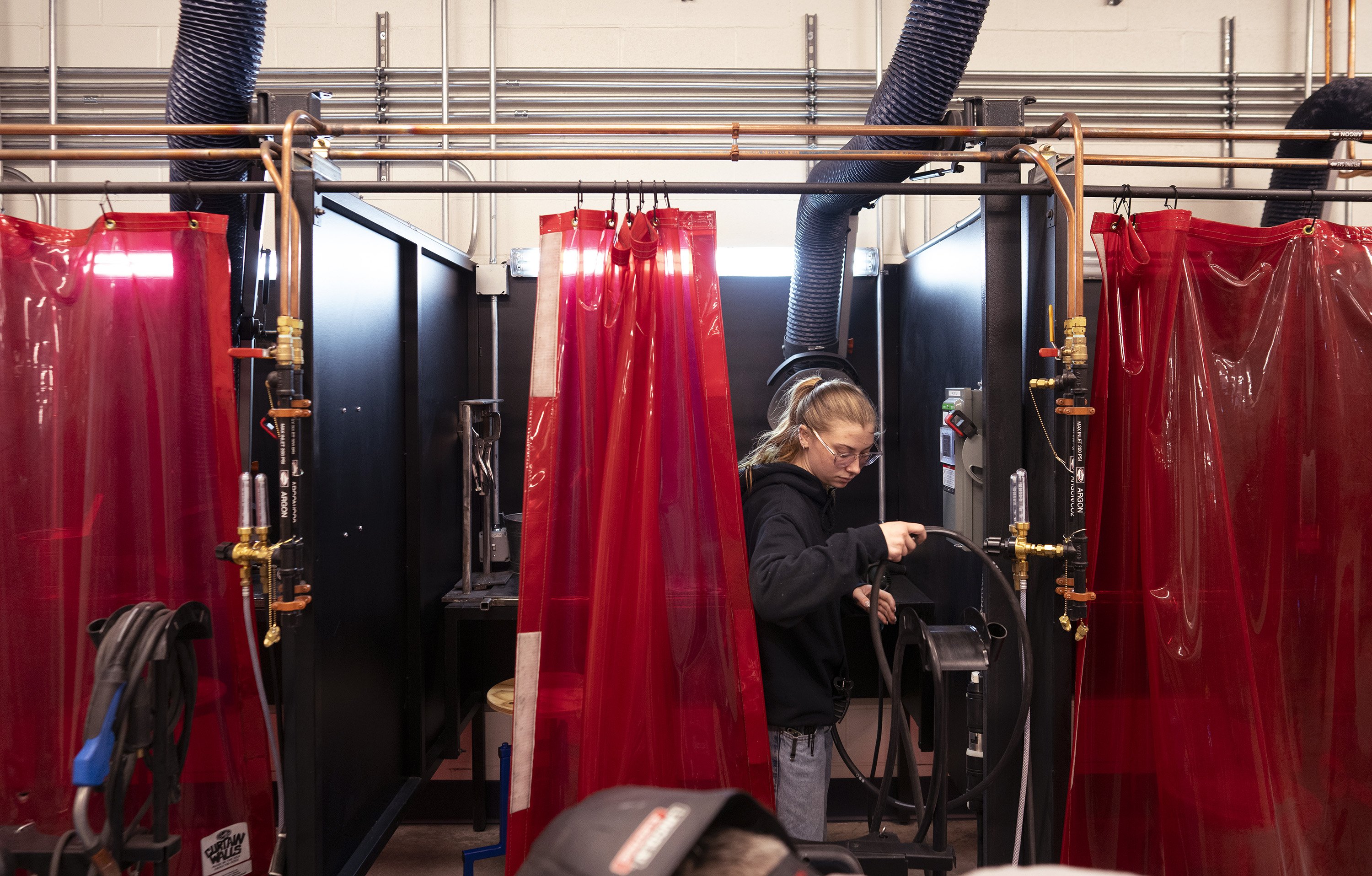 Bella Martin sets up a work station to practice tig welding at York County Community College’s Center for Excellence for Manufacturing and Trades in Sanford on Aug. 25. (Gregory Rec/Staff Photographer)
Purchase this image
Bella Martin sets up a work station to practice tig welding at York County Community College’s Center for Excellence for Manufacturing and Trades in Sanford on Aug. 25. (Gregory Rec/Staff Photographer)
Purchase this imageIn late August, Marin was just a few days away from finishing the 10-week welding course. She moved around the large, airy workspace with confidence.
She appeared at ease as she pulled a protective hood down over clear glasses and got to work perfecting a metal joint. Her face lit up and her hands moved animatedly as she talked about the different rates of energy and types of gases needed for different types of welding. She beamed as she presented the electric blue painted metal stool she built.
“It feels nice to know that it’s not that I don’t like school,” she said. “I do want to learn. I definitely think I have gained more confidence knowing I do have the ability to learn new things. I feel prepared for bigger things in life.”
Workforce Pell is a rare federal education policy that nearly everyone is behind. The consensus is that low-income students interested in learning a trade, like welding, deserve the same federal financial support as those seeking an associate or bachelor’s degree.
“What’s really cool about this is that it’s another avenue for individuals to access resources to help support their skills development,” said Dan Belyea, who was part of Maine’s Workforce Pell Advisory Committee and is the chief workforce development officer for Maine’s community colleges.
Allowing students to use Pell money for workforce training makes the nation’s higher education system fundamentally more equitable, said Colby College education professor Adam Howard.
But there’s some nuance.
“The real question is whether these programs lead to good wages, further education and greater choices over a longer period of time,” said Howard.
Pell Grants are available to all low-income students, a status determined by filling out a federal financial aid application.
For the 2024-25 school year, the federal government doled out $38.6 billion in Pell Grants to 7.3 million students. In Maine, roughly $140.6 million went to more than 30,000 students.
This year, the maximum Pell grant is $7,395 for two full semesters. The amount a student qualifies for is based on their need. The amount distributed is based on how many hours of classes they take. Students can use Pell to cover up to 12 full semesters, or around 180 weeks of classes.
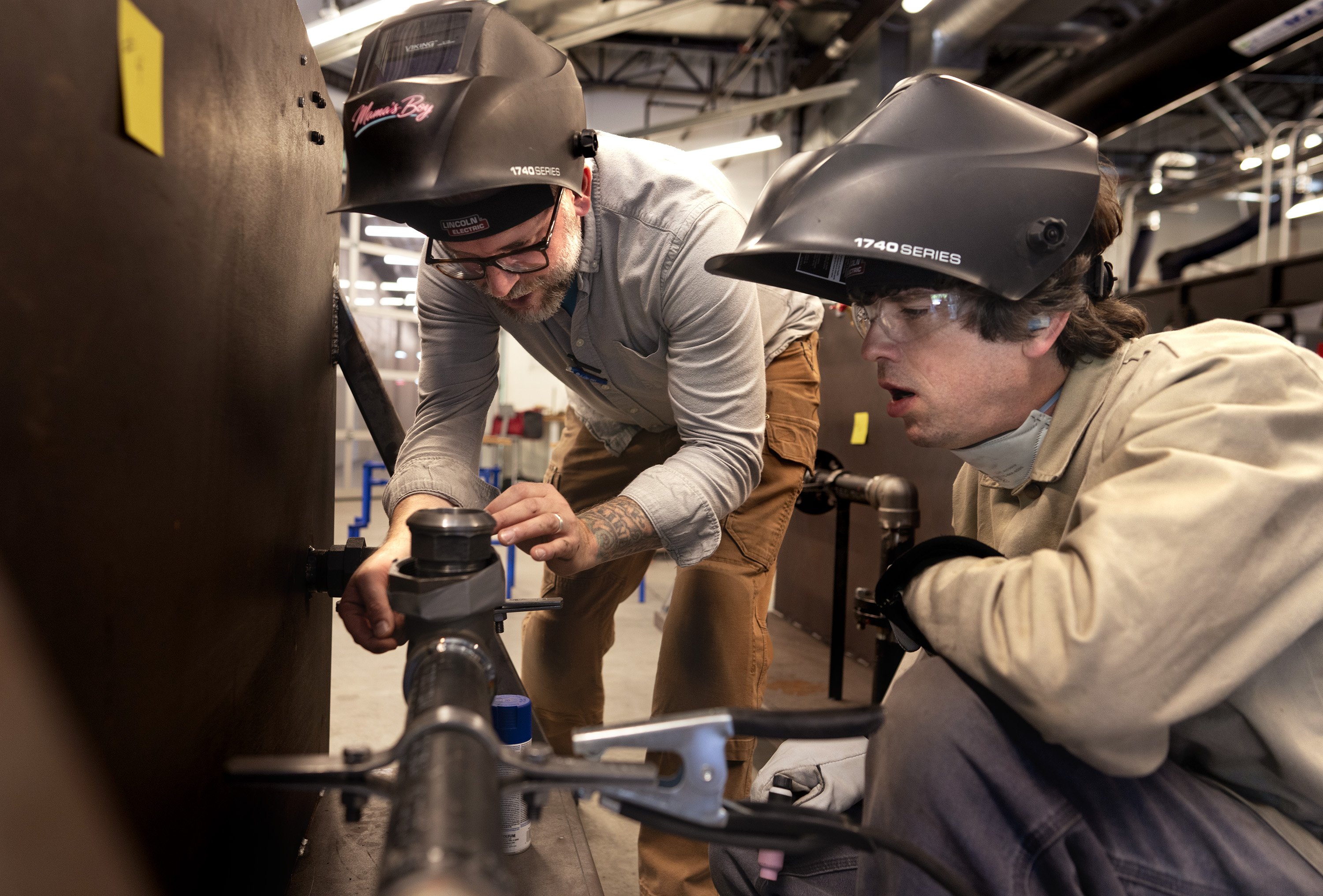 Instructor Michael Aaskov talks with Marty McCue about a pipe fitting that McCue is about to weld. (Gregory Rec/Staff Photographer)
Purchase this image
Instructor Michael Aaskov talks with Marty McCue about a pipe fitting that McCue is about to weld. (Gregory Rec/Staff Photographer)
Purchase this imageHoward said this is a notable footnote. While he is confident that short-term credentials can help students get started, he questions whether they will provide significant upward economic mobility, especially if students use their resources earlier and are left with more limited financial support if they eventually decide to seek more costly degrees.
“Short-term credentials can be a ladder or a cul-de-sac,” he said.
For a program to qualify for Workforce Pell, it must be deemed “high-skill,” “high-wage” or “in-demand.” Programs that could fall within those bounds include those preparing students for careers in childcare, medical assistants and trucking.
Programs must also be able to be combined with other courses to lead to larger credentials. The idea behind these guardrails is to protect against career stagnation.
But Howard still has concerns.
“An in-demand job is not necessarily a good job, he said. “I’m skeptical that these programs lead to better economic opportunities for individuals. I think they’re meeting the demand of employers.”
Michael Aaskov, the York County Community College welding instructor, explains to his students that they might not be welders forever, but that this program can serve as the beginning of a career path that could lead them to work in fabrication, estimation or engineering.
“This program provides direction,” said Aaskov. “It serves as an inflection point.”
Welding student Marin never considered attending a four- or two-year program. She knew it wouldn’t be for her, she said, and she’s proud that she’s finding her way into a career without forcing herself through a process she doesn’t think would have served her.
In late August, she accepted a job from Casco Bay Steel, where she will build metal pieces for bridges for $25 an hour. Before joining the welding program, she made $18 an hour working in childcare.
“It blows my mind,” said Marin. “That one day I could be driving on a bridge I helped build.”

