Просмотр новости
Найдите то, что Вас интересует
 Спутники
 РН
РН SpaceX
 Роскосмос
 NASA
NASA
СпутникиРНSpaceXРоскосмосNASANASA's Perseverance rover has found evidence of ancient complex water systems on early Mars, including hot hydrothermal activity.
The post Water systems on early Mars were complex and hot first appeared on EarthSky.
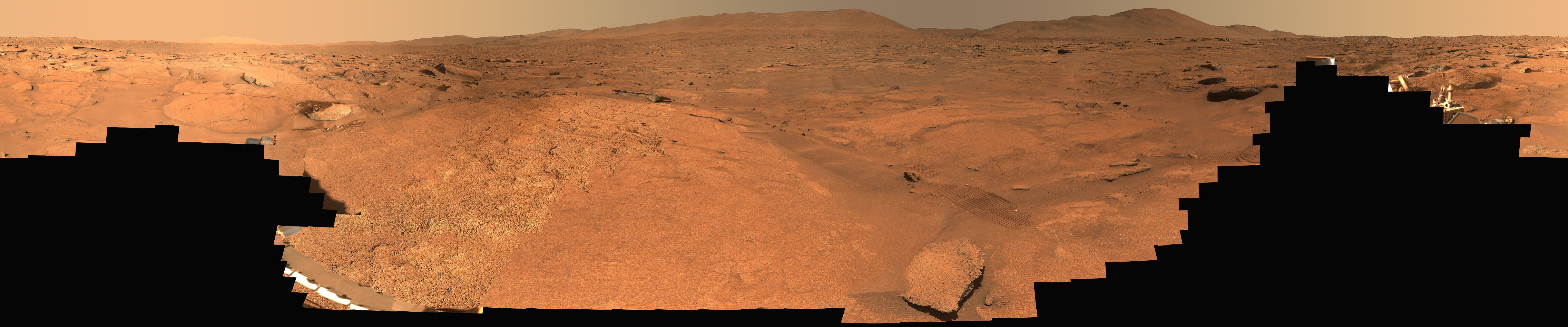
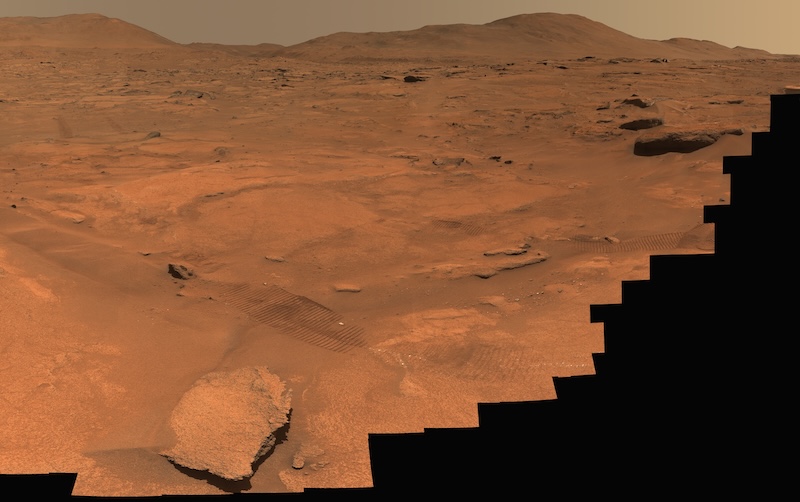 View larger/ full image. | Partial view of the Margin Unit in Jezero crater on Mars. The Perseverance rover has found evidence for complex, long-gone water systems in this location. Image via NASA/ JPL-Caltech/ MSSS.
Mars is a dry planet now, but it was once awash in water. That includes Jezero crater, where the Perseverance rover is still exploring. Perseverance has already found ample evidence that the crater used to be a lake with rivers emptying into it. And now, scientists have found that the water system in Jezero crater was even more complex than previously thought.
Led by Purdue University in Indiana, the researchers said on September 21, 2026, that a region in the crater called the Margin Unit was shaped by a complex sequence of ancient lakes, groundwater systems and hydrothermal fluids.
The Margin Unit is along the shoreline of the ancient lake. The rover explored across about 870 feet (265 meters) of elevation on the Margin Unit.
The new peer-reviewed findings were published in Communications Earth & Environment on September 21, 2026.
An unexpected discoveryBefore Perseverance landed in Jezero crater, scientists had expected to find sedimentary rocks at the landing site. These rocks would be composed of sand, clay and silt. They are great at preserving traces of ancient microbial life. But the researchers were in for a surprise. The rocks were not sedimentary, but igneous, which form from volcanic activity.
Igneous rocks can preserve details about minerals, how they formed and interactions with water. And it’s in these rocks that Perseverance found the clues to a complex water system in the past. The rover used its SuperCam instrument to analyze the rocks and determine their composition.
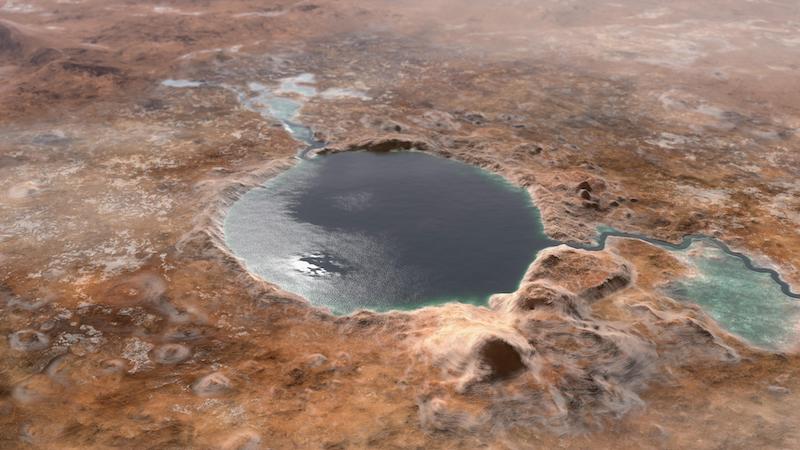 Jezero crater used to be a lake billions of years ago. Image via NASA/ JPL-Caltech.3 separate water episodes
Orbiting spacecraft have detected minerals known as carbonates in Jezero crater. And these carbonates are a key to this new discovery. As lead author Candice Bedford at Purdue University explained:
Before we arrived at the Margin Unit, the main hypothesis — derived from orbital observations — was that the carbonate seen from orbit formed from interaction with the lake that existed in Jezero crater. But now we know that this location became a sort of crossroads for aqueous systems. The Margin Unit findings are important because Jezero crater sits inside one of the largest exposures of carbonate on Mars, so what we learn here reaches well beyond this crater.
The rover has found that the rocks interacted with water on three primary occasions.
In the first episode of water interaction, carbon-dioxide-rich groundwater reacted with olivine. This formed ridges of carbonate that run through the fractures in bedrock at low elevations. Those ridges are still there today.
The second episode involved water from the former lake. Co-author Eleni Ravanis, a planetary scientist at the University of Hawaii at Manoa, said:
Early water systems on Mars included hydrothermal activitySome of the Margin Unit rocks also contain silica. Turning olivine into carbonate can leave silica behind, and we see more of that silica in rocks that sat below the water line.
The final water episode created mineral veins at one location in the eastern part of the Margin Unit. They are about 10 inches (25 centimeters) thick and contain minerals like calcium sulfate and fluorite. This finding is particularly interesting, since it indicates that hydrothermal fluids — hot water — once flowed through the rocks.
As is almost always the case, there are surprises waiting when you are exploring another world. As Bedford summarized it:
If there is one thing I have learned after 10 years working with Mars rovers, it is that Mars constantly throws surprises at you. It is very rare that things are as we expect them to be from orbital data. I hope this work helps reshape how scientists view the history of water in Jezero crater and across Mars. Ultimately, I hope it helps planetary scientists reconstruct the changing climate and habitability of early Mars.
 Candice Bedford, a research scientist at Purdue University, led the new study about water systems on Mars. Image via Purdue University.Subsurface olivine
Another notable discovery was that of olivine. At higher elevations in the Margin Unit, the rocks were course-grained and crystalline. That’s evidence for the mineral olivine. Plus, it was untouched by water. Instead, the olivine formed in a body of hot magma underground. It then gradually cooled. It was exposed on the surface when the ground above it eroded away.
Lower down in the Margin Unit, the olivine grains have silica between them. And interestingly, the carbonate and silica are important clues to possible past microbial life. On Earth, when water interacts with olivine, the reaction can release hydrogen, which can be a food source for some microbes. And it leaves behind carbonate and silica, two minerals that can preserve traces of the ancient microbes.
Last year, researchers in France also reported finding evidence for ancient hydrothermal systems in Jezero crater.
Bottom line: NASA’s Perseverance rover has found evidence of ancient complex water systems on early Mars, including hot hydrothermal activity.
Read more: Perseverance rover reveals history of ancient habitable lake
Read more: Curiosity rover insights after 5000+ sols on Mars
Paul Scott Anderson has had a passion for space exploration that began when he was a child when he watched Carl Sagan’s Cosmos. He studied English, writing, art and computer/publication design in high school and college. He later started his blog The Meridiani Journal in 2005, which was later renamed Planetaria. He also later started the blog Fermi Paradoxica, about the search for life elsewhere in the universe. While interested in all aspects of space exploration, his primary passion is planetary science and SETI. In 2011, he started writing about space on a freelance basis with Universe Today. He has also written for SpaceFlight Insider and AmericaSpace and has also been published in The Mars Quarterly. He also did some supplementary writing for the iOS app Exoplanet. He has been writing for EarthSky since 2018, and also assists with proofing and social media.
| # | Наименование новости | Тональность | Информативность | Дата публикации |
|---|---|---|---|---|
| 1 | Тайны Красной планеты: ровер НАСА раскрыл сложную историю воды на Марсе | 0 | 9.32 | 27-09-2026 |
| 2 | Марсоход Curiosity обнаружил на Марсе следы древней песчаной бури, бушевавшей ... | 0 | 5.74 | 01-10-2026 |
| 3 | Астробиологи рассказали, где искать жизнь на Марсе | 0 | 8.1 | 16-05-2026 |
| 4 | Новое геохимическое моделирование, проведённое исследователями JAXA и Токийского университета, объясняет, ... | 0 | 5.55 | 28-09-2026 |
| 5 | «Новая китайская карта Марса нового поколения, чтобы сделать китайскую программу ... | 0 | 6.18 | 29-09-2026 |
| 6 | 🔴 Марс хранит тайны, которые раскрываются буквально под колёсами ровера! ... | 0 | 7.19 | 30-09-2026 |
| 7 | 3D-printed Martian mud homes look critical for life beyond Earth | 0 | 10.85 | 26-09-2026 |
| 8 | Perseverance впервые сам определил координаты на Марсе 📍 Марсоход Perseverance ... | 0 | 8.69 | 27-09-2026 |
| 9 | NASA случайно ударило по Марсу обломками спускаемого аппарата и получило ... | 0 | 7.17 | 27-09-2026 |
| 10 | El Desierto de Tabernas, Marte en la Tierra | 0 | 7.28 | 01-10-2026 |