Просмотр новости
Найдите то, что Вас интересует
 Спутники
 РН
РН SpaceX
 Роскосмос
 NASA
NASA
СпутникиРНSpaceXРоскосмосNASAResearchers in Ireland have found a new way to decode the weather on exoplanets. They started with the planetary-mass object SIMP 0136.
The post Weather on exoplanets: Decoding the atmosphere of SIMP 0136 first appeared on EarthSky.
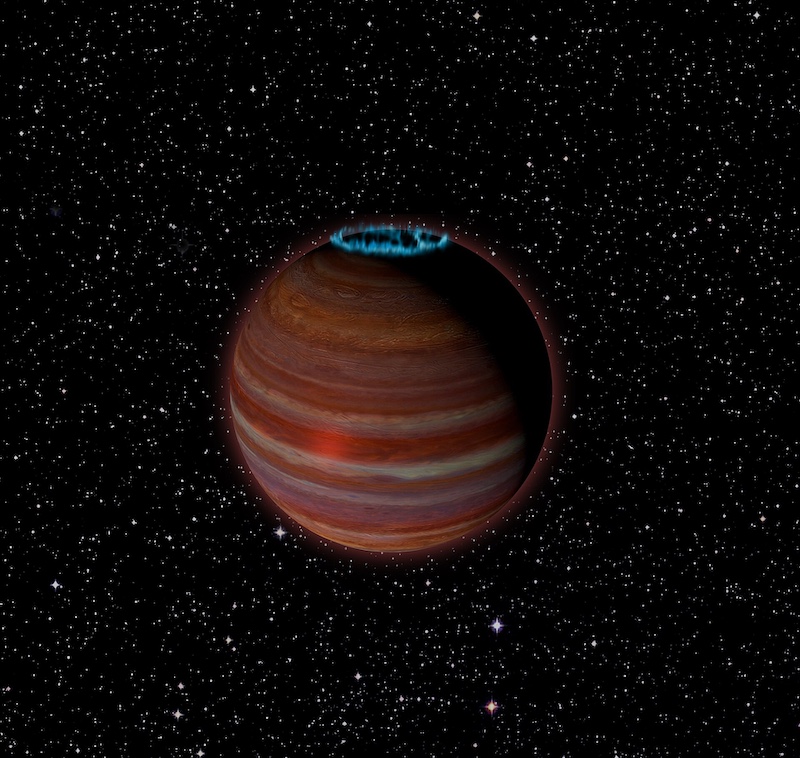 Artist’s concept of SIMP 0136. Researchers at Trinity College Dublin have found a new way to study the weather on this world and exoplanets. They used this object as an early target to test their technique. Image via Chuck Carter/ Caltech/ NRAO/ AUI/ NSF/ Wikipedia.
Astronomers said this month (September 15, 2026) they’ve found a way to decode weather on exoplanets. They used a new technique to look at a planetary-mass object called SIMP 0136. They found its weather is shaped primarily by changes in temperature and the vertical structure of its clouds.
Exoplanets are worlds orbiting distant stars. A few decades ago, we hadn’t directly detected any. But today, using a variety of techniques, astronomers know 6,000+ exoplanets. They are all extremely far away, light-years beyond our solar system. And so they’re difficult to study. The researchers — at Trinity College Dublin in Ireland — said they used the James Webb Space Telescope (JWST) for their observations.
They said other astronomers can also use the new work to study exoplanet weather. So, will this new technique open a door to our understanding of other worlds?
The new peer-reviewed findings were published in Astronomy & Astrophysics on September 16, 2026.
Tracking the weather on SIMP 0136Astronomers have sometimes labeled SIMP 0136 as a brown dwarf or “failed star.” But in 2017, a study revealed the object’s mass to be as low as 12.7 Jupiter masses … maybe. If it’s true, the object might be considered a rogue planet. It appears to be a member of a relatively young (200 million-year-old) stellar moving group — a loose collection of young stars sharing a common age, origin and motion through space — called the Carina-Near stellar moving group.
SIMP 0136 is about 13 times the mass of Jupiter. It’s hot, around 1,500 degrees Fahrenheit (816 degrees Celsius). It resides 20 light-years away in the constellation Pisces the Fish.
How did the researchers study its weather? They used a statistical technique called Principal Component Analysis to track how the object’s light changes as it rotates. Basically, the analysis simplifies complex data by identifying the main patterns that change together across the observations.
The most dominant patterns are connected to weather-related changes. They are distinct from smaller fluctuations and random noise in the data. The data also revealed minute changes in brightness of SIMP 0136 as it rotated.
Complex but organizedThe changes in temperature and vertical structure of the atmosphere are the two main processes that affect the weather on SIMP 0136. There are also three recurring weather states that rotate in and out of view. These produce a patchwork of hotter, thinner-cloud regions, alongside cooler areas with thicker, vertically extended clouds.
But despite this complexity, the atmosphere of SIMP 0136 is remarkably organized rather than random. Lead author Merle Schrader at Trinity College Dublin said:
Twist of cosmic fateWe also discovered that these drivers of the weather patterns on SIMP-0136 persist over time, even as the detailed appearance of the atmosphere evolves over more than a dozen rotations.
In relative terms, SIMP 0136 is one of the easier brown dwarfs for us to capture high-quality data from. These data have been studied before by established methods, allowing us to compare some of the results from this new technique to what we already know about this object. The technique has also helped us develop a better understanding of what drives the weather on this faraway world and how these weather patterns interact and co-exist, but perhaps even more importantly, it shows how this approach can be further refined and applied to other, less well-known brown dwarfs in different parts of space.
There’s also a more personal aspect to this research. The light coming from SIMP 0136, which provided the data, was observed by the James Webb Space Telescope in 2023, but it had been travelling through space for two decades — since around the year Schrader was born. As she noted:
Light travels at around 300,000 km/s [186,000 miles per second] but, even at that speed, it took two decades to reach us, peering through the JWST lenses.
When you consider light takes just over a second to reach the Moon after leaving Earth, that gives a sense of how far away SIMP 0136 is, and how incredible astrophysical progress has been. I think it’s amazing that we have been able to discern the intimate weather patterns of a distant world and map their interactions from our cosy little corner of the universe, when all we observe directly of these objects is a single pixel spread across the light spectrum.
 Merle Schrader at Trinity College Dublin is the lead author of the new study about SIMP 0136 and weather on exoplanets. Image via Merle Schrader.Why study weather on exoplanets?
So why did the researchers choose SIMP 0136? And why study the weather on exoplanets? As Johanna Vos, Associate Professor in Trinity School of Physics, explained, the goal is to study a wide variety of giant planets and brown dwarfs:
1st 3D weather map from an exoplanetOur findings will transform how astronomers analyse future JWST observations. Since our approach rapidly identifies the dominant components of the atmosphere, it offers an efficient first step before we begin computationally intensive modelling.
Applying this technique to a wide range of brown dwarfs and giant exoplanets will help us better understand the diverse weather systems that shape worlds far beyond our solar system.
Last year, researchers at the European Southern Observatory said that they created the first 3D weather map for an exoplanet. The planet is called WASP-121b, aka Tylos. It’s a hot Jupiter in the direction of the constellation Puppis the Stern. Like all hot Jupiters, it orbits close to its star, with the same side always facing the star. It’s about 900 light-years from Earth.
Bottom line: Researchers in Ireland have found a new way to decode the weather on exoplanets. They started with the planetary-mass object SIMP 0136.
Paul Scott Anderson has had a passion for space exploration that began when he was a child when he watched Carl Sagan’s Cosmos. He studied English, writing, art and computer/publication design in high school and college. He later started his blog The Meridiani Journal in 2005, which was later renamed Planetaria. He also later started the blog Fermi Paradoxica, about the search for life elsewhere in the universe. While interested in all aspects of space exploration, his primary passion is planetary science and SETI. In 2011, he started writing about space on a freelance basis with Universe Today. He has also written for SpaceFlight Insider and AmericaSpace and has also been published in The Mars Quarterly. He also did some supplementary writing for the iOS app Exoplanet. He has been writing for EarthSky since 2018, and also assists with proofing and social media.
.jpg)