Просмотр новости
Найдите то, что Вас интересует
 Спутники
 РН
РН SpaceX
 Роскосмос
 NASA
NASA
СпутникиРНSpaceXРоскосмосNASAThe rise in the minimum water temperature could be behind the arrival of species that were previously rarely seen along the coast
FOLLOWING the images captured in early September of a blue shark off the coast of Almuñécar, local divers, biologists from the University of ... Granada and the Aula del Mar all agree that for the past three years or so they have been seeing, with "unusual frequency", animals that were previously rarely sighted along the Granada province's Costa Tropical. Whales, manta rays, blue sharks and turtles have become regular visitors to the area.
Marcos González grew up diving in La Herradura and owns the Open Water diving centre and the Open Water Adventures boat tour company: “I’ve been observing Mediterranean wildlife all my life and it’s always been the same: in summer one type of fish would turn up, in winter another. But for a few years now we’ve been noticing changes, and they’re becoming more and more pronounced.”
He recalls that his first major whale sighting was three years ago. Before that, he’d only seen them two or three times. Since then, sightings have become much more frequent: “Last year, in a single day, we saw more than a dozen between La Herradura and Almuñécar," he says.
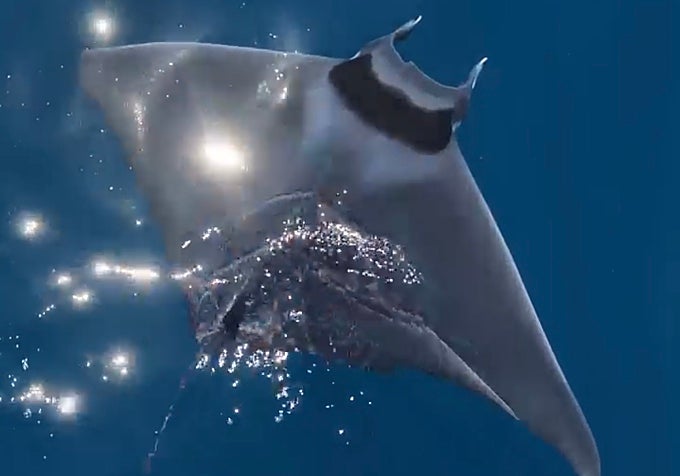
What really surprised Marcos were the manta rays, known as ‘Móbulas’. “I’d never seen them before, nor had my father, nor the fishermen either. One day we saw two, two years ago around Christmas and after that we kept seeing more and more. Last year was incredible, in a single day we saw as many as ten or twelve of them together. That’s extraordinary," he says.
The blue shark they spotted earlier in September is a species that is native to these waters, although it’s rare to see one due to overfishing. “Sharks are very important for the marine ecosystem. Seeing one is a pleasure and it’s good for the sea. There’s no need to be afraid: the best thing is to enjoy it," Marcos points out.
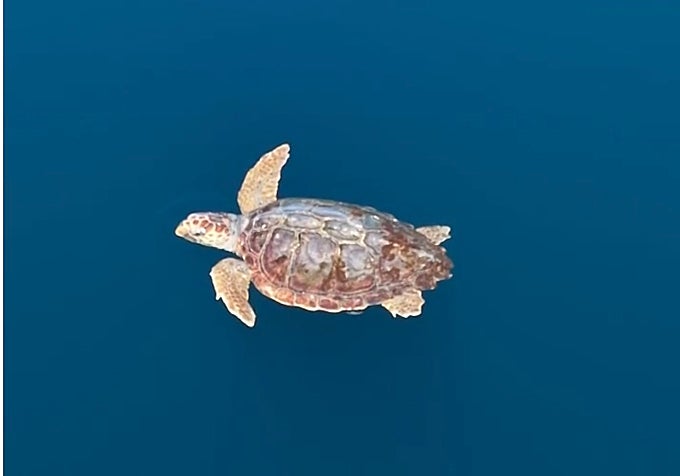
This year, he says, has been the year of turtles. “I used to see one a year, or none at all; this year I’ve seen dozens and dozens." Marcos still remembers the days following last winter’s storms, which kept the sea choppy for 53 days. When the storm finally subsided, the crew came across seven or eight turtles, two of which were very weak from having been unable to feed for so many days while the sea was rough. They called 112 and a specialist team collected them, nursed them back to health and later released them back into the sea.
After seeing so many unusual marine species along the Costa Tropical Marcos decided to organise boat trips which he dubbed ‘safaris’: trips on which, accompanied by experts, they observe whatever the Mediterranean has to offer that day, be it a piece of coral, a jellyfish or, with a bit of luck, a large marine animal.
Luis Sánchez Tocino knows the coastline very well. He was a lecturer in Marine Zoology at the University of Granada and remains associated with the Department of Zoology as a consultant. Sánchez Tocino highlights the presence of large animals such as the fin whale and the humpback whale, species which “passed through the Granada coastline and stayed longer than usual; in some cases, they could be heard from the beach itself”.
According to Luis, the key to these movements lies in food. “Whales are migratory: they follow routes in search of food. If, at any given time, there is plenty of food in an area, they stay longer; if they cannot find any, they continue on their way.” And their food supply depends on deep-sea currents, which carry nutrients to the surface.
Héctor Pula, technical manager of the Aula del Mar at the University of Granada, explains that a study is currently being carried out into the species which are washing up on the Granada coast more frequently than usual.
Although he says that the analyses are still ongoing and there are no definitive results, he points out that it is not the maximum water temperatures that really matter for the fauna, but the minimum ones. “What really affects the species is the minimum temperature reached by the water, usually in winter. When that minimum rises above the limits within which a species feels comfortable, that species may move and colonise areas where it was not previously found.”
As they explain, the minimum winter temperature on the Granada coast used to be around 12 degrees. Now, for much of the year, it remains at 13 or even 14 degrees. “That extra degree or two is allowing species that are not adapted to the cold and which previously did not reach this far to do so now.”
Oceanographic buoyThis is happening with species such as the Canary seabream – also known as the ‘parrotfish’, which is found in warmer waters such as those around the Canary Islands, but is now seen much more frequently off the coast of Granada, with a population that is "on the rise". He also mentions the Canarian seabass, a species of pufferfish that was previously very rare but is now being spotted with juvenile specimens, a sign that it is reproducing in the area. Also, the ‘egg-yolk’ jellyfish, which is associated with warm waters and is appearing more and more frequently along the coast.
Just before the summer, the Aula del Mar installed an oceanographic buoy fitted with sensors to measure temperatures both at the surface and on the seabed. According to the organisation, it is the first of its kind in the Mediterranean within the international Aqualink network. The buoy will provide real-time and long-term oceanographic data that will contribute to the study of phenomena associated with climate change, such as heatwaves, as well as facilitating the calibration of remote sensors, the validation of oceanographic models and the monitoring of changes in marine ecosystems.
It will still take some time to build up a historical record of data, but one of the aims is that, through continuous monitoring, it will be possible to confirm or rule out whether the rise in minimum water temperatures could be behind the arrival of all these species.
| # | Наименование новости | Тональность | Информативность | Дата публикации |
|---|---|---|---|---|
| 1 | Blue shark sighting in the waters off Granada's Costa Tropical | 0 | 10.37 | 08-09-2026 |
| 2 | Whale shark spotted by Newport Beach fishing charter | 0 | 6.78 | 18-09-2026 |
| 3 | Almuñécar and La Herradura hotels 90 per cent full in September | 0 | 11.76 | 17-09-2026 |
| 4 | 29 loggerhead turtles released into the Mediterranean Sea in Almeria province | 0 | 11.48 | 27-08-2026 |
| 5 | Rare sighting of spinetail devil rays off the San Diego coast | 0 | 4.21 | 15-09-2026 |
| 6 | Malaga to replace trees most at risk of losing branches with other urban species | 0 | 9.22 | 11-09-2026 |
| 7 | Andalucía temperatures set to rise again on Monday, triggering new heat and wind warnings | 0 | 8.21 | 14-09-2026 |
| 8 | La temperatura política sube en Andalucía | 0 | 10 | 22-09-2026 |
| 9 | The best form of therapy is a day at the seaside on Granada's Costa Tropical | 0 | 6.8 | 08-09-2026 |
| 10 | Malaga police express alarm over rising gun ownership as gangs acquire military-grade weapons | 0 | 14.17 | 24-09-2026 |