Просмотр новости
Найдите то, что Вас интересует
 Спутники
 РН
РН SpaceX
 Роскосмос
 NASA
NASA
СпутникиРНSpaceXРоскосмосNASAOf all 101 democratic constitutions we examined, the U.S. Constitution has the second-most onerous amendment process.
 An eighth grader at Meridian Academy in Boston holds her humanities class project using the preamble to the Constitution. (Barry Chin/The Boston Globe via Getty Images)About this research
Ahead of Constitution Day on Sept. 17, this analysis looks at the hardest and easiest national constitutions to amend. It’s an excerpt from a broader July 2026 analysis about ways that American democracy stands out internationally. For more information on why and how we did this, visit the larger analysis.
Note: Ahead of Constitution Day on Sept. 17, this analysis looks at the hardest and easiest national constitutions to amend. It’s an excerpt from a broader July 2026 analysis about the ways that American democracy stands out internationally.
In Pew Research Center surveys, Americans overwhelmingly favor several proposed changes to the U.S. political system, from term and age limits for government officials to campaign finance limitations. But many of those changes would require amending the Constitution, which is extremely difficult. The Constitution has been in effect for 237 years but has been formally amended just 27 times.
Hardest and easiest national constitutions to amend
Difficulty score based on easiest pathway, as specified in constitution
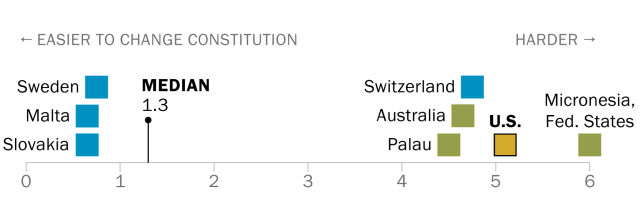
Note: When a constitution specifies more than one amendment process, the “difficulty of amendment” scores represent the least difficult process. Data is based on the 106 countries we classify as democracies and includes some fully self-governing territories whose sovereign status is disputed.
Source: Pew Research Center analysis using scoring system based on “Toward a Theory of Constitutional Amendment” by Donald S. Lutz (American Political Science Review, June 1994).
PEW RESEARCH CENTER
Hardest and easiest national constitutions to amend
Difficulty score based on easiest pathway, as specified in constitution
| Democracy | Difficulty of amendment |
|---|---|
| Micronesia, Federated States | 6.00 |
| United States | 5.10 |
| Switzerland | 4.75 |
| Australia | 4.65 |
| Palau | 4.50 |
| Fiji | 3.80 |
| Costa Rica | 3.65 |
| Liberia | 3.60 |
| Romania | 3.35 |
| Grenada | 3.30 |
| Philippines | 3.30 |
| Marshall Islands | 3.25 |
| Belgium | 3.10 |
| Japan | 3.10 |
| Netherlands | 3.10 |
| Paraguay | 3.00 |
| Taiwan* | 2.90 |
| Brazil | 0.90 |
| Denmark | 2.75 |
| Northern Cyprus | 2.55 |
| South Korea | 2.55 |
| Ireland | 2.50 |
| Bolivia | 2.40 |
| Andorra | 2.55 |
| Ecuador | 2.30 |
| Liechtenstein | 2.30 |
| Colombia | 2.25 |
| Italy | 2.25 |
| North Macedonia | 2.25 |
| Greece | 2.20 |
| Argentina | 2.10 |
| Nepal | 2.10 |
| Lithuania | 2.00 |
| Montenegro | 2.00 |
| Peru | 2.00 |
| Dominican Republic | 1.80 |
| Chile | 1.75 |
| Ghana | 1.75 |
| Luxembourg | 1.75 |
| Solomon Islands | 1.75 |
| Uruguay | 1.75 |
| Poland | 1.70 |
| Estonia | 1.65 |
| Germany | 1.60 |
| India | 1.60 |
| Namibia | 1.60 |
| Finland | 1.55 |
| Croatia | 1.45 |
| Antigua and Barbuda | 1.30 |
| Monaco | 1.30 |
| South Africa | 1.30 |
| St. Lucia | 1.30 |
| Czech Republic | 1.25 |
| Iceland | 1.25 |
| Jamaica | 1.25 |
| Spain | 1.25 |
| Bulgaria | 2.00 |
| Guyana | 1.15 |
| Lesotho | 1.15 |
| Senegal | 1.15 |
| Albania | 1.05 |
| Armenia | 1.05 |
| Kosovo | 1.55 |
| Moldova | 1.55 |
| Slovenia | 1.05 |
| Bahamas | 1.00 |
| Barbados | 1.00 |
| Botswana | 1.00 |
| Malaysia | 1.00 |
| Tonga | 1.00 |
| Trinidad and Tobago | 1.00 |
| Bhutan | 0.90 |
| France | 0.90 |
| Mongolia | 0.90 |
| Panama | 0.90 |
| Austria | 0.80 |
| Belize | 0.80 |
| Cape Verde | 0.80 |
| Cyprus | 0.80 |
| Dominica | 0.80 |
| East Timor | 0.80 |
| Hungary | 0.80 |
| Kiribati | 0.80 |
| Latvia | 0.80 |
| Malawi | 0.80 |
| Mauritius | 0.80 |
| Nauru | 0.80 |
| Norway | 0.80 |
| Portugal | 0.80 |
| Samoa | 0.80 |
| Sao Tome and Principe | 0.80 |
| Seychelles | 0.80 |
| Sri Lanka | 0.80 |
| St. Kitts and Nevis | 0.80 |
| St. Vincent and the Grenadines | 0.80 |
| Suriname | 0.80 |
| Tuvalu | 0.80 |
| Vanuatu | 0.80 |
| Sweden** | 0.75 |
| Malta | 0.65 |
| Slovakia | 0.65 |
* The data in the table refers to the “Additional Articles of the Constitution,” which effectively rewrote the old 1947 Republic of China constitution.
** Although Sweden’s constitution formally consists of four “fundamental laws,” the data in the table refers specifically to the Instrument of Government, which contains most of the basic principles of government. However, the difficulty of amendment score applies to all four fundamental laws.
Note: When a constitution specifies more than one amendment process, the “difficulty of amendment” scores represent the least difficult process. Data is based on the 106 countries we classify as democracies and includes some fully self-governing territories whose sovereign status is disputed.
Source: Pew Research Center analysis using scoring system based on “Toward a Theory of Constitutional Amendment” by Donald S. Lutz (American Political Science Review, June 1994).
PEW RESEARCH CENTER
Using a classification scheme developed by the late political scientist Donald S. Lutz, we scored the amendment rules of 101 democratic constitutions. (The other five democracies have “uncodified” constitutions, meaning their governance rules are distributed across multiple statutes, legal precedents, customs and unwritten norms.) For constitutions that contain more than one amendment procedure, we used the “least difficult” path, which may or may not be the most frequently employed.
Of all 101 constitutions, the U.S. Constitution has the second-most onerous amendment process. Amendments must be approved by two-thirds votes in both the House and Senate – itself a tall order in these polarized times – and then be ratified by three-quarters of state legislatures, or 38 of 50.
The only democracy whose constitution is even harder to change is the Federated States of Micronesia (FSM), a former U.S. trust territory in the South Pacific with about 76,000 inhabitants. The easiest path to changing the FSM’s constitution involves two separate two-thirds majority votes in the 14-person legislature, approval by the country’s president, and subsequent approval by three-quarters of voters in at least three of the FSM’s four states.
Other countries with constitutions that are nearly as hard to change are Palau, Switzerland and Australia. Like the U.S. and the FSM, these countries all require ratification at both the national and state levels.
At the other extreme, many countries with unicameral (single-chamber) legislatures can amend their constitutions much like how they pass regular laws, just requiring a larger majority in favor.

Drew DeSilver is a senior writer at Pew Research Center.
| # | Наименование новости | Тональность | Информативность | Дата публикации |
|---|---|---|---|---|
| 1 | Behind the Kansas constitutional amendment vote this November | 0 | 8.84 | 05-10-2026 |
| 2 | my tribe is currently attempting to amend our constitution and they sent me the WHOLE current… | 0 | 3.49 | 03-10-2026 |
| 3 | Quiz: How much do you know about the First Amendment? | 0 | 5.5 | 15-09-2026 |
| 4 | How much do Americans know about the First Amendment? | 0 | 5.78 | 15-09-2026 |
| 5 | Kansas constitutional amendment would 'clarify' voting requirements. What to know | 0 | 5.18 | 21-09-2026 |
| 6 | Americans Are Negative About Social Media’s Impact on Democracy – and the Rest of the World Is Catching Up | 0 | 9.51 | 01-10-2026 |
| 7 | Trump has not beaten the First Amendment, try as he might | 0 | 12 | 20-09-2026 |
| 8 | Trump administration's quiet move makes it harder for some US citizens abroad to vote, lawsuit says | 0 | 5.16 | 02-10-2026 |
| 9 | Trump administration’s quiet move makes it harder for some US citizens abroad to vote, lawsuit says | 0 | 6.87 | 02-10-2026 |