Просмотр новости
Найдите то, что Вас интересует
 Спутники
 РН
РН SpaceX
 Роскосмос
 NASA
NASA
СпутникиРНSpaceXРоскосмосNASAOrganizers of a cyber conflict exercise say Washington needs to prepare for attacks that both disrupt civilian services and pressure Taipei without triggering outright military conflict.
Barks_japan/Getty Images
 By
David DiMolfetta,
By
David DiMolfetta,
Cybersecurity Reporter, Nextgov/FCW
| October 7, 2026 11:59 AM ET
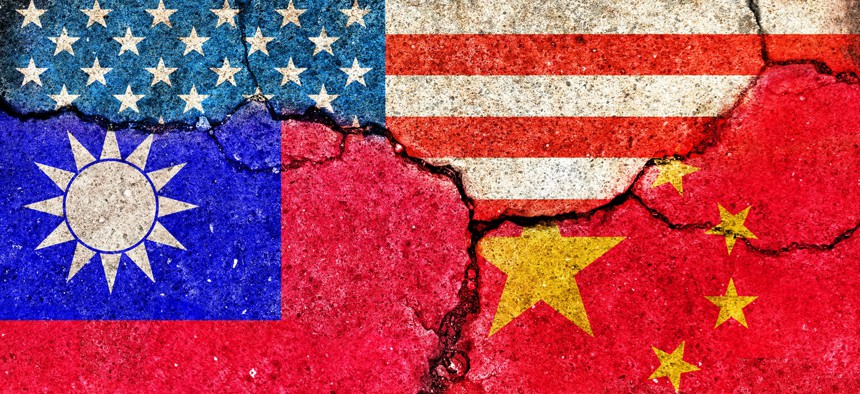
The United States devotes too little attention toward preparedness for a Chinese campaign of cyberattacks and economic pressure against Taiwan, organizers of a recent war game warned Tuesday, arguing that gaps between military and civilian planning could delay assistance to the island.
The Foundation for Defense of Democracies exercise examined how Beijing could disrupt Taiwan’s communications networks to extract political concessions without launching an invasion. The simulation was held in Taiwan in late September, and its findings were briefed to Taiwanese President Lai Ching-te and his national security team, according to the think tank.
Mark Montgomery, an FDD senior fellow and retired Navy rear admiral who helped lead the exercise, said Washington routinely rehearses possible military conflict over Taiwan but is less systematic about preparing for the cyber operations he considers more likely to occur.
“The Department of Defense sees it as a problem for the other federal agencies, and the other federal agencies don’t have a budget or a systematic process for running these kinds of tabletops,” he said in a briefing with reporters.
The exercise began with localized cellular disruptions, information manipulation and pressure on satellite connectivity. A second phase escalated to damaged undersea cables, disabled electrical substations supporting telecommunications and strained backup networks, according to Craig Singleton, FDD’s China program director, who played China in the simulation.
The aim was to make daily life less reliable and undermine confidence in Taiwan’s government while avoiding a direct confrontation with the United States, Singleton said. Communications outages could also compound problems in other sectors, disrupting payments, slowing emergency coordination and making power failures harder to manage.
Taiwanese participants rerouted traffic and activated alternatives. But the harder test was whether those systems could sustain services for weeks as Beijing studied the response and targeted the backups, he said.
Asked by Nextgov/FCW about lessons from Salt Typhoon, the Chinese hacking campaign that breached U.S. and global telecommunications networks, Singleton said that operation informed the scenario, but it wasn’t named directly in the exercise packets.
A separate Chinese hacking collective dubbed Volt Typhoon — which seeks to establish access to critical infrastructure for disruptive or destructive attacks during a major crisis or conflict — was also not mentioned directly, but its activities also influenced the war game.
“If an adversary already understands the network, its dependencies and its fallback pathways, then disruption can become much more targeted and adaptive,” Singleton said.
Montgomery said policymakers also tend to underestimate recovery times for systems that are taken down, especially when restoring one service depends on bringing others back online. He described that as a recurring problem in exercises across several countries.
“You know they’re speaking in minutes and hours, and my experience is days or weeks,” he said.
The warnings underscore the range of threats Taiwan faces beyond a possible Chinese invasion. In its 2026 worldwide threat assessment, the Office of the Director of National Intelligence said Chinese leaders did not currently plan to invade Taiwan in 2027 and had no fixed timeline for unification. Beijing preferred achieving its goal without force, the assessment said, while continuing to develop military options.
More recently, U.S. officials have assessed an invasion before 2028 as increasingly unlikely, citing military readiness delays and China’s interest in Taiwan’s next presidential election.
China claims Taiwan as its territory, although it has never governed the self-ruled island, and views bringing the island under its control as central to national unification. China has not ruled out using force, but cyberattacks and economic pressure could offer ways to weaken Taiwan’s resistance and push its leaders toward concessions without the risks of an invasion.
Montgomery separately warned that early 2028 could bring intensified cyber and economic coercion if Taiwan’s Democratic Progressive Party wins a fourth consecutive presidential election. FDD hopes to run future exercises with congressional staff and federal agencies, he added.
| # | Наименование новости | Тональность | Информативность | Дата публикации |
|---|---|---|---|---|
| 1 | Вероятность войны США и Китая из-за Тайваня оценили | 0 | 22.5 | 06-10-2026 |
| 2 | Report: Chinese 'cyber spies' hacked top US agencies | 0 | 14.17 | 26-08-2026 |
| 3 | Chilling plot reveals Chinese 'cyber spies' hacked top Trump government agencies and the Senate | 0 | 13.61 | 26-08-2026 |
| 4 | Taiwan might as well give up now | 0 | 6.88 | 23-09-2026 |
| 5 | В США моделируют сценарии бунта общества в случае киберкатастрофы | 0 | 5.99 | 09-10-2026 |
| 6 | The Trump-Xi Summit Is Over, But Taiwan Is Still Bracing for the Fallout | 0 | 11.73 | 28-09-2026 |
| 7 | Offshore Wind Farms Could Create Radar Blind Spots and ‘Ghost’ Targets - Chinese Study | 0 | 8.98 | 27-09-2026 |
| 8 | Бряцают, глядя на Китай: США имитировали камуфлетный ядерный взрыв | 0 | 7.26 | 02-10-2026 |
| 9 | В КНР посоветовали США быть осторожными с нарративом о "вторжении" на Тайвань | 0 | 9.34 | 06-10-2026 |
| 10 | МИД Китая призвал США к осторожности при рассуждениях о «вторжении» на Тайвань | 0 | 7.17 | 06-10-2026 |