Просмотр новости
Найдите то, что Вас интересует
 Спутники
 РН
РН SpaceX
 Роскосмос
 NASA
NASA
СпутникиРНSpaceXРоскосмосNASASeattle ranked second to last among the nation's 50 largest cities for the share of households with children in which grandparents are the primary caregivers, FYI Guy writes.
It’s a sign of Seattle’s affluence that probably hasn’t occurred to many: The city has almost no “grandfamilies.”
Demographers and child-welfare experts use that term for households in which grandparents become the primary caregivers for their grandchildren. In many American cities, these arrangements function as an indispensable safety net — older adults dipping into fixed incomes and retirement years to provide food, clothing and shelter, often for kids whose parents face acute hardship or are absent altogether.
In Seattle, grandfamilies are a rarity.
According to 2024 census data, Seattle ranked second to last among the nation’s 50 largest cities for the share of households with children in which grandparents are the primary caregivers. Of the roughly 60,700 Seattle family households raising kids under 18, just about 1,050 — 1.7% — were led by grandparent caregivers. Only Austin, Texas, ranked fractionally lower, at 1.6%.
Compare that to some Rust Belt and Southern cities, where grandfamilies are relatively commonplace. About 10% of Cleveland’s child-rearing households are grandparent-led. Detroit sits at around 9%, followed by Memphis, Tenn., at 8% and Louisville, Ky., at 7%. In those cities, roughly 1 in 10 to 14 families with kids relies on a grandparent as primary guardian. In Seattle, the ratio is closer to 1 in 58.
Seattle ranks second-lowest for ‘grandfamilies’
In Seattle, the grandparents are the primary caregivers in just 1.7% of households with children, the second-lowest percentage among the 50 largest U.S. cities.
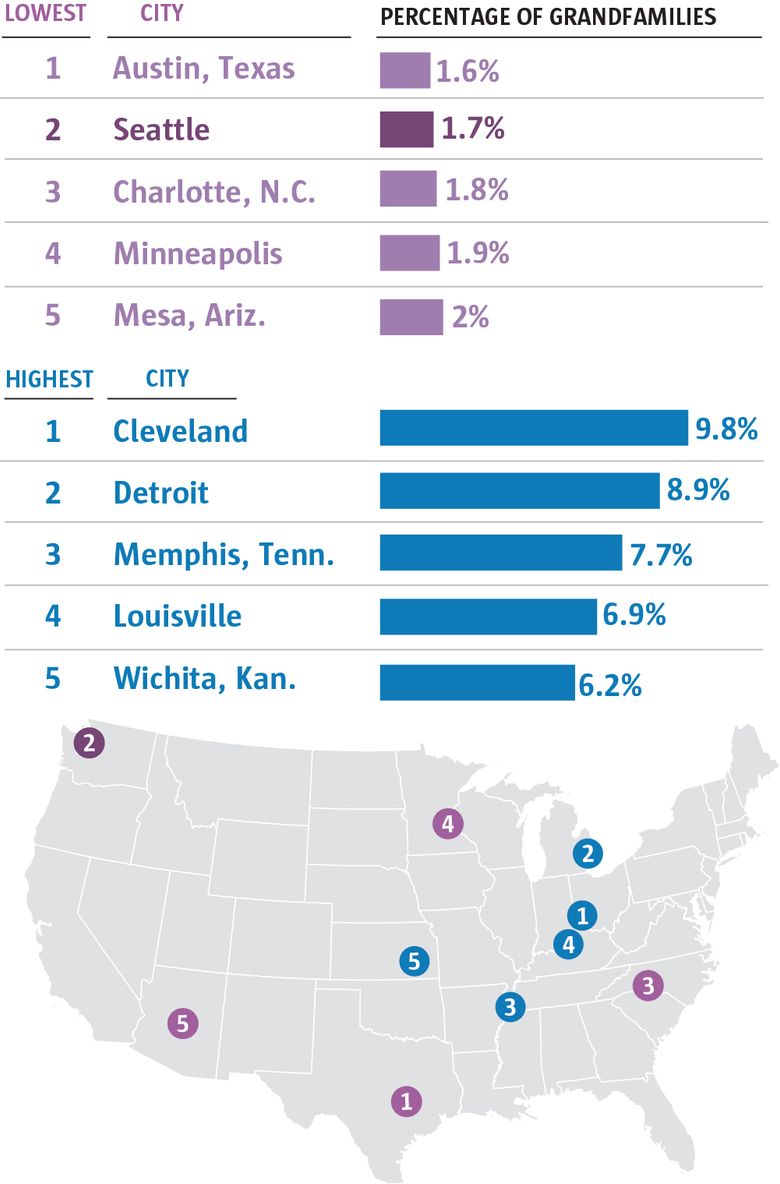
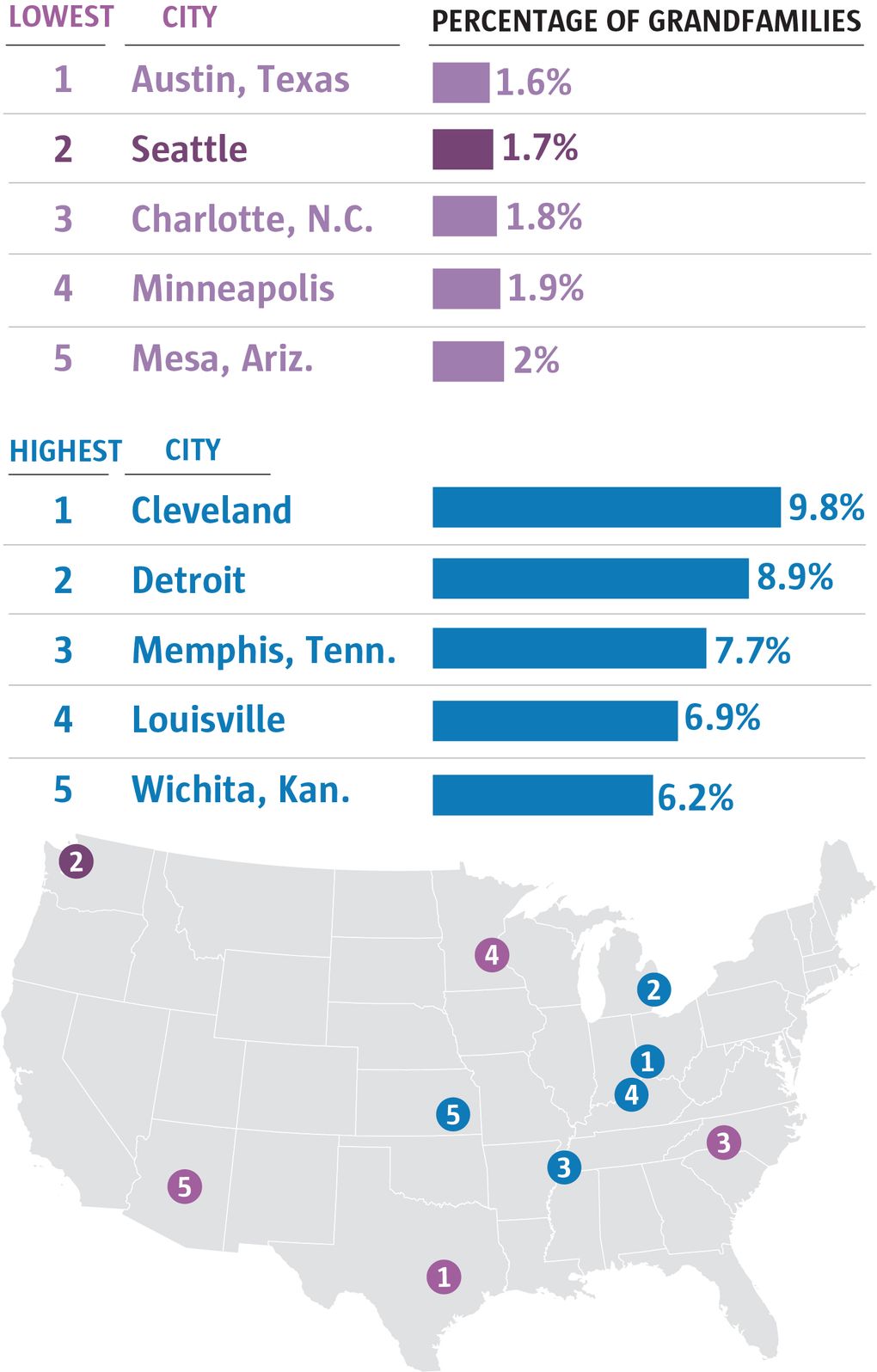
Even compared with other high-cost West Coast tech hubs, Seattle stands out on the low end: San Francisco sits just above 2%, while San Jose is closer to 3%.
Nationally, the number of grandfamilies has surged over the past 40 years. Child-welfare research shows that in the 1980s and 1990s, they formed largely in response to teen pregnancies, climbing female incarceration rates and the crack cocaine epidemic. More recently, the opioid and fentanyl crisis has driven most new grandfamilies.
In the late 1990s, the term “grandfamily” gained formal use among advocacy groups fighting to give these households legal recognition and access to foster care benefits without forcing them to sever parental rights. Over the past 25 years, those efforts reshaped federal and state laws, leading to dedicated support networks like Washington’s Kinship Navigator program.
It’s tempting to read Seattle’s low number as a mark of domestic stability, but it may be just as much a byproduct of the city’s affordability crisis.
Raising a family within Seattle city limits has grown so expensive that the population of families here has effectively been filtered down to the most economically resilient. Census data shows around 77% of Seattle households with kids are headed by married couples, one of the highest shares among major U.S. cities. And in 2024, those married-couple Seattle households had a median income in excess of $250,000 — the Census Bureau’s top-coded upper limit, after which it doesn’t report an exact dollar amount.
Decades of rising living costs in Seattle have coincided with a shrinking presence of working-class families and fixed-income seniors inside city limits — the same groups most likely to rely on grandparent safety nets.
In grandfamilies, the grandchildren’s parents may or may not be present — in many cases, they are, they’re just not the primary caregivers. True “skip-generation” households, in which grandparents raise grandchildren with no parent in the home at all, are also far less common in Seattle than in most other cities.
In Cleveland, for example, skip-generation arrangements accounted for roughly half of all grandparent-caregiver households. Census data counted only about 200 such households in Seattle, representing less than 20% of its grandfamilies.
Many more Seattle households include grandparents but are not grandfamilies — situations in which parents remain the primary providers. Census data shows around 3,300 such multigenerational households in Seattle: Grandparents are present, but provide family support rather than serving as the financial safety net and primary caregiver.
Gene Balk / FYI Guy: gbalk@seattletimes.com. Gene Balk is a columnist at The Seattle Times, where he writes about local demographics and other data for his FYI Guy column.
| # | Наименование новости | Тональность | Информативность | Дата публикации |
|---|---|---|---|---|
| 1 | Seattle’s childless core: Six areas in city recorded zero kids in 2024 | 0 | 13.53 | 21-09-2026 |
| 2 | Same-sex couple households surge, but Seattle still loses top spot | 0 | 16.54 | 22-06-2026 |
| 3 | Seattle ranked fourth among large cities for growth last year | 0 | 13.99 | 14-05-2026 |
| 4 | Seattle ranks fourth among world’s top cities in new report | 0 | 10.38 | 28-09-2026 |
| 5 | Why Seattle ranks near the bottom for free-and-clear homes | 0 | 13.97 | 01-06-2026 |
| 6 | Seattle ranks No. 2 in U.S. for growth in credit union banking | 0 | 15.62 | 10-07-2026 |
| 7 | Seattle ranks 3rd in U.S. for shrinking commutes. Here’s why | 0 | 15.19 | 01-09-2026 |
| 8 | Seattle parks rank high nationally, but that doesn’t come cheap | 0 | 15.75 | 26-05-2026 |
| 9 | The overlooked driver of Seattle’s housing squeeze: Living alone | 0 | 12.84 | 04-09-2026 |
| 10 | Seattle officially joins the ranks of top cities | 0 | 13.57 | 02-10-2026 |