Просмотр новости
Найдите то, что Вас интересует
 Спутники
 РН
РН SpaceX
 Роскосмос
 NASA
NASA
СпутникиРНSpaceXРоскосмосNASAWhat are the main highlights of the program marking the 150th anniversary of Pablo Casals’ birth? To mark the 150th anniversary of Pablo Casals’ birth, the Pau Casals Foundation is organizing or participating in a wide range of events. Many institutions, festivals, and concert organizers around the world have chosen to pay tribute to Casals. […]

(c) Apeda Studio / Pau Casals Foundation
What are the main highlights of the program marking the 150th anniversary of Pablo Casals’ birth?
To mark the 150th anniversary of Pablo Casals’ birth, the Pau Casals Foundation is organizing or participating in a wide range of events. Many institutions, festivals, and concert organizers around the world have chosen to pay tribute to Casals. There will, of course, be even more events in Spain, particularly in Catalonia, where the opening of the Palau de la Música in Barcelona this September will be dedicated to Casals.
 Bernard Meillat
Perhaps even more importantly, Casals’ audiovisual archives have been cataloged, and the most significant recordings are currently being restored and will soon be available to music lovers around the world.
Warner will release a 27-CD box set next fall featuring exclusively live recordings, almost all of which are previously unreleased. About ten documentaries and some forty filmed concerts will be screened, broadcast, or made available online. There will also be two new documentaries, one of which is produced by Arte.
We will be celebrating Casals’s anniversary for over a year! Since he was born at the end of December 1876, we thought we should start the celebration now and continue it through the summer of 2027.
The Casals Foundation will lend Casals’ Goffriller to the winner of the Queen Elisabeth Competition. What can you tell us about this instrument?
Casals’ Goffriller is, one might say, a legendary instrument, if only because Casals played it for 65 years! Every cellist and countless music lovers have the sound of this instrument, as played by Casals, etched in their ears and hearts. All cellists—and, for example, the members of the competition jury—dream of holding it in their hands and playing it, even if just for a moment!
It’s true that the sound Casals drew from the instrument was unique and instantly recognizable: so warm and human. It’s difficult to determine how much of that was due to Casals himself, how much to the cello itself and how much to the gut strings. But there you have it — it’s a great mystery that we’ll solve with the winner of the Queen Elisabeth Competition!
Compared to other Goffrillers, what are its distinctive features?
What are the distinctive features of this instrument? It’s true that it’s a fairly small cello, which suited Casals very well, with a slender, elegant profile. Like most Goffrillers and cellos built in the late 17th or early 18th century, it was scaled down in size in the early 19th century. People wanted cellos that were easier to handle and play. Casals’s was no exception. It was reduced in all dimensions, both in length and width. This was done very well and may be responsible for the beauty of its sound!
Casals said it was a capricious instrument—that is, a cello with a personality of its own, one that doesn’t bend to the musician’s will. For example, if you play it forcefully, it will resist; it won’t produce the volume you’d expect even if you press down on the bow with all your strength.
On the other hand, this cello has a naturally warm tone, a singing quality, flexibility, and, in particular, the ability to express and bring out all the nuances from piano to pianissimo. One might think that it was this sensitivity, this humanity of the instrument, that captivated Casals and led him to keep it throughout his life, considering it his ‘best friend’.
Why did you choose the Queen Elisabeth Competition for the instrument loan?
Casals had bequeathed his instrument to the Pau Casals Foundation, which he established in 1972, a year before his death, stipulating that his wife would care for it for as long as she wished. When Mrs. Casals decided last year to return the cello to the Foundation, we considered all possibilities.
Casals was deeply committed to making music accessible to everyone and to helping young musicians through his teaching, his countless master classes, and his participation in the Marlboro Festival… The price of instruments is so high now that it is impossible for young instrumentalists to have access to very good instruments, except through foundations that lend them out. The decision to lend the instrument to a young musician was therefore a natural one. And there, the idea of the very strong bond that had united Queen Elisabeth and Casals since the early years of the 20th century came naturally.
They shared not only musical bonds, but also human and philosophical ones, united by a shared sense of duty to fight against injustice and war. Queen Elisabeth attended the Prades Festival very often; she also visited Casals in Marlboro, Puerto Rico, Zermatt, and Berlin, where he conducted his oratorio El Pessebre. If proof were needed, the coincidence of their 150th anniversary and the 75th anniversary of the Competition finally convinced us. The Queen had spoken to Casals about her plan for the Competition, and Casals had strongly encouraged her.
Since there are Russian competitors in the Queen Elisabeth Competition, theoretically, the prize could go to Russia—and your instrument along with it. What would Casals, who always championed peace and freedom, think if his instrument were sent to a country that started a war against another country and is still waging it?
Casals spent his entire life defending peace, human rights, and justice. He refused to perform in countries under dictatorship, and even in countries that had agreed to allow Franco to remain in power. The idea of Casals’s cello going to Russia today is unthinkable. If a Russian musician were to win the Competition, the cello would be loaned to them only if they clearly take a stand against war and no longer reside in Russia. This is a situation that can be delicate, but it is not possible to act otherwise if we wish to remain faithful to Casals’ spirit.
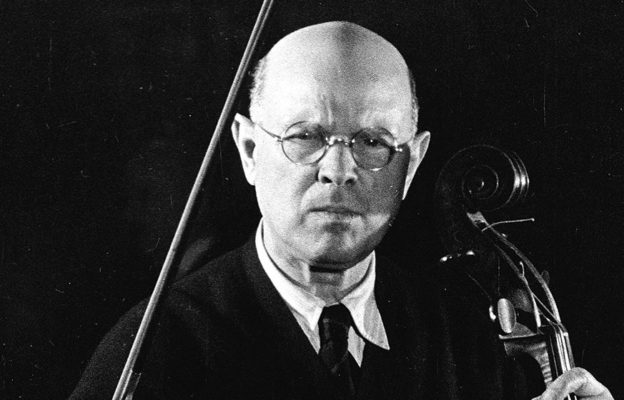 Pablo Casals
Would you consider to collaborate also with other competitions?
There are other cello competitions that are very important and of a very high standard. But the Queen Elisabeth Competition is the most prestigious when it comes to string instruments. And above all, there is this bond between Casals and Queen Elisabeth that makes this partnership a natural one.
What is your greatest wish for this 150th anniversary?
On the 150th anniversary of Pablo Casals’ birth, there are many things to wish for. He would certainly be appalled by what the world is going through today. Our aim is to remain true to his ideals and preserve his human and artistic legacy, which continues to inspire musicians and citizens to this day. Musically, we have many projects with young musicians, notably using films and the numerous recordings of his master classes, as well as expanding our support through a competition for cellists under 21, a summer festival in the spirit of Marlboro, and concerts.
On a human level, it is no longer quite the same struggle against war that Casals waged in the 1960s. We have entered a new era. But we want to continue to share the faith that Casals held in the human spirit, as well as his determination to fight against the atrocities of war, the dictatorships that crush humanity, and the cruelest injustices, and to help refugees who have had to flee their countries, just as he himself had done with such dedication
| # | Наименование новости | Тональность | Информативность | Дата публикации |
|---|---|---|---|---|
| 1 | К 160-летию со дня основания Московской консерватории | 0 | 10 | 13-09-2026 |
| 2 | « Existential intensity » – Carlos Païta conducts Mahlers Sixth Symphony | 0 | 10.41 | 18-09-2026 |
| 3 | «Взгляните на афиши»: Музыка Чайковского оказалась сильнее политических конъюнктур | 0 | 22.97 | 24-04-2025 |
| 4 | Лучший виолончелист России выступит в Петрозаводске | 1 | 13.57 | 02-10-2026 |
| 5 | Концерт, посвященный Пуччини и Казарновской, пройдет в Петербурге 25 октября | 0 | 10.36 | 08-10-2026 |
| 6 | Омский симфонический оркестр готовит специальный проект в честь своего 60-летия | 0 | 8.89 | 21-09-2026 |
| 7 | Ольга Любимова отметила уникальность фондов Псковского музея | 0 | 15.62 | 08-10-2026 |
| 8 | L'agenda d'avui, 30 de setembre: òpera comentada, filosofia i el futur dels festivals | 0 | 8.36 | 30-09-2026 |
| 9 | La tradición y el folclore marcan la jornada del Día de Cantabria en Cabezón de la Sal | 0 | 4.56 | 09-08-2026 |