Просмотр новости
Найдите то, что Вас интересует
 Спутники
 РН
РН SpaceX
 Роскосмос
 NASA
NASA
СпутникиРНSpaceXРоскосмосNASABats appear in the fossil record abruptly, with fully functional wings and advanced echolocation already intact.
Bats appear in the fossil record
abruptly, with fully functional wings
and advanced echolocation already intact
Bat Origin Is Still One of Evolutionists’ Greatest Puzzles
An international team of scientists is no closer to solving it
Six years ago, I reported on a Smithsonian magazine article titled, “Why Bats Are One of Evolution’s Greatest Puzzles.”[1] Now in 2026, evolutionists are still looking for evidence of the evolutionary origin of bats.[2]
For decades, researchers have debated where and when bats first appeared. Africa, Asia, and North America have all been proposed as possible birthplaces of this elusive mammal. As recently as September 30, a team from University College Dublin admitted, “scientists have spent decades trying to resolve basic questions about how bats evolved and how their most unusual traits developed.”[3] They currently argue that Europe was where bats first appeared. That is a lesser question than how a non-flying rodent became an expert at powered flight.
Getting Bat Genomes Back to Genesis
The task of determining the birthplace of this group of mammals was recently carried out by the Bat1K consortium, a global effort dedicated to sequencing the genomes of all living bat species. Co-founded by University College of Dublin (UCD) School of Biology and Environmental Science professor Emma Teeling, the international team of 137 researchers from 64 countries combined genomic data from every living bat family with evidence from ancient fossils.
Their goal was to reconstruct the evolutionary history of the world’s only mammals capable of true powered flight. The study, published in Nature, examined 103 bat genomes, including 42 newly generated chromosome-level assemblies, covering all 21 recognized bat families. Researchers also incorporated evidence from 44 fossil bats into their analysis.
The results—in the words of evolutionary biologist Ariadna E. Morales— suggest that bats first evolved in Europe during the late Paleocene, and their descendants subsequently moved into Africa. The data obtained from the Bat1K consortium help resolve several long-running disagreements about how different bat families are related. Briefly, they determined that “the results reveal unexpected evolutionary connections among unusual bat groups.”[4]
In other words, the evidence points to the conclusion that different bat varieties diversified from an original created bat kind, as taught in Genesis.
Did Transposable Elements Give Bats Their Unique Skills?
How do evolutionists explain the lack of fossil evidence for the step-by-step development of these traits? Often, they say that bats simply “evolved” these traits very early in their evolution. An example is the assertion that “the fossil bat Vielasia, which sits on the oldest branch of the bat family tree. … suggests echolocation had already appeared close to the beginning of bat evolution.” Taken together, the Bat1K consortium postulated that both powered flight and echolocation emerged before modern bat groups began diversifying.[5] That’s like saying two miracles occurred without leaving a trace.
One key non-evolutionary mechanism suggested to account for bat variability is the activity of transposable elements—specialized genetic segments that move around to generate diversity. As the study’s authors themselves acknowledge, “The acquisition and evolution of these unique traits [in bats] have been the center of heated debates, particularly in relation to the evolution of flight and echolocation.”[6] [Notice “begging the question” about evolution, and failing to consider alternatives to materialistic philosophy.—Ed.]
The Evolutionary Gap
Bats’ unique traits place them among the most distinctive mammals alive today. They are the only mammals capable of sustained powered flight. Most species also use echolocation to navigate and hunt in total darkness. Making up roughly one-fifth of all living mammals, bats fill vital ecological niches around the world.[7] Many bat species are remarkably resistant to disease, allowing them to live far longer than other mammals of similar body size.
The large anatomical gap between bats and other mammals is why bats remain a centerpiece in discussions challenging conventional evolutionary models.[8]
The Nature of the Bat Fossil Record
Because their delicate, lightweight skeletons rarely fossilize, the overall bat fossil record was long considered notoriously incomplete. However, this is no longer true. The international Bat1K consortium scientists recently compiled, then analyzed, 44 key fossil bat specimens collected from around the world. Beyond full skeletons, the broader fossil record consists of a sparse scattering of fragmented jaws, teeth, and isolated bones unearthed in Wyoming, Paris, Egypt, and India. Significantly, researchers have not found a single transitional intermediate connecting non-flying terrestrial mammals to fully developed bats.
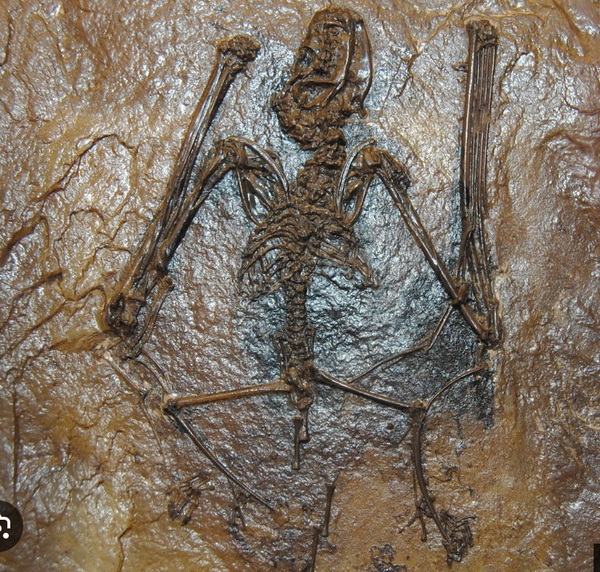
Palaeochiropteryx tupaiodon found in the Messel Oil Shale in Germany. Note the preservation of a great detail of the bat’s anatomy.
A fossil bat from the Messel Oil Shale in Germany (Palaeochiropteryx tupaiodon), dated by conventional geologists at 47 to 48 million years old, has a fully developed wing structure. Likewise, the oldest complete bat skeletons ever discovered—two exceptionally preserved specimens from the Green River Formation in Wyoming, dated to 52 million years old—are undeniably bats, lacking all evidence of transitional flight anatomy.[9]
Summary
After analyzing over a hundred genomes and decades of fossil discoveries, evolutionists are no closer to solving the bat puzzle than they were when the Smithsonian ran its headline in 2020. The high-resolution data from the Bat1K consortium does not document how non-flying mammals turned into aerial acrobats. Rather it reveals how remarkably engineered bats are. Rather than tracing an evolutionary journey from the ground up, the newest findings affirm what the fossil record has shown all along: bats have always been bats.
Ultimately, the Bat1K project provides a magnificent catalog of modern bat biology, but it leaves the central evolutionary question unanswered. Computational reconstructions and massive genomic data sets cannot conjure transitional fossils out of thin air. Instead, the evidence continues to tell a consistent story: bats appear in the fossil record abruptly, with fully functional wings and advanced echolocation already intact. The breathtaking diversity seen across living species does not point to a blind evolutionary climb from terrestrial mammals, but rather showcases an elegantly designed genetic toolkit—equipped with mechanisms like transposable elements—capable of generating rich variation within the original created bat kind.
<span style="display: inline-block; width: 0px; overflow: hidden; line-height: 0;" data-mce-type="bookmark" class="mce_SELRES_start"></span>
References
[1] Bergman, Jerry, “Evidence for Bat Evolution? Still Looking After All These Years, Smithsonian Magazine Attempts to Explain Away the Problem,” https://crev.info/2020/05/bat-evolution-still-looking/, 8 May 2020.
[2] Buckland-Reynolds, Sarah, “Bats Challenge Evolution Five Ways,” https://crev.info/2026/09/sbr-bats-challenge-evolution-five-ways/, 2026.
[3] University College Dublin, “Bats May Have First Evolved in Europe 65 Million Years Ago,” https://www.sciencedaily.com/releases/2026/09/260929053531.htm, via Science Daily, 30 September 2026. Original press release at UCD: https://www.ucd.ie/research/news/2026/batsoriginatedandtookfirstflightineuropenewucd-ledresearchsuggests/
[4] University College Dublin, 2026.
[5] University College Dublin, 2026.
[6] Morales, et al., 2026.
[7] University College Dublin., 2026.
[8] Sherwin, Frank, “The Evidence Rats Out Bat Evolution” Impact, https://www.icr.org/content/evidence-rats-out-bat-evolution, 31 May 2016.
[9] Bergman, Jerry, “Evidence for the Evolution of Bats,” Origins 47:10-15, February 2008.
 Dr. Jerry Bergman has taught biology, genetics, chemistry, biochemistry, anthropology, geology, and microbiology for over 40 years at several colleges and universities including Bowling Green State University, Medical College of Ohio where he was a research associate in experimental pathology, and The University of Toledo. He is a graduate of the Medical College of Ohio, Wayne State University in Detroit, the University of Toledo, and Bowling Green State University. He has over 1,900 publications in 14 languages and 40 books and monographs. His books and textbooks that include chapters that he authored are in over 1,800 college libraries in 27 countries. So far over 80,000 copies of the 60 books and monographs that he has authored or co-authored are in print. For more articles by Dr Bergman, see his Author Profile.
(Visited 74 times, 8 visits today)
| # | Наименование новости | Тональность | Информативность | Дата публикации |
|---|---|---|---|---|
| 1 | Bats may have first evolved in Europe 65 million years ago | 0 | 9.47 | 30-09-2026 |
| 2 | Where Did Bats Originate? Huge Genetic Study May Have Settled the Longstanding Debate and Rewritten the Creatures' Evolutionary Tree | 0 | 9.03 | 25-09-2026 |
| 3 | Evolutionists Still Finding Imaginary Feathers on Dinosaurs | 0 | 11.3 | 02-10-2026 |
| 4 | 蝙蝠起源于欧洲 | 0 | 33.08 | 24-09-2026 |
| 5 | These are the first feathers ever found in fossilized dinosaur poop | 0 | 11.72 | 25-09-2026 |
| 6 | UV light reveals possible camouflage on a 125-million-year-old crocodile | 0 | 7 | 15-09-2026 |
| 7 | 97-million-year-old fossils reveal the earliest known animal “GPS” | 0 | 8.22 | 02-10-2026 |
| 8 | В Китае нашли новый вид способных к полету микрорапторов | 0 | 6.82 | 29-09-2026 |
| 9 | 1.7-billion-year-old fossils reveal a crucial clue to the rise of complex life | 0 | 8.04 | 27-09-2026 |
| 10 | This 2-pound dinosaur is rewriting what scientists know about evolution | 0 | 9.25 | 10-03-2026 |