Просмотр новости
Найдите то, что Вас интересует
 Спутники
 РН
РН SpaceX
 Роскосмос
 NASA
NASA
СпутникиРНSpaceXРоскосмосNASAFive decades after his prescient wartime exposé of the Khmer Rouge, Ith Sarin resurfaces to shed new light on his life ahead of the publication of a new translation.
Five decades after his prescient wartime exposé of the Khmer Rouge, Ith Sarin resurfaces to shed new light on his life ahead of the publication of a new translation.
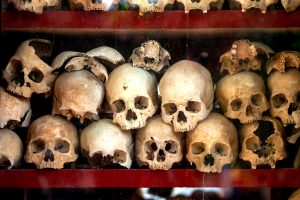
The skulls of Khmer Rouge victims on display at Wat Thmei in Siem Reap, Cambodia.
Credit: DepositphotosIn late 1973, Cambodia was in the middle of the war that would bring the Khmer Rouge to power, and Phnom Penh was abuzz over the publication of a short but timely memoir by a relatively unknown figure, Ith Sarin. At that point, both the urban Cambodian population and the foreign Cambodia watchers still understood little about the identities, ideology, organization, or culture of the band of communist revolutionaries that were closing in on the country’s capital. Now, for the first time, Sarin’s memoir offered tantalizing inside details of the Khmer Rouge from someone who had defected to join their ranks and then rallied back to the government in Phnom Penh to tell all.
It was meant as a warning against impending communism, and it would prove a prophetic glimpse into Cambodia’s coming nightmare.
Titled “Regrets for the Khmer Soul,” the book described how Sarin and an unnamed friend (Kuong Lumphon, we know now), both educators and intellectuals, had been led by clandestine Khmer Rouge guides out of Phnom Penh and into the “liberated zone,” where they lived and worked for nine months. It described their meeting Khmer Rouge cadres and intellectuals, attending conferences, working at a “propaganda bureau,” and being indoctrinated in Khmer Rouge ideology.
Sarin wasn’t seeking communism, exactly. He was fed up and going to join the “Front” – the National United Front of Kampuchea – an alliance between the communist Khmer Rouge (backed by their Vietnamese communist allies) and the non-communist, royalist supporters of the deposed but popular Prince Norodom Sihanouk, its nominal head. The Front’s stated objective was to topple the corrupt pro-American Lon Nol regime and return Sihanouk to power.
In “Regrets,” however, Sarin described how his disillusionment with the Front grew as he came to realize that the Front was only, well, a front: completely controlled by hardcore communists, governed by the Central Committee of the Communist Party of Kampuchea (CPK), who were only using Sihanouk for the recruiting power of his name, while internally despising him. They let slip that they had no intention of returning Sihanouk to power, despite what most believed. But Sarin had a poor appetite for radical communism, it turned out, and he concluded that the ideology was incompatible with “the Khmer soul.” He and Lumphon defected a second time, this time in the other direction.
Besides recounting Sarin’s disillusionment, “Regrets” revealed in unprecedented detail the inner workings of the Khmer Rouge. It told how they organized themselves and the communities they had captured inside the liberated zone. It described in meticulous detail their discipline, their philosophy, their practices of collective living, their relationship with the populace, their daily work, and how they ate, dressed, and spoke. For the first time, it revealed to the outside world the name of the man who led the CPK Central Committee: Saloth Sar, who would soon come to be known by his revolutionary name, Pol Pot. It accurately predicted the prohibition of Buddhism. And it presciently highlighted hidden tensions between the Cambodian and Vietnamese communists.
Despite captivating Cambodian readers, “Regrets” was not taken very seriously by many in the foreign press corps or the intelligence community in Phnom Penh. Of the former, only Washington Post correspondent Elizabeth Becker reported seriously on its revelations, which she says was criticized by one veteran American journalist as a “rookie mistake.” Most foreign journalists tended to dismissed “Regrets” as government propaganda. Meanwhile, some in the intelligence sphere dismissed it as propaganda for the other side, claiming that it was too flattering of the communists.
But history would soon vindicate “Regrets,” as it would prove to be a sober, accurate, and prophetic (albeit mild) premonition of what life under the Khmer Rouge would shortly be like for the entire population. Its details, like the identities of party leadership and their intentions toward Sihanouk, were spot on. (It lacked any warning of the executions, mass displacement, or starvation that would come to characterize that period. Alas, the severity of these would surprise nearly everyone when they finally came. )

Photographic displays at the Tuol Sleng Genocide Museum (formerly the S-21 security prison) in Phnom Penh, Cambodia. Photo via Depositphotos.
***
Until now, little else has been known about the life of this man who appeared briefly on the scene and attracted the spotlight at a turning point in Cambodia’s history. Who was Ith Sarin before fleeing to the maquis in 1972? What happened to him after he published his wartime exposé?
Rumors abounded – that he was executed for treason, that he was imprisoned, that his book was banned – but not all of it was true. It is well known that he survived the murderous Democratic Kampuchea regime that held power from 1975 to 1979 and emigrated to the United States as a refugee; historian David Chandler interviewed him there in 1988. Thirty years later, in 2018, Sarin was interviewed again by Rinith Taing of the Phnom Penh Post, who discovered him retired, at age 80, back in his native Siem Reap province. In the article, Sarin comes across as cagey and reclusive, declining to show his face in the domestic press (we see only a photo of the back of his head), telling Rinith that he didn’t want government officials or journalists to find him, asking that his location not be published.
But I wanted to find Sarin, and I had a good reason. I am a Khmer translator and a student of Cambodian history. More than 15 years ago, I came across a digital copy of “Regrets” in Khmer on the internet and translated it into English for my own interest, sharing it only informally with a few people. But in recent years I became determined to publish my translation for the benefit of other students of Cambodian history.
It is easy to find summaries of the book’s contents in the writings of historians like Becker and Chandler. You can even find partial translations, if you dig deep enough. (U.S. foreign service officer Timothy Carney published an excerpt in a 1977 paper at Cornell University.) But no complete English translation of this landmark document had ever been published, and I became determined to publish mine, with the blessing of Sarin. I felt reasonably confident that Sarin would want to talk if he knew my objective.

A copy of the first edition of Ith Sarin’s “Regrets For the Khmer Soul,” published in Phnom Penh in 1973. Photo by Timothy Carney.
Once I decided on my course, it took me three years to find him, over three trips to Cambodia. I queried Rinith, to no avail. I networked with Facebook contacts looking for family members or acquaintances. I enlisted help from registry officials at the Siem Reap provincial hall, with no results. I even resorted to cold calling people with his surname in U.S. phone directories, looking for relatives. Eventually, seemingly out of leads, I was ready to give up, unsure of whether he was even still alive.
Then unexpectedly, in November 2025, while visiting Cambodia, a contact claiming to be Sarin’s nephew in Australia reached out and passed me a phone number. It was real: Sarin himself answered the phone. He listened patiently to my pitch about translating and publishing his book. He was interested, as I’d wagered. Still protective of his address, he proposed to meet me in a noodle shop in rural Siem Reap two days hence.
When I finally met him face-to-face, Sarin was surprised to find that I was an American and not Khmer. He seemed pleased by this and opened up to me. Besides agreeing to the publication of my translation of “Regrets,” during our conversation for the next hour-and-a-half, he was remarkably forthcoming with information about his life and responsive to my curious and probing questions. In that interview I managed to fill in a lot of gaps and even correct some myths about his fascinating biography.
***
Before revolution swept Cambodia, Sarin was a teacher and an educational administrator. This is well known. But less well known is that, even then, he was already acquainted with some of the men who would later become infamous Khmer Rouge revolutionaries.
While serving as regional “inspector of schools” in his native Siem Reap province in the 1960’s, he supervised Kaing Guek Eav – the infamous future commandant, a decade later, of the grim prison S-21. Under his revolutionary name, Duch, Eav would preside over the torture, interrogation, and execution of more than 12,000 party insiders and their families. But before that, before the war even, Eav was a young math teacher at a high school in Kampul Kdey, Siem Reap, and Ith Sarin was his boss.
Sarin related to me that he had friction with Eav – not for the last time, as we’ll see – as Eav was a vocal critic of the school system and not shy about complaining. He told me how Eav was transferred twice to other schools because of his propensity to spread “red” doctrine to the students, leading eventually to his arrest by Sihanouk’s men in 1968.
Other future Khmer Rouge luminaries with whom Sarin rubbed shoulders during this time include Khieu Samphan, the future prime minister of Democratic Kampuchea, and Son Sen, its future defense minister.
It is well known that Sarin defected to the liberated zone from Phnom Penh in 1972. But I was surprised to learn that he didn’t live in Phnom Penh. At the time, he was inspector of schools in Oddar Meanchey, far away in Cambodia’s northwest. In this role, he sometimes traveled to the capital, and it was on one such trip in April 1972, far from home, that he defected.
“Did you tell your wife?” I asked him. He did not; he just disappeared, as far as his family knew.
As to why he did it, Sarin told me that after a while, he became “disgusted” with the corruption and incompetence of the Lon Nol regime.
The events and revelations of the next nine months, from April 1972 to January 1973, are well documented in “Regrets.” But though Sarin became a vocal opponent of communism, he made a point of telling me about his admiration for certain Khmer Rouge intellectuals he met during that pivotal period. A number of the French-educated cadres who attended the “Conference of Intellectuals” in May 1972 made a lasting impression on him as truly “generous and thoughtful” people, he said. (Norodom Phurissara, Thiounn Thiouenn, and Sieng Pao Se were mentioned by name.)
He is unabashed in his admiration of Hou Yuon, the Khmer Rouge celebrity and CPK Central Committee member who presided at that conference, and who conversed at length with Sarin. Sarin praised Yuon as “totally fearless,” always cheerful, and a captivating speaker. He estimates, with regret, that “90 percent” of this thoughtful faction did not survive party purges, which consumed Yuon among many others.
In contrast with these admirable figures, Sarin felt that some of the other leaders who sat on the CPK Central Committee – he mentioned Saloth Sar and Nuon Chea specifically – were too strict and harsh, citing their stinginess with the food regime as an example. These are the men who would go on to rule the country in its darkest hour.

The author, Matthew Madden, with Ith Sarin at a restaurant near his home in Siem Reap province, Cambodia, Nov. 20, 2025. Photo by Matthew Madden.
Before writing “Regrets” in Khmer, Sarin wrote a private report in French for the government, which was shared with the U.S. embassy. He told me that many names in that report were excluded from the Khmer version. This was, he said, to protect from the public the identities of acquaintances still underground in the maquis. Reading an English translation of this private French report later, I noted with interest that listed among the more famous attendees of the 1972 conference is Kaing Guek Eav, whom Sarin had declined to name in “Regrets.” Apparently Eav was one of those acquaintances whom Sarin protected.
But while Sarin and Eav had long known one another, they weren’t exactly friends: Sarin told me how at that conference, during a “criticism and self-criticism” session, Eav targeted Sarin for criticism. He was unhappy that Sarin smiled too much while speaking of Lon Nol and his regime, instead of the appropriate expressions of somberness and fear that one ought to exhibit when speaking of such things. (Incidentally, Sarin says that he was unaware of M-13, the nearby prison camp and forerunner of S-21, which Eav was already supervising at the time.)
What became of Ith Sarin after the publication of “Regrets”? This is a topic on which little information has hitherto been available. Histories claim variously that Sarin was imprisoned or surveilled, and his book banned, but without detail or citation. I asked Sarin about this, and he said he was never imprisoned, though there were many such rumors at the time. One rumor, he said, was that he was executed on Bokor Mountain by Lon Non, Lon Nol’s brother.
In fact, Sarin claimed to have suffered few adverse consequences from his book or defections. On the contrary, he told me how he was given high-status government employment in Phnom Penh after his return. He was given not one but two important jobs in the Khmer Republic during its final two years, in addition to retaining his title as inspector of schools. With a commission as a major, he was tasked with publishing the army’s newspaper Ruom Kamlang (“Joining Forces”) under another semi-famous figure from this period, army spokesperson Col. Am Rong. Rong was the official editor, but Sarin claimed that he was the one who did most of the work. And he was appointed as a trainer in a new school being set up for national security police in Prek Pneov, outside Phnom Penh, under former Prime Minister In Tam. Sarin had a good relationship with Tam and holds him in high regard, he said, as well as his predecessor Hang Thun Hak, with whom he also enjoyed a positive relationship following his return.
As for rumors of “Regrets” being banned, it’s possible that later printings were restricted. But Sarin insisted that the first printing of 4,000 copies sold out, and that he was personally invited to meet President Lon Nol in his office, where Nol requested 200 copies for himself. Certainly, the publication of “Regrets” did nothing to harm his career in the Republican regime.
Few details are available about Sarin’s experience in Democratic Kampuchea. Alas, I could not delve very far into this rich topic with him for lack of time. But given his status as a traitor from their movement and a public critic, his life would have been in exceptional peril from the Khmer Rouge had he been discovered. Regarding Eav, I asked Sarin what his reaction was when he eventually learned (after the fact) what role Eav went on to play in the regime as Duch, commandant of S-21. “Chills,” he told me. “If they had found me at the time, I would have been dead within 24 hours.”

Kaing Guek Eav, alias Duch, the former commander of the S-21 security prison, attends a hearing of the Extraordinary Chambers in the Courts of Cambodia in Phnom Penh, Cambodia, Mar. 29, 2011. Photo by ECCC.
So how did he survive those years? According to Sarin, his earlier time in the maquis with the communists familiarized him with their manner of speaking and thinking. This enabled him to mimic those patterns, while posing as a sympathetic “base person.” (Base people were liberated-zone insiders, favored by the Khmer Rouge and generally subject to better treatment than the urban evacuees, or “new people.”) A combination of this insider savvy and the use of multiple pseudonyms, plus a hefty dose of “luck,” allowed him to survive the regime. And his book? So few copies survived that period that not even Sarin himself has one.
Regarding his emigration to the United States, Sarin said this was not something he really sought out. After the collapse of Democratic Kampuchea, rather than flee to the refugee camps on the border, he returned to Phnom Penh. His identity as a critic of the Khmer Rouge gave him status in the eyes of the new Heng Samrin regime, and they recruited him to work for them. But he was reluctant to be used as a pawn by yet another regime. Instead, he was reunited there with his former U.S. embassy contact Timothy Carney, who encouraged him to emigrate. He would have to first go to the border camps, which Carney persuaded him to do, but then Carney did the legwork of securing refugee visas for his family.
Sarin spent most of the rest of his life, uneventfully, in the United States. He lived briefly in Ohio and Florida and settled in Southern California, working various jobs, primarily as a tailor. He became a U.S. citizen. His progeny span the American West Coast. One daughter is a university professor in California. Finally, in his old age, he returned to Cambodia to retire.
Does he miss the United States? “Not really. But when I was in America, I missed Cambodia,” he said. Nevertheless, back in his homeland, he still remains paranoid about being found and used for political purposes. I asked him why, and he said that he is “exhausted.” In Cambodian politics, power and alliances are ever shifting, and having a high profile and being allied with a regime or faction can be dangerous and simply, well, exhausting.
I got the impression that in his mind, his identity still holds some political currency in Cambodia, all these decades later. He is apparently unaware of the extent to which politics in the country has long since moved on from that period.
Thankfully, he did not seem to feel that my project posed a threat. The idea of having his book published abroad in English seemed a satisfying prospect for him, one that apparently offered little risk of exhaustion. Perhaps he is thinking of his legacy. He is 86 years old now, and in poor health.
When all is said and done, he will be remembered for one thing in Cambodian history: disappearing into the maquis and returning to write the book that prophesied Cambodia’s grim future. Perhaps seeing this achievement published in English before he leaves this world will help him feel that that legacy has been cemented.
“Regrets for the Khmer Soul” will be published soon by Mekong River Press.
| # | Наименование новости | Тональность | Информативность | Дата публикации |
|---|---|---|---|---|
| 1 | Matthew Campbell on the ‘Man Who Stole the Gods’ | 0 | 6.69 | 15-06-2026 |
| 2 | ‘I Was Forced to Shock Them’: Life Inside Cambodia’s Online Scam Compounds | -2 | 6 | 17-03-2026 |
| 3 | Сергей Нарышкин представил подготовленный РИО двухтомник по истории Крыма | 0 | 0 | 02-10-2018 |
| 4 | Forgotten Faces in the Contested South China Sea | -2 | 3 | 02-04-2026 |
| 5 | Shockwaves Across Asia: The Iran War’s Strategic Fallout | 0 | 7 | 13-03-2026 |
| 6 | К юбилею конкурса "СМИротворец" выпустят книгу | 0 | 0 | 21-09-2018 |
| 7 | What Consultation Looks Like on a Cambodian Carbon Offset Project | -2 | 6 | 30-04-2026 |
| 8 | Why Does Okinawa Have So Many US Military Bases? | 0 | 5 | 29-05-2026 |
| 9 | Southeast Asia’s Toxic Rivers: No Easy Solutions | -2 | 6 | 29-06-2026 |
| 10 | Бывший игрок NFL Каперник, игнорирующий гимн США, выпустит автобиографию | 0 | 0 | 13-02-2020 |