Просмотр новости
Найдите то, что Вас интересует
 Спутники
 РН
РН SpaceX
 Роскосмос
 NASA
NASA
СпутникиРНSpaceXРоскосмосNASASoon after planes were first used in war, there were specialists on the ground coordinating strikes. Space-based weapons could one day yield new observers.
By Michael Peck
Oct 28, 2025
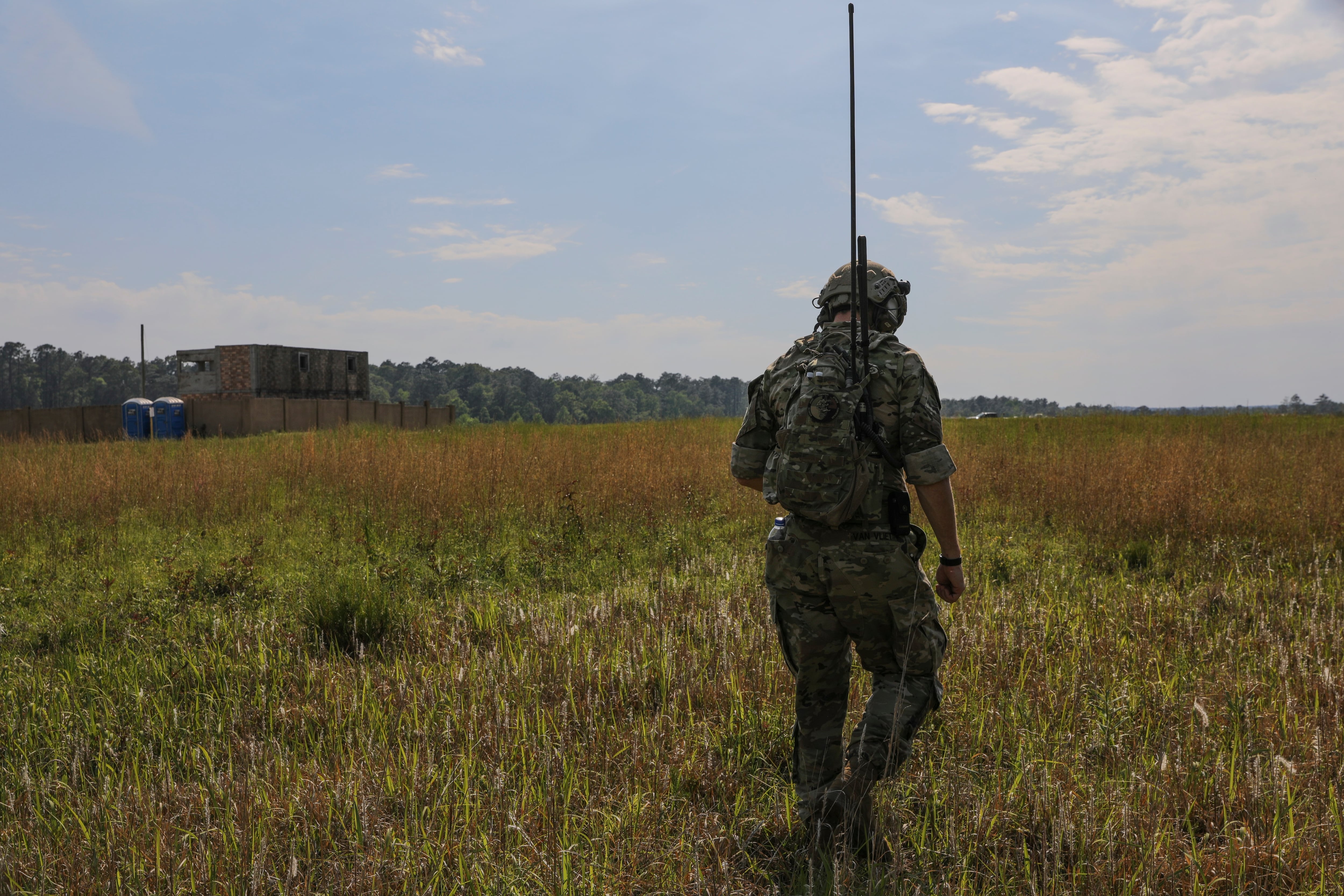 A Joint Terminal Attack Controller participates in an exercise at Camp Shelby, Mississippi. (Sgt. Alexis Washburn-Jasinski/U.S. Army)
Not long after airplanes were first used in war, armies realized that close air support required specialists on the ground to coordinate with the pilots. Hence the advent of forward air controllers, and later the U.S. military’s Joint Terminal Attack Controllers, or JTACs.
But if you need JTACs to call in air strikes, and space-based weapons are becoming a reality, then don’t you also need specialists to call in space strikes? That’s why there should be Space Joint Terminal Attack Controllers, or SJTACs, argue two experts.
For example, “the space JTAC would connect tactical, on-the-ground SOF [special operations forces] units with space assets for targeting adversary military airbases, critical infrastructure, and more complex targets, such as Russian floating nuclear power plants,” wrote retired U.S. Army colonel Kevin Stringer and Marius Kristiansen, a Norwegian Army officer, in a July essay for the Irregular Warfare Initiative website.
Unlike space personnel already assigned theater special operations commands, SJTACs would embed with special operations tactical units, the essay suggests. They would “enable the assessment of vulnerabilities, ensuring precision in any potential attack, as well as monitoring target activities, tracking movements, and providing real-time situational awareness for preemptive strikes or future sabotage missions,” Stringer and Kristiansen wrote.
SJTACs are needed to coordinate the advent of space-based weapons that paint a future where orbital bombardment of ground targets is the norm, the pair argues.
“As space capabilities develop from science fiction to reality, the SJTAC could access future space weaponry ranging from lasers, electromagnetic pulse (EMP) weapons, to the currently theoretical ‘Rods from God’ kinetic bombardment concept,” Stringer and Kristiansen wrote.
Just as JTACs are needed to target airstrikes and avoid hitting friendly forces, SJTACs would perform the same role for space.
“For normal airstrikes, an infantry scout or aviation aeroscout can call them in during an emergency,” Stringer told Defense News. “But the margin of error grows with a generalist doing infrequent specialist activities. A JTAC is a professional who focuses on this task. The SJTAC would be similar.”
There has long been an intimate link between space and special operations forces. The “Cyber-Space-SOF” triad is seen as a strategic capability, while U.S. Space Force is now standing up its own special operations component as part of U.S. Special Operations Command (SJTACs would belong to that Space Force component).
“Combined with space and cyber capabilities, SOF can access satellite communications, space-based reconnaissance, and cyber tools to disrupt enemy activities while maintaining a low signature,” the essay explained.
One question is redundancy. Rather than having separate SJTACs, would it be simpler to offer additional training in space capabilities to existing JTACs? Such training could be added to the Army-run Special Operations Terminal Attack Control Course, or SOTACC, which certifies JTACs. Or, the space role could be handed to Air Force combat controllers.
Stringer and Kristiansen disagree. In their view, SJTAC critics “overlook the fact that with space defined as a separate warfighting domain from the air, and with the creation of U.S. Space Force as a separate service, organizational logic and the development of deep space expertise necessitate a division of labor that would place the SJTAC function firmly within the Space Force sphere of responsibility.”
Separate STACs “would also avoid the inefficiency of having SOF from each service — Army, Navy, Air Force, and Marines — develop their own SJTAC capabilities," the essay argues.
SJTACs would also be useful for coordinating U.S. space capabilities with NATO and other allies, Stringer and Kristiansen wrote.
“Given that not all NATO countries have space assets, and the planning assumption is that NATO SOF formations will operate in a combined fashion, a space JTAC becomes a critical linkage for allied interoperability,” the essay suggested.
Ultimately, if the special operations community wants to play a role in space-based capabilities, it will need to have its own space specialists, Stringer argues.
“Without this function, SOF will not be able to access the developing space capabilities nor be involved in their development and experimentation,” Stringer told Defense News.
About Michael Peck
Michael Peck is a correspondent for Defense News and a columnist for the Center for European Policy Analysis. He holds an M.A. in political science from Rutgers University. Find him at theuncommondefense.com. His email is mikedefense1@gmail.com.
| # | Наименование новости | Тональность | Информативность | Дата публикации |
|---|---|---|---|---|
| 1 | Space Force wants advanced tech for space-based interceptors | 0 | 5 | 16-12-2025 |
| 2 | US Air Force looks to convert offshore oil rigs into rocket recovery platforms | 0 | 5 | 18-05-2026 |
| 3 | ICEYE sees role as Europe’s defense space-intelligence linchpin | 5 | 7 | 17-11-2025 |
| 4 | The US military wants a fleet of laser trucks. Here’s what they might look like. | 0 | 5 | 01-07-2026 |
| 5 | SWORD training platform key to US space superiority, program head says | 5 | 7 | 28-01-2026 |
| 6 | Space warfare in 2026: A pivotal year for US readiness | 0 | 5 | 05-01-2026 |
| 7 | В современной войне есть нечто поважнее БПЛА. Самое главное — в космосе (Forbes, США) | 0 | 8 | 27-06-2026 |
| 8 | Space Force’s 15-year vision calls for more personnel, simulators and survivability | 0 | 5 | 20-04-2026 |
| 9 | Начальник Генштаба: соперники России готовятся к войнам с использованием оружия из космоса | 0 | 0 | 02-03-2019 |
| 10 | Поважнее беспилотников: почему главное поле боя современной войны перемещается в ... | 0 | 7 | 27-06-2026 |