Просмотр новости
Найдите то, что Вас интересует
 Спутники
 РН
РН SpaceX
 Роскосмос
 NASA
NASA
СпутникиРНSpaceXРоскосмосNASAData from 74,430 USPTO final rejections: most §103 combinations use 2-3 references. When does a chain of obvious steps stop being obvious?
Continue reading this post on Patently-O.
by Dennis Crouch
How many prior art references does an examiner combine in a typical obviousness rejection? Many patent prosecutors have a feel for this -- perhaps colored by their memory of a six-way rejection. To get an actual measurement, I parsed a collection of final action rejections mailed by the USPTO from January 1 through June 5, 2026 that includes at least one obviousness rejection under 35 U.S.C. § 103. This is about 75k office actions containing 200k separate obviousness rejection statements.
The results: Two and three reference combinations together account for 65% of all rejection statements, the mean is 3.08 references, and single-reference § 103 rejections (one document modified by ordinary skill or general knowledge) make up 7%. See Dennis Crouch, Single-Reference Obviousness: Federal Circuit Says Don't Re-Do the Prior Art's Work, Patently-O (Jan. 26, 2026). Examiners usually do not need more than three documents to make their case. (Note, these numbers focus on the single largest combination in an office action).
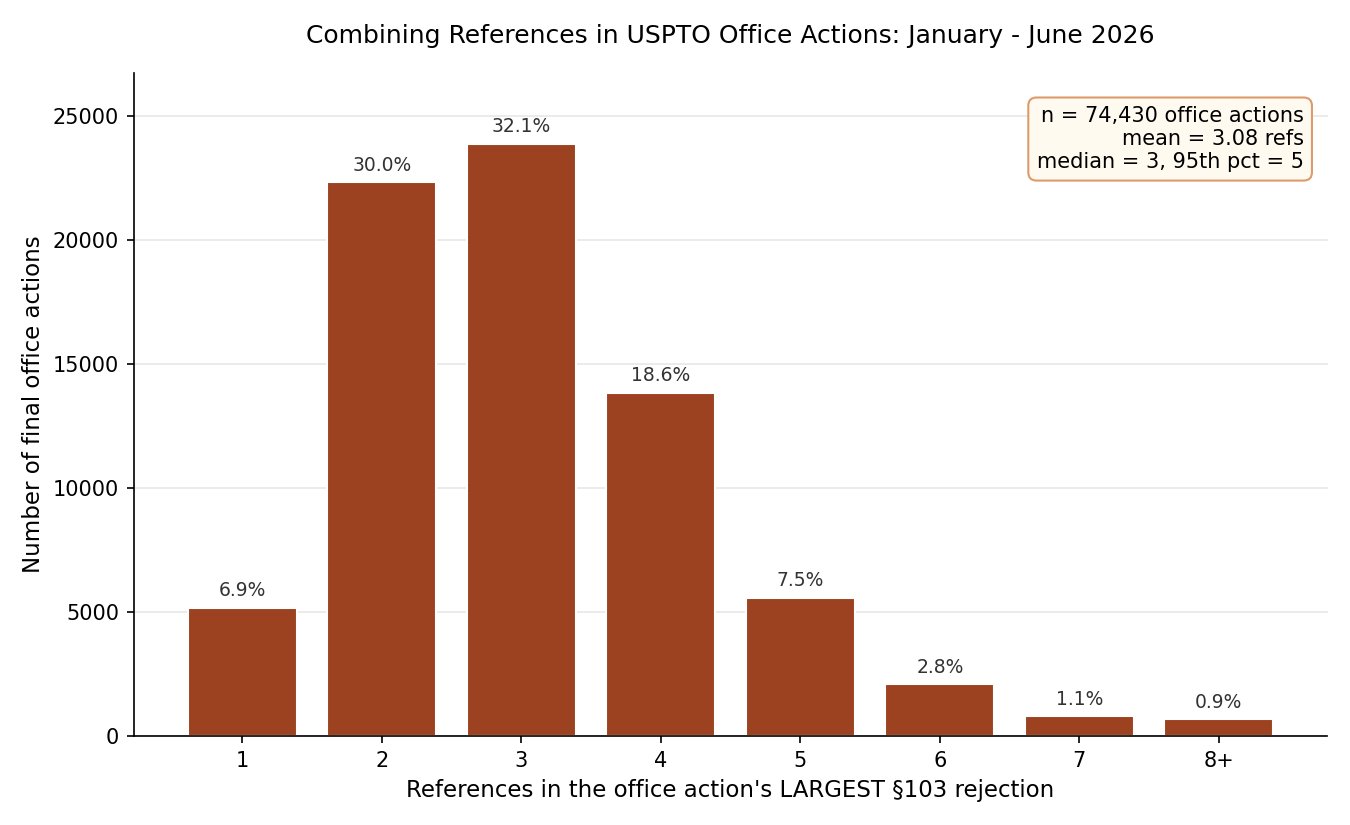
31% of final office actions contain at least one rejection combining four or more references, and about one in twenty reaches six or more.
Some areas of technology use more references per rejection -- The art units examining artificial intelligence lead the agency at a 3.80 mean, with 11% of their final office actions including a stack of six or more references.
The Supreme Court's most recent pronouncement on obviousness came in KSR International Co. v. Teleflex Inc., 550 U.S. 398 (2007), but that case involved two key references. In my view, multi-reference rejections create a different doctrinal puzzle as office practice builds larger combinations by chaining pairwise steps, each link carrying its own one-sentence motivation. That sequential structure is defensible as far as it goes. But, even where every individual combination might be obvious, a long enough series of obvious steps, with enough alternative branching paths, eventually stops being obvious as a whole. Examination practice has no tool for locating that limit. See, Dennis Crouch, Mind the Gap: The Middle Layer of Obviousness Doctrine, Patently-O (Apr. 14, 2026).
| # | Наименование новости | Тональность | Информативность | Дата публикации |
|---|---|---|---|---|
| 1 | Same Direction, Different Engines: FY2026 Utility and Design Grant Projections | 0 | 5 | 19-06-2026 |
| 2 | Pre-Negotiated: How Continuations and Art Units Shape the First-Action Allowance | 0 | 5 | 19-06-2026 |
| 3 | The First Offer Accepted: First-Action Allowances and the Track 1 Premium | 0 | 7 | 17-06-2026 |
| 4 | Has the Late-Continuation Surcharge Shifted Filing? | 0 | 5 | 15-06-2026 |
| 5 | The Federal Circuit’s Expanding Grip on Dismissed Patent Claims | 0 | 5 | 16-06-2026 |
| 6 | Hooked on Differences: Design Patent Doctrine and Schedule A Litigation at the Federal Circuit | 0 | 3 | 14-06-2026 |
| 7 | Found vs. Findable: Judge Stark Maps the Skilled-Searcher Test | 0 | 5 | 23-06-2026 |
| 8 | En Banc Ninth Circuit to Reconsider Copyright’s Total Concept and Feel Test | 0 | 5 | 22-06-2026 |
| 9 | Provisional Typo Spoils Priority Date | 0 | 5 | 24-06-2026 |
| 10 | Кудрин считает недостаточными меры для роста российских патентов в мире | 0 | 0 | 19-09-2019 |